Artist, writer and educator Padmini Mongia encounters Anne Minich, and starts a friendship and a growing engagement with Anne’s work.
On a cold, blustery November day last year, I went for a show to the da Vinci Alliance. By the time I arrived, the talk on the ground floor was almost over and people were moving upstairs. I wandered to the back of the room where I encountered Anne Minich. Although I had not formally met her, I knew her work from previous shows at Commonweal and, of course, I recognized her. I told her how much I’d enjoyed her work at her previous two shows. We started talking, easily and effortlessly; somebody even shushed us as the sound of our conversation carried upstairs.
Anne invited me to visit her at her studio, and she told me this was not an invitation she extended randomly. I readily agreed. Immediately after Thanksgiving, I visited her. We talked for hours, discovering a shared view of many things. We learnt we knew people in common, and that we had a link to India through these people. We also discovered a mutual interest in narrative. I had taken a collection of my short stories for Anne, and over the next several days, she read and commented on them. Their slightly odd disposition resonated with her. Her irreverence about so many things, not least subject matter, echoed mine. Over the next few months, we visited often. Despite the short amount of time we’ve known each other, we have discovered—through each conversation—greater depths to our shared interests. This short reflection on some of her work in the recently concluded show, “Bodies and Souls” at PAFA continues some of those meditations.
Built around the collection of the Kohlers, “Bodies and Souls” is inclined towards the erotic and the religious, sometimes the surreal and even the macabre, all features we often find in Minich’s work. One of her most moving pieces in the show is a small pencil drawing of the torso of a man, with the heading “Christmas Eve, 1993.” His chest is marked by a delicate cross.
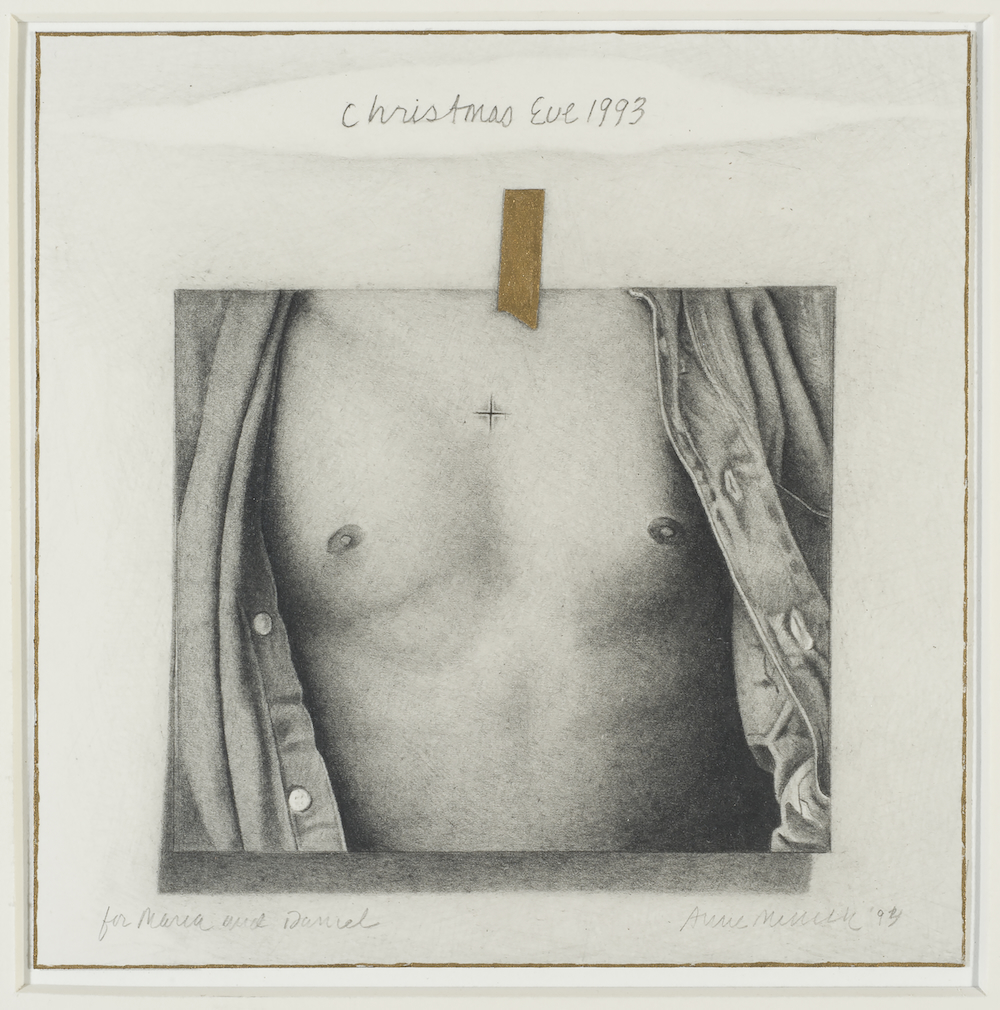
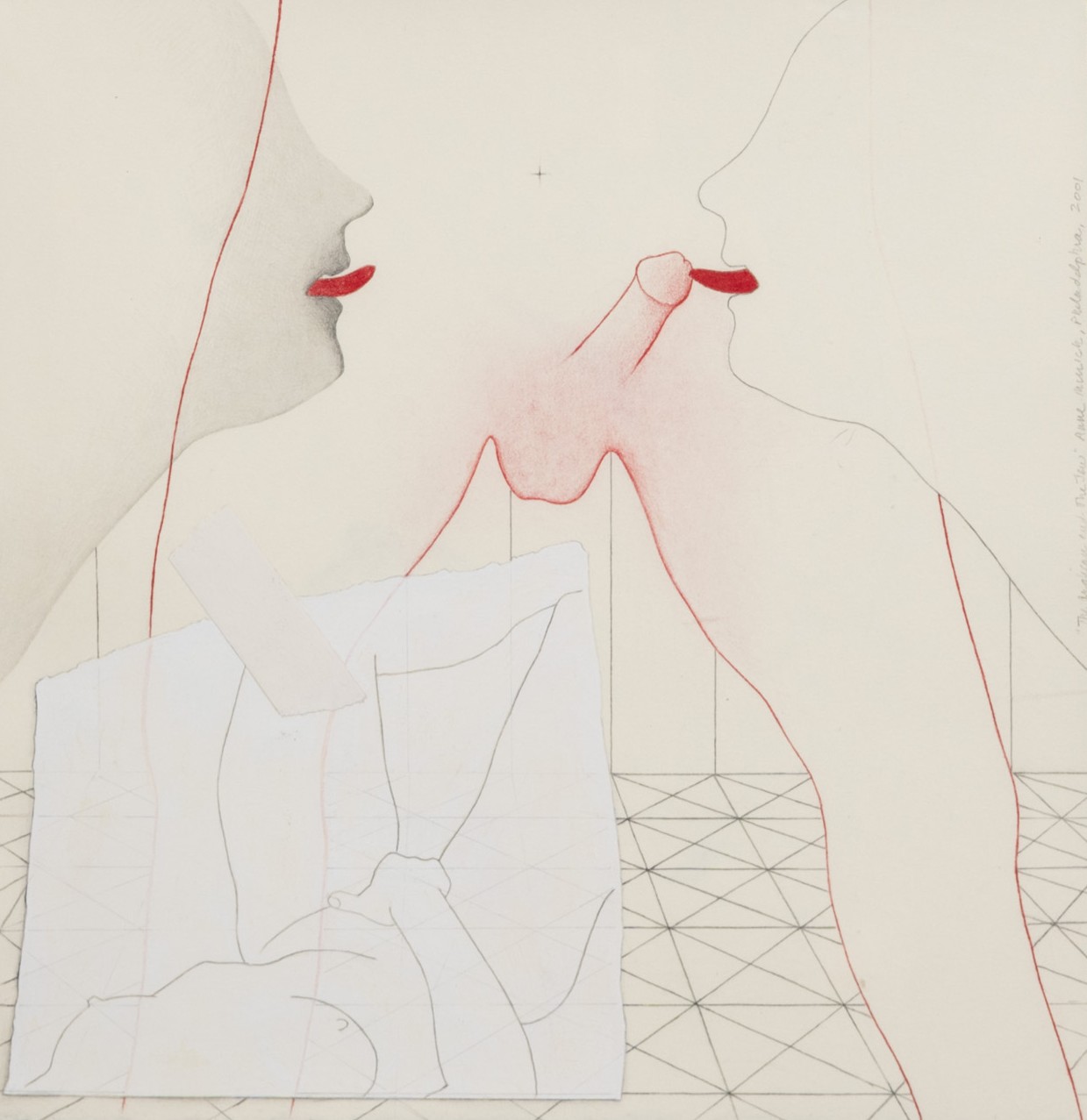
In this work, we see many of Minich’s recurring interests: the cross, the written text, the integrated frame, and the invitation to misread the “real” and the constructed. A piece of tape seems to hold the drawing to the mat, as if the work is in process and the viewer has stumbled upon it. Often in Minich’s works, this tape is hyperreal, so that it may be mistaken for the actual thing, as in “The Anglican and the Jew” placed nearby. However, in “Christmas Eve, 1993,” the tape is painted gold, lifting it out of the “real” and making it resonate with the cross below.
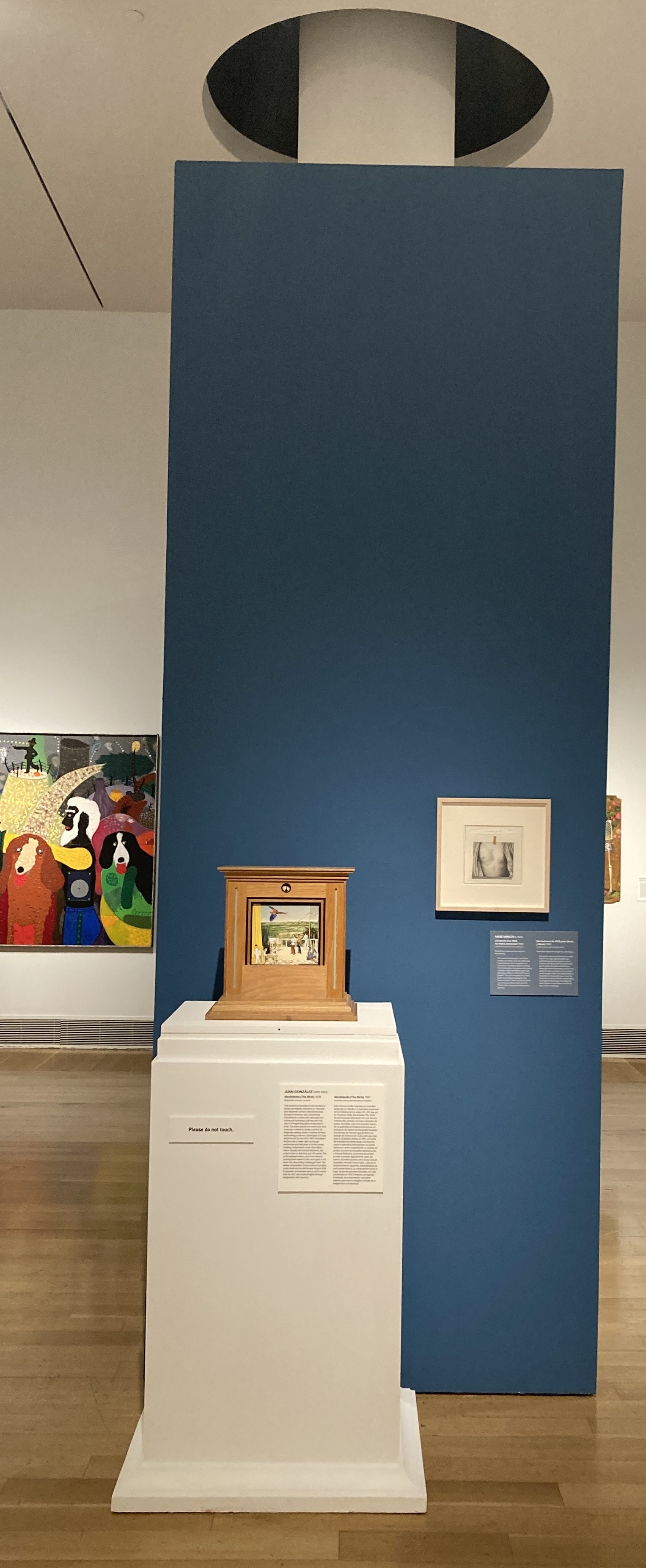
As in many Minich pieces, words are integrated into them. Even if the other features of a work—the text written on the border of the piece, the gold tape—did not guide the viewer towards narrative, the words in Minich’s paintings are an invitation towards story telling and meaning making, with the suggestion that one is not possible without the other. In this instance, the header of the drawing states, “Christmas Eve, 1993.” Even if all this inscription did was merely to state the date, the specificity of Christmas Eve draws the viewer towards the religiosity of the piece. Not only that, the placement of this drawing over Juan González’s “Nacimiento” underscores the religious and the Christian. The wall text explains that the “cross incised on his [Juan González] chest refers to his being baptized in the Roman Catholic faith.” González was a close friend of Minich’s. His complex painting reveals a birth, perhaps a secular one but also one with religious echoes. A parrot flies overhead, ordered fields and farms form the background, but in the foreground, along with a crying baby are a winged, crowned angel, irises, and other flowers reminiscent of Christian terminology.
.jpg)
The placement of these two pieces in the show allows them to pay mutual homage to each other. They resonate in terms of content and meaning but they also affirm and assert the deep relationship shared by these two painters. The blue panel behind the pieces, the pillar which disappears into the ceiling, and the solitariness of these two works becomes itself an altar. It invites us to pause and pay homage as one would in a place of worship.
Minich’s works almost always have a stamp, a mark which affirms her religious past. Although she is no longer a practicing Episcopalian, she was raised as one. By inserting a mark of her past into her paintings, she says she affirms and acknowledges her formation. She is not in any way suggesting her ongoing embrace of the religious. As a viewer without the aid of conversations with the maker of the art, one may not be able to determine Minich’s distance from the religious marks she integrates. Yet, the acceptance of a past, of finding a visual way to suggest the passage of time is moving. In other Minich pieces in this show, narrative guides us if not towards meaning at least towards deciphering how meaning is made. A piece of tape (albeit drawn) suggests the temporary; that it’s in gold makes it evoke the religious. The intimacy of the text inscribed in this drawing tells us when it was made; the wall text tells us to whom it was not gifted. The passage of time, which is one of the features on which narrative relies, is embedded in this drawing. Time moves, plots move, things happen and meaning shifts as a result.
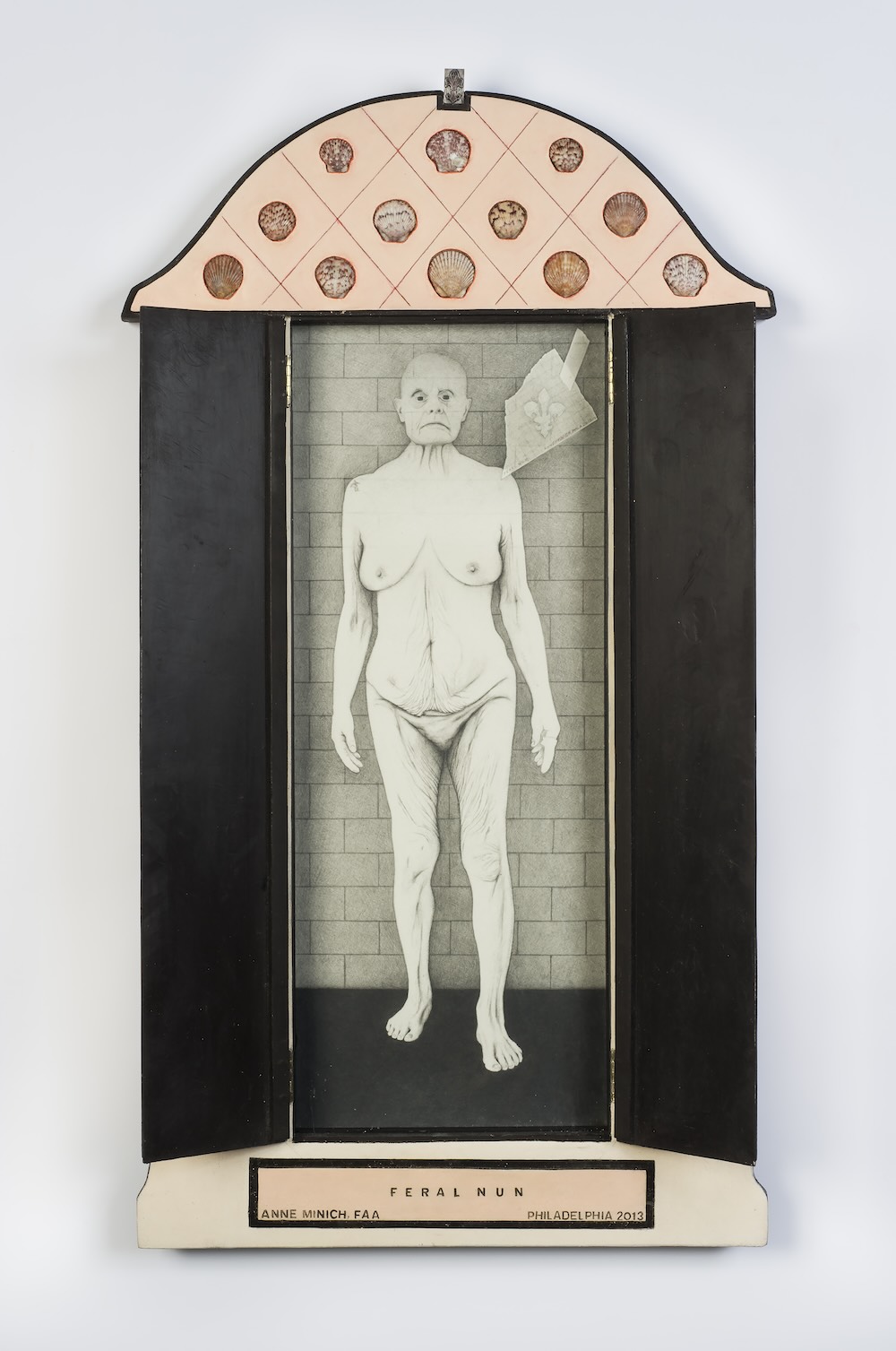
In “Feral Nun,” the passage of time is hanging on the skin of the figure, a self-portrait in all her splendor. Placed within a shadow box whose doors may be closed, the piece gains through its homage to the religious. The elaborate doors, the twelve embedded shells in the arch above, and the taped scrap of paper with the fleur-de-lis all invite a deeper reading of the piece. This is no drawing meant merely to please. It is earthy, altogether human, vulnerable and defiant at once. The feral nun is there. Look at her and marvel at her.
In “The Anglican and the Jew” the visual meaning may be easier to grasp than the religious ones. Yet, this work also offers its complexity via the hyperreal drawing seemingly taped to the left of the piece. The wall text tells us the piece is based on an erotic fantasy, and one may read the central drawing as rendering that fantasy. However, on the left of the work is an elegant drawing of a woman pleasuring herself. It appears taped to the painting, except it is not. The drawing tricks you into thinking it is taped on, whereas it is an integral part of the same picture plane as the rest of the piece.
The curators of “Bodies and Souls” remind us, via Oscar Wilde, that a portrait may tell us more about the painter than the subject of the painting as in Wilde’s “The Picture of Dorian Gray.” Souls may be revealed through their bodies. In Minich’s work, were you to miss this revelation, her drawing or painting would urge you back. With the clues strewn on the work—the fleur-de-lis, the shell, the cross--she would be inviting you to make meaning via narrative by connecting the various features she’s offered you.
On our first visit at her studio, Anne and I discovered that dear friends of hers from India were also known to me. We discovered that Juan González, who had taught at the School of Visual Arts, had been the professor of a close sculptor friend of mine. Another friend of Anne’s, with personal connections to India, had gifted her a replica of the slave-girl from Harappa. Anne gave me that figure and now she stands on a shelf in my apartment. As it turns out, my close friend, the late poet Agha Shahid Ali who passed away twenty-five years ago wrote a poem on this figure back in 1990 (linked below). Given all these connections and overlappings, small wonder that I feel I am still meeting Anne, that our conversation has just begun.
https://www.poetryfoundation.org/poetrymagazine/browse?volume=156&issue=1&page=38
Padmini Mongia teaches literature in English at Franklin & Marshall College in Lancaster. She is the author of Pchak, Pchak: A Story of Crocodiles (2008), Baby Looking Out and Other Stories (2018), and I do So I do (2026). She is also an abstract painter who has shown her work in Philadelphia, Lancaster, and New Delhi. She has just completed a short entry on Bill Hutson, the late abstract painter, for the Centre Pompidou catalog accompanying their show, Paris Noir, which will open in Martinique in December 2026.
Want to stay in the know about Philly’s visual arts scene? We’re developing a semi-regular Art & Image Newsletter - featuring interviews, articles, and reviews straight to your inbox!