.jpeg)
What societal concerns do you hope to amplify through your artwork?
On one hand, I think art should not—and cannot—be used to channel direct messages. When a piece is fully charged with a so-called message or politics, to me it loses the quality of actually being art. It becomes activism. Metaphorically, artworks can and should transmit energies that point us toward more tangible thoughts or emotions, but this should happen on a poetic plane.
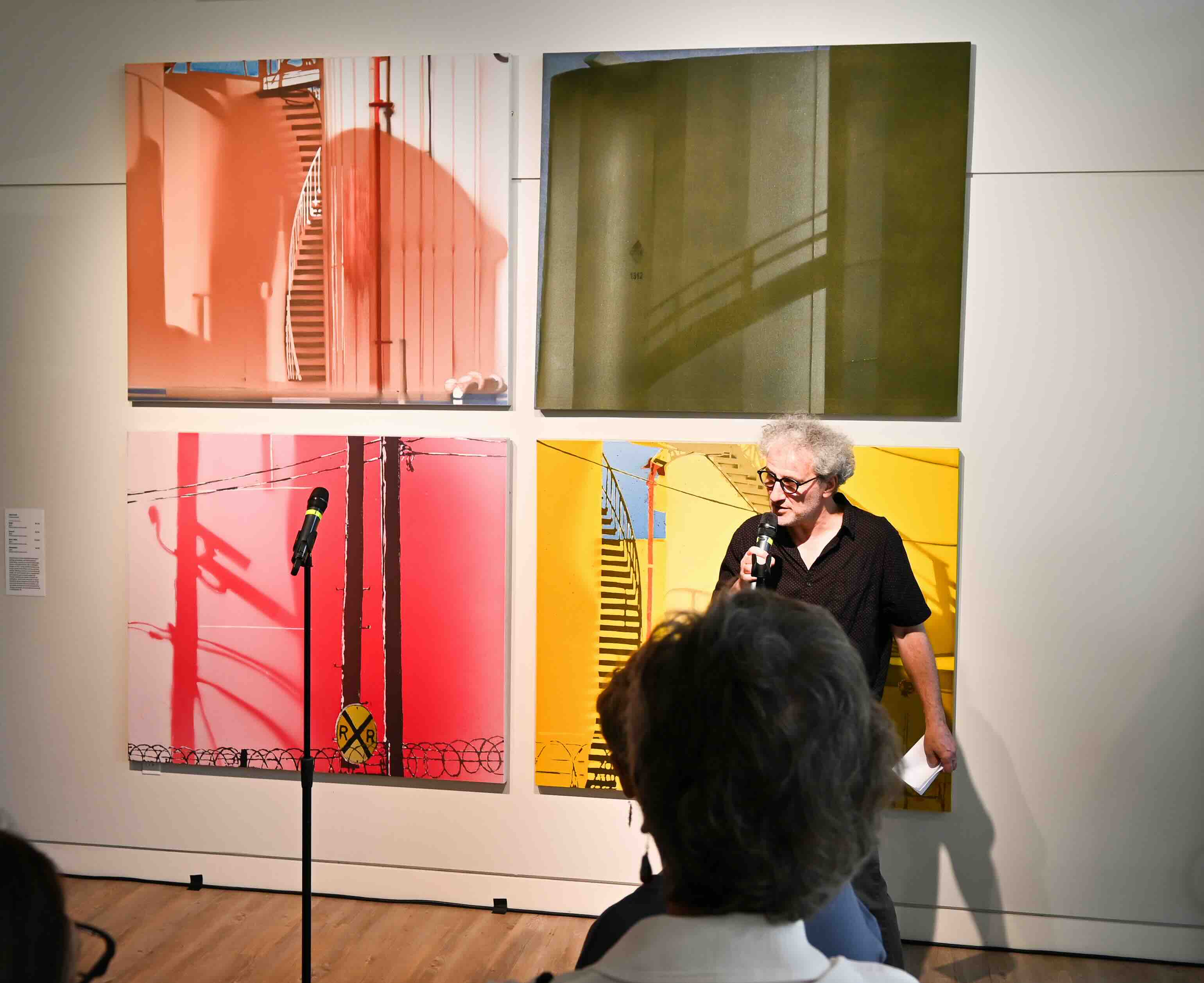
On the other hand, our deep dependence on fossil fuels—and the absence of a clear, shared vision of what life could look like beyond that—is staggering. By engaging with the industrial environment as a central motif in my paintings, I hope to open up space for reflection. I’d like people to look at our surroundings differently, and allow themselves to wander into that uncertainty.
Being from Budapest, Hungary, what led to you coming to Philadelphia and pursuing art?
I lived my early adult life as an artist in Hungary and had a fairly successful career up to the age of 40. Then came the political power grab in 2010, which had been looming in the late 2000s, and I wanted to stay out of that climate as much as I could. So I applied for residencies and joined as many projects and exhibitions abroad as possible.
In 2009, I won a national fellowship that included a residency in New York City, which helped me imagine a future here. I was still finishing my doctorate during the early years of the authoritarian regime and was actively engaged in the opposition—as an artist, a citizen, and an activist.
By 2014, after they won a second term, it became clear we couldn’t change the country’s direction, and I didn’t want to be part of what Hungary was becoming. Fortunately, I had both the opportunity and a partner to make a move, so we built a life here. Ending up in Philadelphia wasn’t planned—it just happened, magically. We fell in love with the city the first time we visited in 2014, and later made deep friendships and connections that made us feel at home. We’ve now been residents for ten years. But looking around us in this country today, we’re increasingly terrified—it reminds us of the very reasons we left Hungary in the first place.
What is your artistic process like when designing a piece?
I think in series rather than individual pieces, so there’s always a framework—outlined gradually by both my life and work. When something new emerges, it might take months or even years to find the right methods or techniques to bring that image to the surface. Then I play with it. That’s how the individual works come about.
Being labeled as a “visual storyteller,” do you believe each work tells its own story or is there an overarching theme?
This connects to the previous question—there’s always an overarching theme that carries me away for years sometimes. The theme unfolds—like a musical motif—through the way individual images appear and, like facets of an object, come together to speak about it as a whole.
What have you found inspiring recently?
It relates to my public art project, which treats the industrial environment as a medium. I’m planning to work on the surface of oil silos, and in order to define the narrative—what should be depicted—I need to engage with people. That’s totally outside my comfort zone in terms of my artistic process, and that’s what inspires me most right now: figuring out how to create a situation where the right people are engaged in the right way, and finding stories—linking back to your previous question—that speak to our collective memories or archetypal stories, our shared mythology. These silos, like ancient Greek hydrias, become vessels—monumental carriers of communal narrative.
You noted the “character traits” of architecture—can you expand on what that means to you?
Yes. I mentioned this in the context of working in warehouses back in the ’90s and early 2000s in Hungary. It was a strict, almost factory-like environment—it felt like labor. It’s a personal experience, but it also connects to the functional architecture around me, which I started incorporating into my paintings. Or rather, engaging with the built environment shaped my relation to visual language—to painting itself.
That’s also when the idea of genius loci—the spirit of the place—first surfaced for me, through closely observing my surroundings. It was like building a muscle in early life—once it forms, it stays with you. The way I saw and painted the environment then became ingrained in my painterly character and still informs how I work today.
What are your favorite mediums to work with and why?
I’ve worked with different materials, but for at least the past 16-18 years I’ve been collecting pigment colors and mixing them with transparent acrylic. It’s become my preferred medium.
It was partly a result of an allergic reaction to turpentine after about 15 years of painting with oils, but also because of the variety and purity of the pigments I use. The ability to create self-made colors—the hues, tones, and the sheer volume of finely tunable options—has made this technique the most suitable for me.
How do you utilize color in your work?
Completely intuitively—but often in response to how the light tells me to feel. Harmony can’t be explained :)
When painting a landscape, what energy are you trying to capture?
I’ve spent years dealing with the so-called “spirit of the place”—the Genius Loci. So when painting any environment, that’s the energy I tried to capture.
What makes up the spirit of a place is what we humans project onto it—our characters, our culture reflected in our built environment, and the tiniest details on the street: the color of trash, worn edges, smog in the air…
So when I caught the right details and placed them into play within an image, I was able to create a kind of visual tension that I had felt vibrating somewhere. At least, I believe I did.