How does your work–Body/Building–tie together the ideas of Humanity/Anatomy and Architecture?
Pieces in the InLiquid show Human Scale are from my body of work, Body/Building, which is about the connection between humans and architectural structures. Most pieces refer to a specific building or architectural feature with a human attribute, association, or story. A lot of the connections are personal – these are buildings that I have been inside, in cities that I have lived in, or in some cases that I have researched. I take the feature that I am most interested in and abstract it, bringing it down to its most primitive elements. Then I bring it to life with colored glass.
How do you utilize color in your work with stained glass?
Color serves different functions in my work. It can be pure delight, or it can serve as an entry point for engaging with deeper content. It can conjure memories – collective or individual – that turn the glass pieces into celebrations, memorials, or premonitions.
The process of collaging with colored glass is one of the most joyful parts of my practice. I get to play with radiant light, opacity/transparency, texture and tone, and showcase the full range of what glass can do visually. Color is important in my drawings too – heavy texture and layering are often contrasted with the luminosity of watercolor.
Does your work tend to have defined themes?
Yes, and themes shift over time. My recent work has focused more on the body and postpartum experience. It incorporates imagery of bodily landscapes and interiors, and the various medical devices, accessories, and toys encountered during pregnancy, birth, and postpartum. One piece in Human Scale, “Arcus”, has clear architectural connotations, but the word arcus can also refer to a curved structure in the body. That’s what I was thinking about when I made the piece – that kind of dual read of the word and of the curved shapes.
How do you use the abstraction of stained glass to get your theme across to the viewer?
I am interested in creating work that is still open to interpretation and where multiple reads are possible, so abstraction lets me stay in that more mysterious space. Titles can hint at source material or intention.
What is your artistic process like when designing with stained glass?
Everything starts with drawing. I keep a sketchbook around so I can record images that come to me at random, and I also draw from photographs and other source material. I then translate my drawings into glass designs. I’ve found that each stage of making a piece serves a different purpose. I collect glass scraps from fabricators, factories, and other artists, which helps me stay connected with the glass community and minimize waste. I collage with the scraps, which is the most intuitive part of the process. I score and break the glass, which is very satisfying, and begin the more meditative process of wrapping the edges in copper foil. Then I gear up to solder – melting metal always feels hard-core! The final stage of constructing the piece is usually about pushing through and overcoming challenges.
Having your bachelors in cultural history, how do you integrate that history into your artwork (if at all)?
It’s in there for sure. My work reflects a wide range of references and inspirations, many from cultural history – brutalist architecture, midcentury musicals, the biomorphic vessels of early humans, historical gynecological instruments, illuminated manuscripts – as well as my own history with craft and contemporary dance.
What have you found inspiring recently?
Recently I have been revisiting my interest in Paleolithic “Venus” figurines, some of the earliest examples of figurative art. While the figurines were long thought to be fertility symbols or fetish objects, an alternative theory is that they were self-portraits made by women looking down at their own bodies. I have been playing with this perspective, using photographs I took of myself while pregnant, and exploring the roles of decoration, devotion, performance, and technology in the experience of birth, early motherhood, and the aging female body. It’s a new direction, but still feels connected to my prior work.
Artist Talk - Thurs., July 24 • 6-8 pm | Oar Pub at Park Towne Place
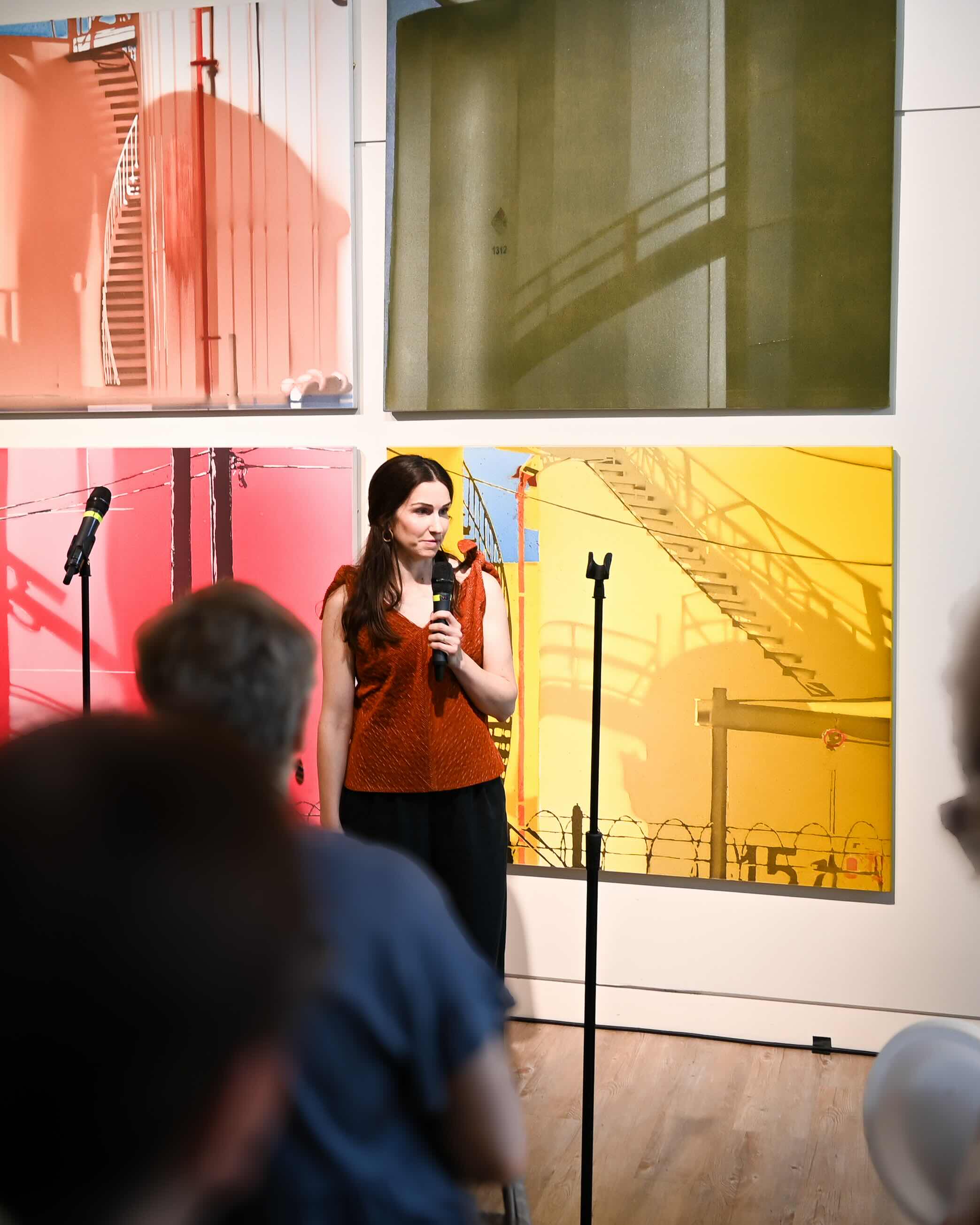
Please join us at 6:00 PM on Thursday, July 24th, for a two-person artist talk with Anna Guarneri and David Beker. Both artists have work in Human Scale, the current exhibition at Park Towne Place exploring notions & histories of architecture.
Human Scale is on view at Park Towne Place through October 13, 2025. You can learn more here and shop the exhibition here