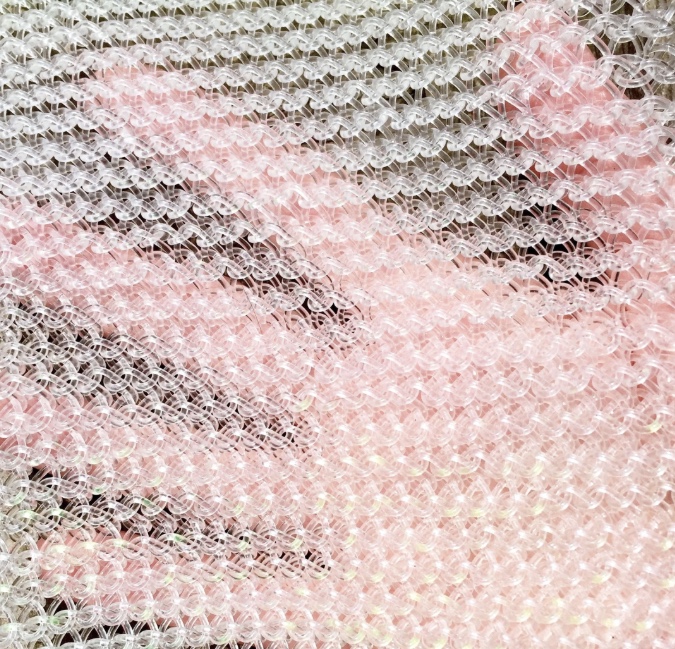
The portrayal of transparency appears throughout your work. What does transparency mean to you as an artistic material and a conceptual understanding?
Transparency is the conceptual foundation in my studio practice. For me transparency means revealing truth without obstructions. As clarity recedes in our contemporary history, I transform hidden issues into visible perceptions through my art. When beginning a body of work, I consider an array of supplies that could be used as artistic materials to portray transparency ignoring their predetermined properties and approaching them as if they were clear. My focus is on studying the capabilities of their structure and conceptualizing the material's physical form into my work. This combined process allows me to realize the work's truth both physically and conceptually.
Transparency is an interesting medium as it reveals inner, otherwise hidden parts, to viewers and audiences. How does working with transparent materials transform the relationship between artist, viewer, and object?
I use transparent materials that allow light to pass through them, as an active device shifting the viewer's perception. This interaction transforms the art object from a static form into an involved experience. It connects the original, invisible idea to the conceptualized material, establishing an open interrelationship that structures meaning, stimulates, and opens creative thought for the viewer.

Your invention of Jelly Yarn® was used by Maison Margiela for their Spring Summer 2026 show, Could you explain how it felt to have a material, made by you, be utilized by another creator in a different artistic discipline such as high fashion?
I was delighted when my company became a Jelly Yarn® vendor for Maison Margiela. My concept, a "clear" waterproof yarn, broadened the material application and definition of traditional fiber yarns. The Clear Jelly Yarn® does not absorb light, allowing light to pass through the material. I eagerly anticipated seeing what Maison Margiela would create under the new direction of Glenn Martens (creative director of Diesel) known for his deconstructed conceptual approach to design.
Maison Margiela's "Look 13" handknit jacket, made from Clear Jelly Yarn®, worn by model Calum Harper, featured in their Spring / Summer 2026, Co-Ed Ready-To-Wear show in the fall was a breakthrough for me. I felt the idea of a transparent yarn vs traditional textiles was not entirely about fashion but spoke more through the concept. The clear knitwear not only provided the wearer to be seen through the garment, but conceptually functioned as a performance piece. I am gratified that Clear Jelly Yarn® is now recognized as a viable contemporary textile in the industry, seen by a worldwide audience.
Seeing the success of your innovative materials move from craft books such as, Yummy Yarns, to being featured in the Venice Biennale in 2019, and then to high fashion houses such as Maison Margiela; How do you think the meaning of craft transcends these higher artistic boundaries?
The meaning of craft can transcend higher artistic boundaries by rejecting predetermined functions. While selling Jelly Yarn® as a craft retailer for crochet and knitting, I simultaneously used my vinyl yarn product as a sculptural medium for many years. I presented and marketed the yarn not just as an alternative to fiber yarn, but as a viable medium for art making. I developed the yarn as a round plastic strand, envisioning its potential without pigeonholing it as just a needle arts material. I asked myself why can't a yarn be glossy, waterproof, translucent, or transparent? Because I have presented Jelly Yarn® in projects as a concept rather than functionality, it has gained acceptance as a crafting yarn, contemporary art medium, high fashion textile. It is now utilized by professions including fashion designers, weavers, film set designs, and music video producers.

You describe your work as minimalist in concept, yet your work comprises interdisciplinary practices and complex processes that guide the outcome of your work. How do you depict the simplicity of the human experience while maintaining the multi-layered richness of your processes?
In my studio practice, I combine physical materials that can be conceptually interpreted to examine complex layers in our living history. My minimalist approach enables me to focus on the depth and strength of the meaning: it is simplistic rather than noisy. I achieve this by using universal archetypal symbols including squares, circles, rectangles, lines, and a limited color palette. For example, in my Uncertainty series, I use the circle as a central symbol, applying short, fast mark-making strokes of graphite—whose origin is carbon, the basis of organic life.
Your work suggests that a bigger materiality lies underneath and within the surfaces that represent the themes of fragility, resilience, memory, and transition. How have you used materiality to represent the inner and outer working parts of those depictions?
I look for materials that depict both the inner and outside duality of the piece physically and conceptually. For example, in my flower petal stain drawings titled In Lieu of Flowers, I create color fields from flower petals. I collect and gently separate the floral petals from the stamen, pistil, and sepal. I relocate the petal's inside space to an outer surface using a technique I developed to absorb the materiality of the petal color into the paper, creating a flat color field. The series explores fragility, transition, and memory with the immediacy of the process, extending the ephemeral life of what was once flowers and connecting the past to the present.
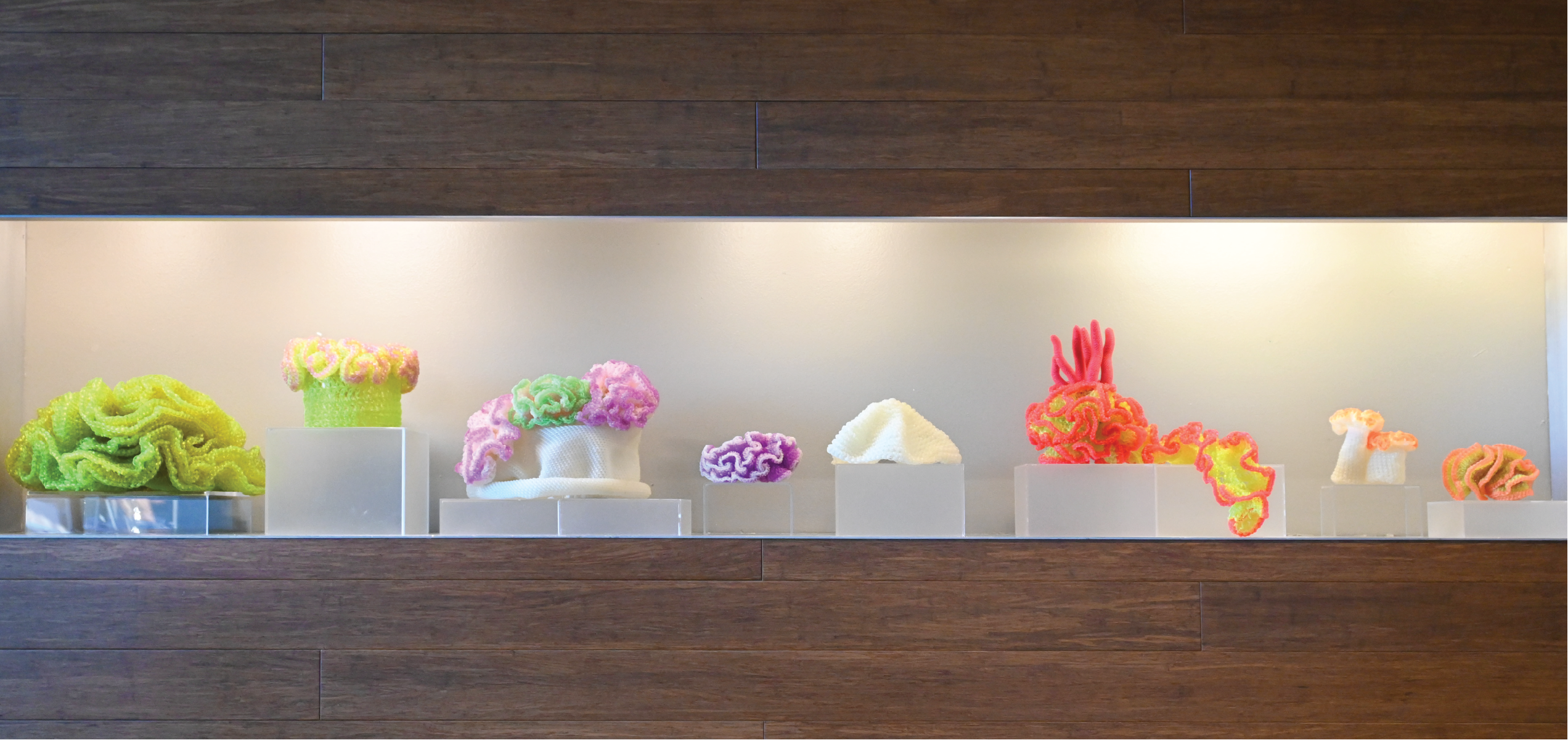
Regarding your exhibition On The Land, In The Sea, you state that you use hyperbolic plane patterns to mimic the hyperbolic geometry structures of particular coral reefs. Could you elaborate on this technical approach and how it helps you to better understand and represent the organic, mathematical forms of real coral reef structures?
Corals and other crenellated sea life maximize their surface area by growing their shapes through hyperbolic geometry. The technique for physically constructing a hyperbolic plane using crochet is credited to mathematician Dr. Daina Taimina, who developed it at Cornell University in 1997. This technique has been used by the Institute For Figuring (IFF) to create the collaborative worldwide Crochet Coral Reef Project (CCR). Similar to crocheting a ruffle, the hyperbolic shape is achieved by increasing the number of stitches exponentially within each row or round. Finding out how to crochet a hyperbolic plane helped me to understand their structure. I then was able to mimic coral structures on a larger scale for my sculptures.
Your background in industrial design involves aspects of form and functionality. How does that practical foundation influence your expressive art practices?
My background in industrial design enabled me to explore various materials, processes, and fabrication techniques. I mine that foundation as a three-dimensional palette in my art practice, integrating the form and functionality into a conceptual body of work instead of thinking of them as physical products. My experience as an industrial designer, now a visual artist, has freed me from seeing materials for their intended function, allowing me to instead approach them from a conceptual viewpoint when creating new artworks.
This exhibition pairs your work of the marines and oceans with Andrea Bartine Caldarise’s landscape paintings. What conversations do you hope emerge from these two dialogues?
When I saw Andrea Bartine Caldarise’s paintings, I immediately saw connections. I hope our paired exhibition, On The Land, In The Sea, encourages conversations about discovery, transporting viewers to surreal scenes in the landscape and under the sea. Caldarise’s landscapes immerse the viewer in bright, dreamlike moments, while my colorful biomorphic forms provide a close-up view of corals, sponges, nudibranchs, and sea anemones, revealing sea life typically privy only to those who have explored under the sea. Both bodies of work emphasize the interdependence of water and land, showing neither can survive without the other.
You mention how growing up in New Jersey during the summers has enabled your passion and fascination with seashells and coral. How have the specific and differential qualities of Jersey Shore marine life, reflected upon your past, affected your artistic choices?
Growing up in New Jersey gave me access to the Eastern shoreline. These repeated experiences— vacationing at the shore, walking along the beach, swimming and briefly scuba diving in the Atlantic Ocean—deepened my connection to sea life. I collect the empty sea shells that wash up on the shoreline as gifts from the ocean—evidence of a sea life that is no longer visible. These past experiences serve as a foundation for my current focus, studying how the material's physical form can be conceptualized into my work. I have also studied Ernst Haeckel's stylized illustrations in his book Art Forms In Nature. Creating the corals and sea life with my Jelly Yarn® brings these relationships together physically and conceptually, presenting oversized crochet constructions that offer a close-up view of what is mostly unseen beneath the sea.
On the Land, In the Sea is on view at The Courtyard by Marriott Philadelphia South at The Navy Yard through April 14, 2026. You can learn more here and shop the exhibition here.