.jpeg)
How does your participation in Make-It-Pop! resonate with the exhibition's emphasis on vibrant colors, graphic styles, and ironic subject matters?
The use of historical graphic imagery is intended to have a disarming effect on viewers in order to be able to discuss dark, difficult issues within our society.
What are your aspirations for viewers' takeaways from experiencing your artwork showcased at the Make-It-Pop! group exhibition at InLiquid Gallery?
Male Gaze in particular represents a larger body of work undertaken within the past three years that takes a sardonic look at white male archetypes within popular western culture in order to examine how these characterizations fit, or more frequently do not fit, into our contemporary cultural discourse.
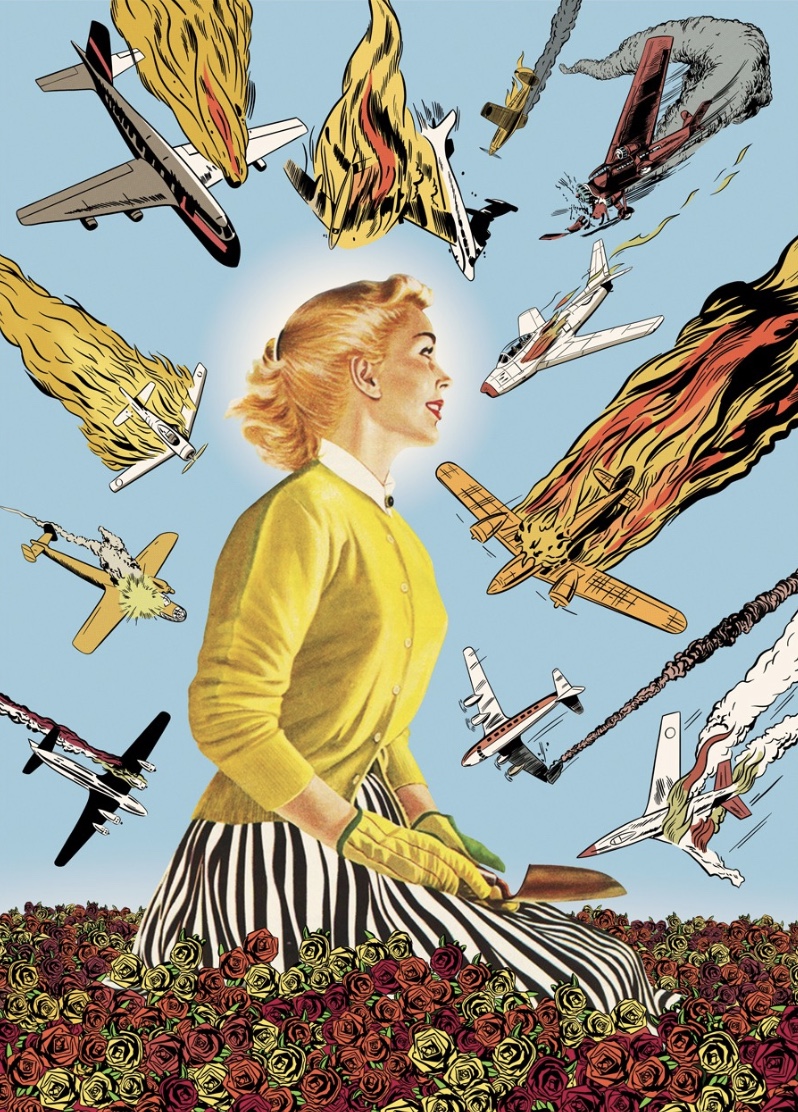
You borrow from mid-twentieth century comic books as a source of imagery and for the variety of compositional strategies for narrative structure. Were you a fan of comic books before, and if so what series do you find most compelling in terms of themes and narrative that can be represented in your own work?
I collected comic books as a child and into early adulthood. That said, the works I borrow from now predate by many decades the books I read. It did provide me with a familiarity with how sequential art operates which I believe is important.
No particular book or series influenced my current work directly, but books that probably shaped my worldview include The Dark Knight Returns by Frank Miller, Scott McCloud’s Understanding Comics: The Invisible Art, and The Watchman by Alan Moore. In terms of understanding the use of satire as a tool to illicit social awareness I was influenced by shows such as The Simpsons and Mystery Science Theater 3000.
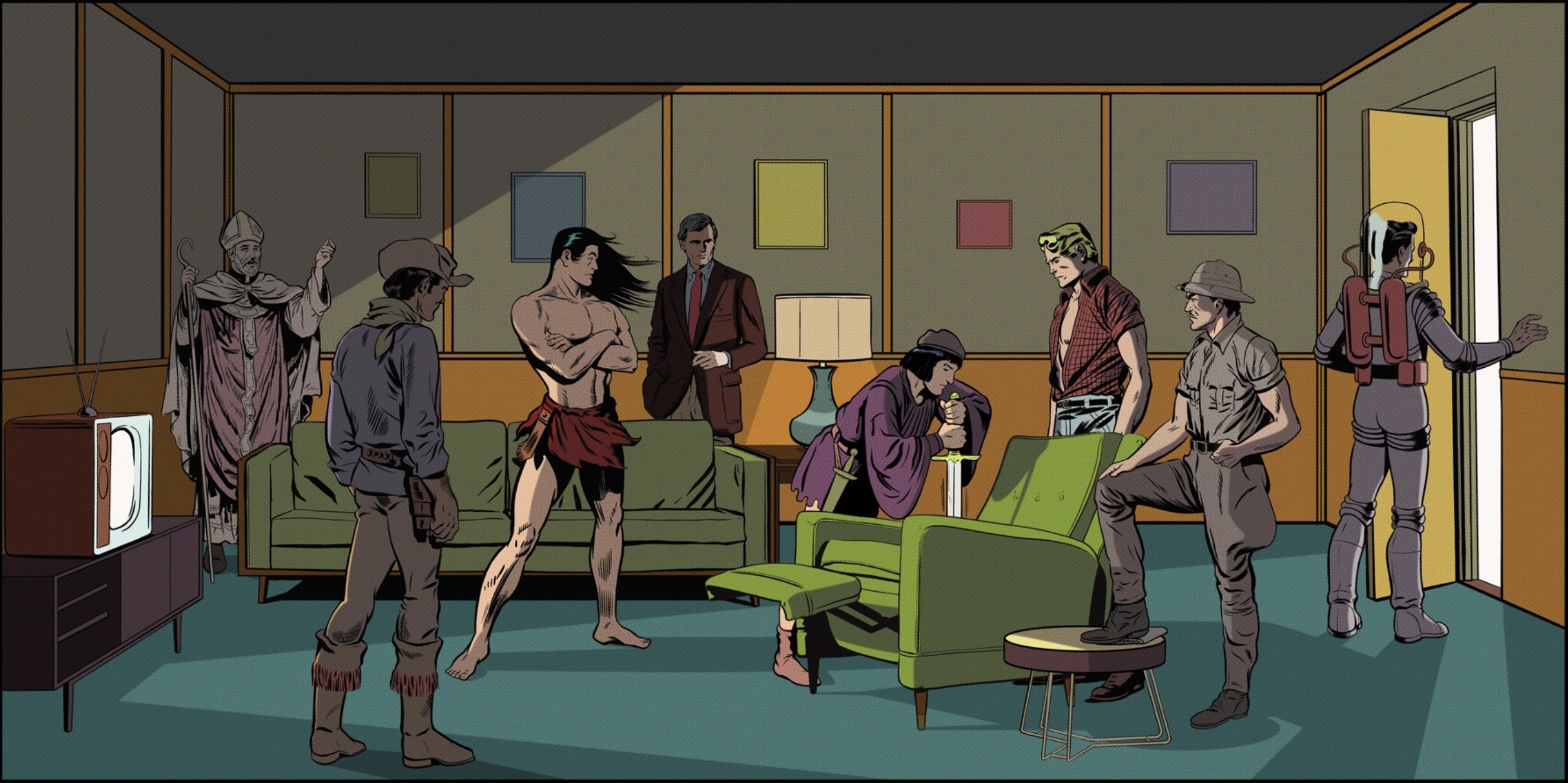
Nostalgia and familiarity are key emotions to be felt by the selection of your imagery. What emotion do you hope to elicit, after those of initial familiarity, once viewers see the re-contextualization?
This piece was deliberately intended to elicit different responses from people of different backgrounds. I think for many people a group of white men staring at an undisclosed subject would evoke fear, dread, or anxiety. Hopefully, those who find this work nostalgic in a positive way will be compelled to ask themselves why they feel that way. The fact that the observers are being observed establishes a dynamic where the viewer questions the nature of the behavior on display.
Your prints combine comic elements with Western art historical references. Can you expand upon how you select and connect those pairings?
The subjects and motivations of twentieth century comic books and the Western European art historical cannon are not terribly different. Whether deliberate or not, they both utilize and perpetuate archetypes that reinforce the authority of those in positions of power.
Despite the best efforts of those that have experimented with mixing “high” and “low” artforms over the past century, I think the general public still thinks about visual culture in terms of those classifications. My intention in presenting the connections I select is to break down those arbitrary distinctions, and drive towards a more useful conversation, namely who has power, how did they achieve it, and what lengths do they go to maintain it?
.jpg)
What broader conversation and specific re-examinations of social ideas do you represent in your work, Male Gaze, your work on display for the Make-it-Pop! exhibition?
Probably to point out that there are no benign or non-political actions in a civilization where certain individuals due to their race, gender, religion, or any other distinction one cares to create are systematically denied opportunities that everyone should enjoy. I think the goal of this work is to force a conversation about the need for self awareness and empathy.