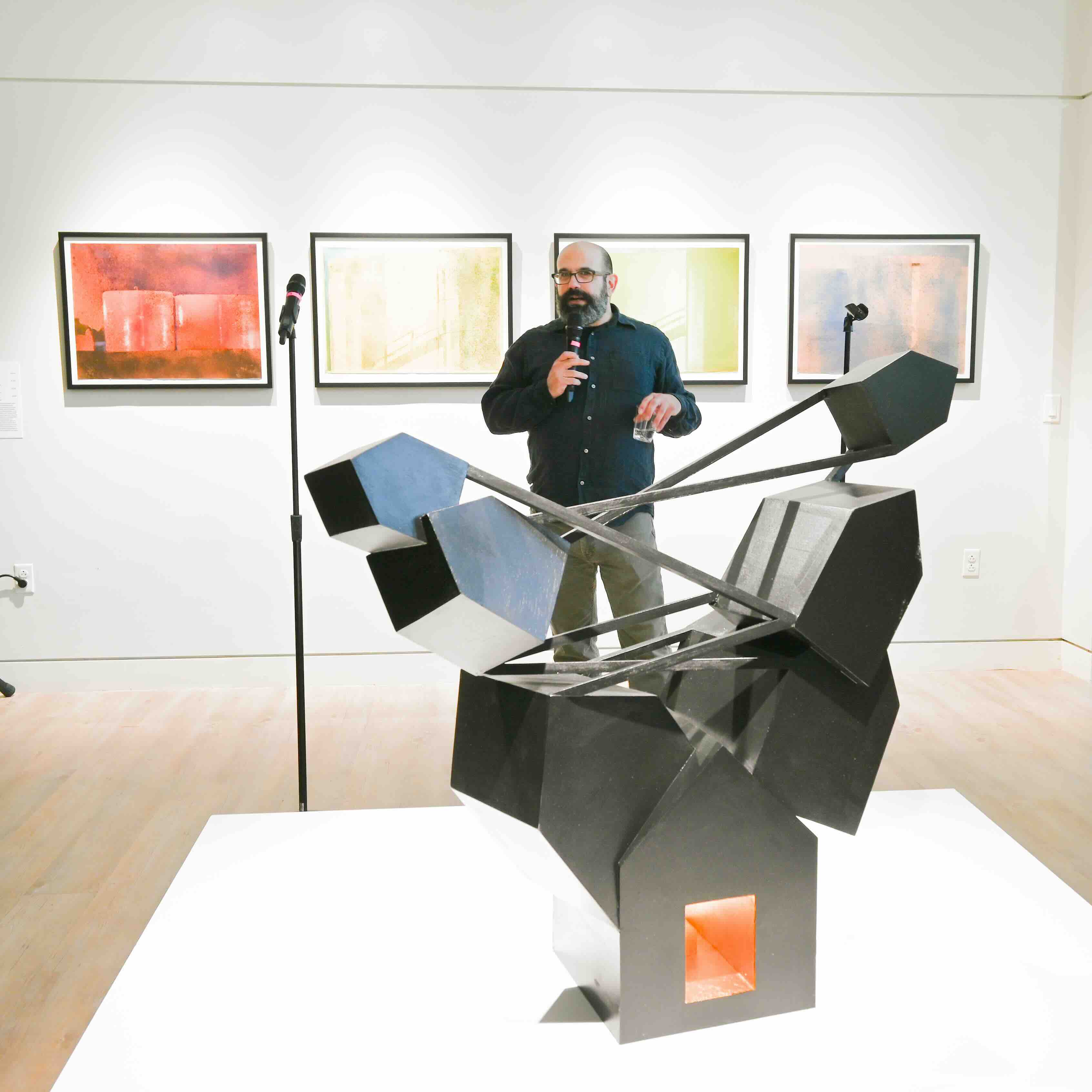
You went to UMD, Parsons, & UPenn, what did you gain from all those different experiences learning about Architecture & Computer graphics? Going down those paths, what made you interested in making art?
I have always created art; it was one of my favorite things to do when I was growing up. The part I enjoyed the most was the physical making of the art. I think that led me more into architecture initially, rather than in a pure art education. I wanted an experience where there were concrete goals and answers at the end of a project, rather than a focus on an aesthetic or subjective experience.
My undergraduate studies at the University of Maryland was in architecture, but it was more of a broad liberal-arts education. It exposed me to history, art, engineering, and of course, architecture in ways that were more complex and interrelated than I would have imagined. It gave me a deep well of skills and experiences to draw from.
The program at Parsons in digital design exposed me to a world of digital making that was just beginning to emerge. At that time, the software was changing quickly and in big leaps. In that environment, I learned how to learn software as if I was learning a language. There were often common roots that could be found in each program, but each one had its own vocabulary and structure that became clearer through every-day use. Above all, Parsons demystified the digital world and gave a practical set of tools to use to explore my art.
The program at Penn in architecture was more grounded than the MFA, but every project explored conceptual and theoretical ideas as well as the human experience of space making. The things learned in this program shaped my world-view of the built-world and formed the design/exploration/creating process I still use to create my current work.
In what ways do you utilize your skills in computer graphics in your physical art? When making a physical piece of art how do you integrate your computer graphics in the design process?
When I begin exploring ideas for a new project, I always start sketching by hand. This gives me the greatest freedom to quickly explore different forms and ideas. As a piece becomes more refined and the iterative changes become smaller, I’ll continue exploring forms with 3-dimensional computer models. This allows for more accuracy with dimensions, volumes, and angles, but still allows for a lot of exploration and refinement. By the time I start constructing the actual piece, it has been well figured out in the digital space.
The computer model also becomes a guide and reference for the construction of the real-world piece. I can use it to calculate angles and dimensions of different parts and understand how different parts are supposed to come together.
Finally, since most people interact with my art through photographs of finished pieces. I spend time with digital photo software to edit photos so they best represent the real piece.
And the opposite, when making more digital art, how do you incorporate Architectural themes? What about Architecture entices you?
I have always been fascinated with architecture; it is an integral part and expression of our culture and we are surrounded by it our entire lives. I’ve always been particularly interested in how different architectural forms create an emotional response when experienced by people - from a soaring cathedral creating a humbling experience to a cramped subway station creating claustrophobia.
When making a sculpture, I draw on those culturally ingrained responses to architectural forms to evoke a similar feeling in the observer. For example, I use a simple house-form in several of my works. This geometric form is not very different from a cube, but it has a whole host of emotional connections to home and childhood that are connected to that form. It makes the sculptures more than a geometric or compositional exercise and starts to draw on deeper meanings of experience.
What is your artistic process like when designing with wood?
Wood is a great material and I love working with it. For making sculpture, I have found that it is more durable than paper, but easier to work with than metal. It is less toxic than plastic and less brittle than glass or ceramic. Wood has a natural beauty that I try to highlight in my pieces, especially the furniture project. But as a natural material, it has quirks and constraints that have to be addressed or the piece won’t hold together. Wood is always moving as the temperature and humidity change which creates challenges that other materials do not inherently have. Understanding these features and constraints has been one of the most important things I’ve learned working with wood.
What have you found inspiring recently?
I’ve been exploring different AI generating tools recently. It is a fascinating experience because, unlike sketching or 3d modeling, I’m not in control of the final image. It is my words interpreted through another ‘mind’. I have found that this gives me unexpected moments of inspiration that can take a design in a direction I may not have come to otherwise.
When crafting wooden sculptures in the guise of furniture, do you design with functionality in mind or are you solely making art?
My work falls across a spectrum from conceptual sculpture to more practical every-day furniture pieces. I think my most successful pieces sit somewhere in the middle of that spectrum. Even my most impractical furniture pieces have fully-functional doors and drawers, space to store items, and durable finishes. Without these elements, I would think of them as sculpture imitating furniture, rather than a conceptual exploration of form through furniture elements.
The pieces that are intended to be viewed and understood more as sculpture, do not have the more practical and identifiable features of furniture. But they are built in a very similar way - all of the work I create follows a similar process and has similar ‘bones’.
Artist Talk - Thurs., July 24 • 6-8 pm | Oar Pub at Park Towne Place
Please join us at 6:00 PM on Thursday, July 24th, for a two-person artist talk with Anna Guarneri and David Beker. Both artists have work in Human Scale, the current exhibition at Park Towne Place exploring notions & histories of architecture.
Human Scale is on view at Park Towne Place through October 13, 2025. You can learn more here and shop the exhibition here