With a keen eye and a sharp pen, artist and writer Derek Ayres takes us on a visual tour of Wicker basket and a short knife at FJORD.
Walking into Wicker basket and a short knife at FJORD, I found myself pointing like Leonardo at the TV. Johns! Elizabeth Murray! Surrealism! Arte Povera! But once the urge to play art history bingo subsides, the work takes over, and the dirty business of looking begins.
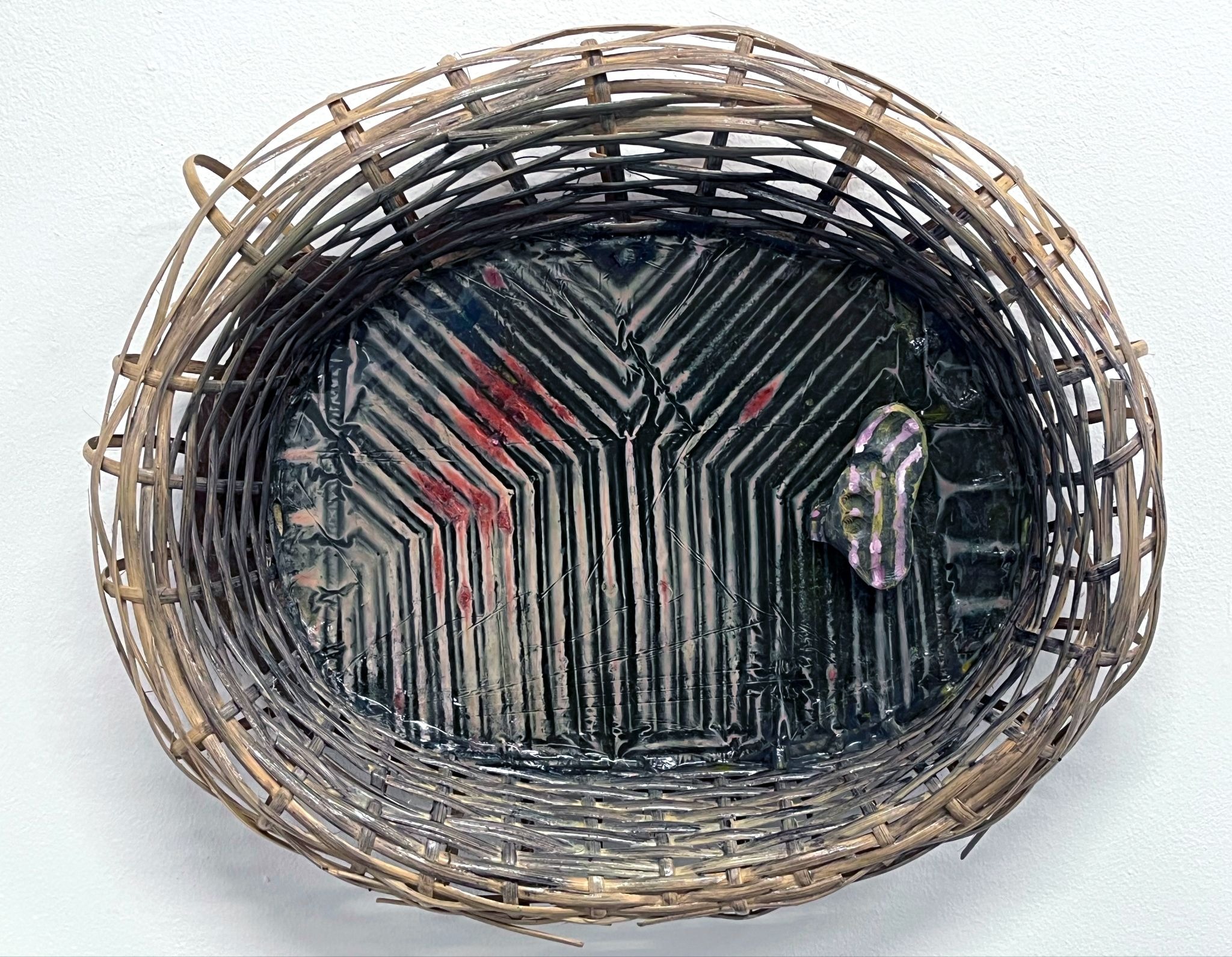
The exhibition brings together Melissa Joseph, Anne Minich, Jim Strong, and Ezra Tessler under the loose organizing principle of foraging. Its title comes from the final work of poet Paul Zweig, whose mushroom-gathering finds an echo in Minich's own interpretation: the wicker basket as the many containers for her found materials, the short knife as the X-Acto blade she uses for carving. But what interested me wasn't so much what these artists gathered as what they used to hold it. The closest thing to literal wicker in the room is the rattan tray used in Strong's Noli Me Tangere, but the whole crew here seems to be deciding what holds an image.
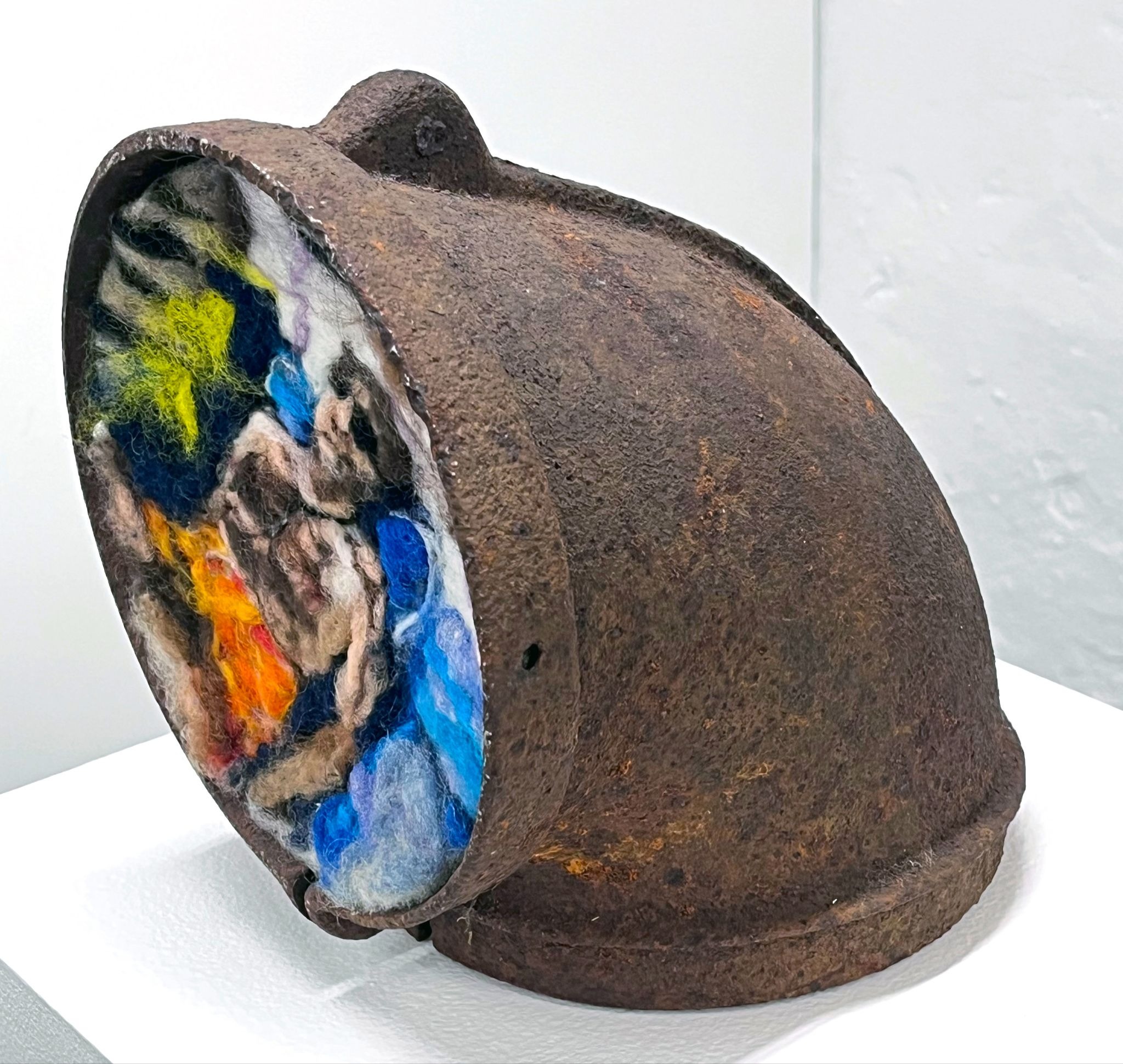
Joseph's two gorgeous needle-felted wool pictures live in salvaged industrial metal. In Bap in Puerto Rico, a sunglassed sunbather in orange trunks is set into the open end of a rusted pipe elbow. In At the farm on Weaver Road, two lambs sleep in a piece of salvaged steel. Here's your Arte Povera, with wool. Delicate, labor-intensive felt meets hard industrial infrastructure, and the metal never pretends to be anything but metal. Images in airy, fibrous wool, framed in heavy, industrial steel fittings, make a wonderfully circular material joke, a perfect surreal collision.
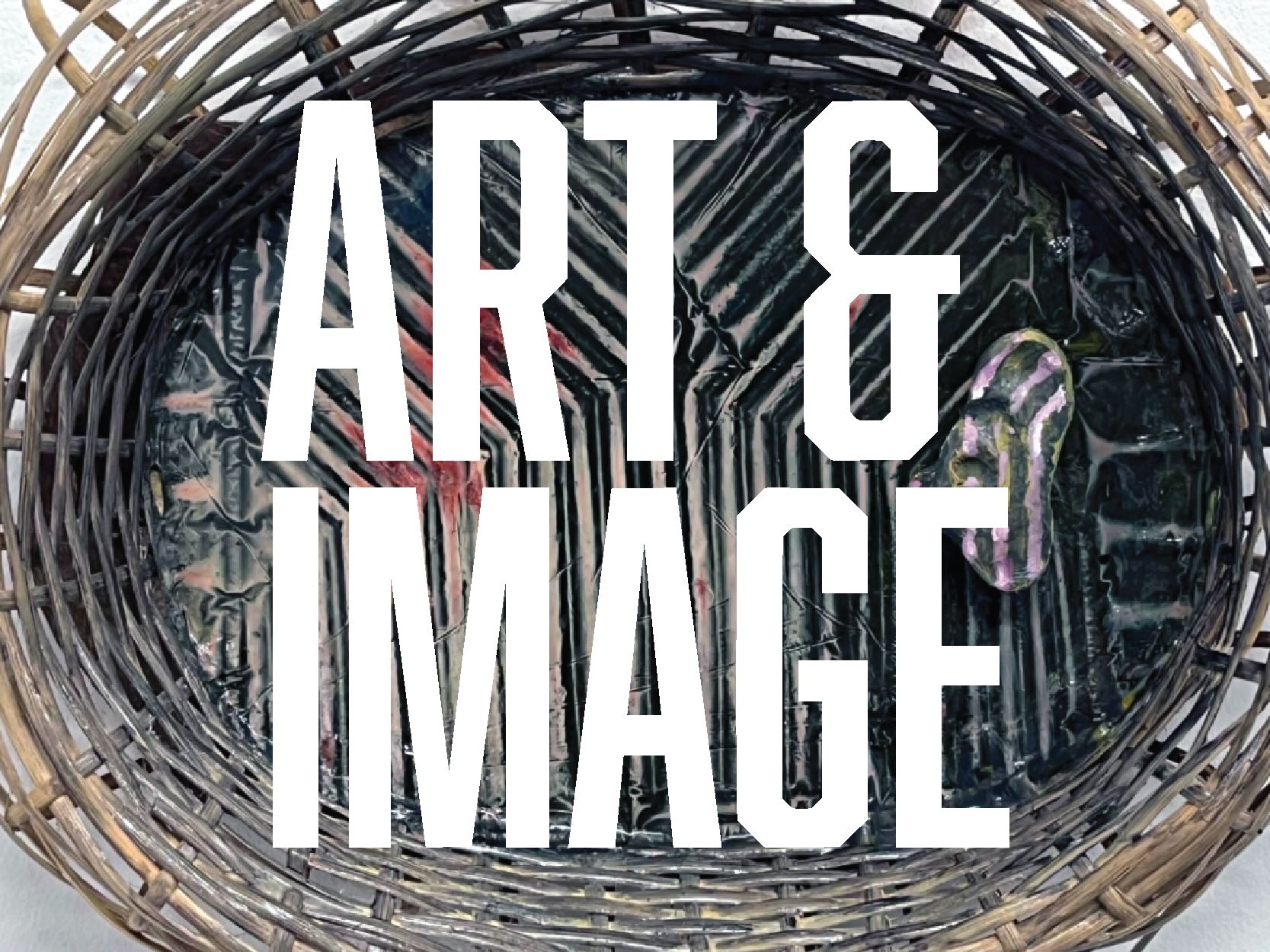
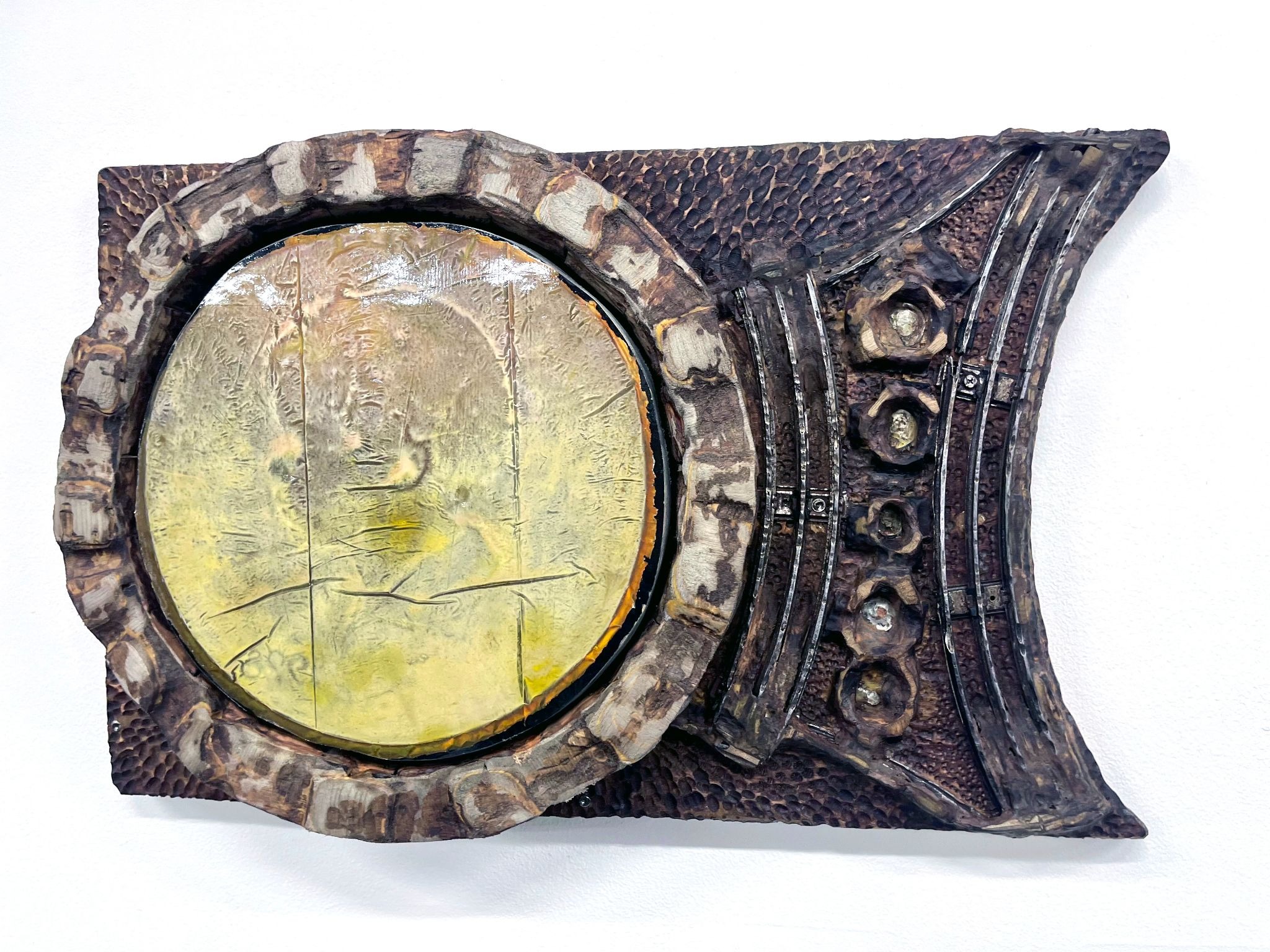
Strong works in almost the opposite direction. Ghostly images emerge in the film of evaporated paint, held in hand-carved wooden frames with the weight and appearance of wrought metal. Antique model train tracks and other found elements are absorbed into the carving. Where Joseph keeps the found object legible as found, Strong folds everything into a single, heavily wrought construction. In Mars, a faint cameo impression occupies a yellow disc surrounded by carved forms, altered coins, and curving antique model train tracks. Cupid and Psyche encloses two contrasting images, one resembling a dark insect, within an equally elaborate construction. These things look much heavier than I'm sure they are. Noli Me Tangere is the exception, lighter and sparer. A carved ear floats in a glossy dark field inside a woven rattan tray, the image seeming less depicted than left behind.
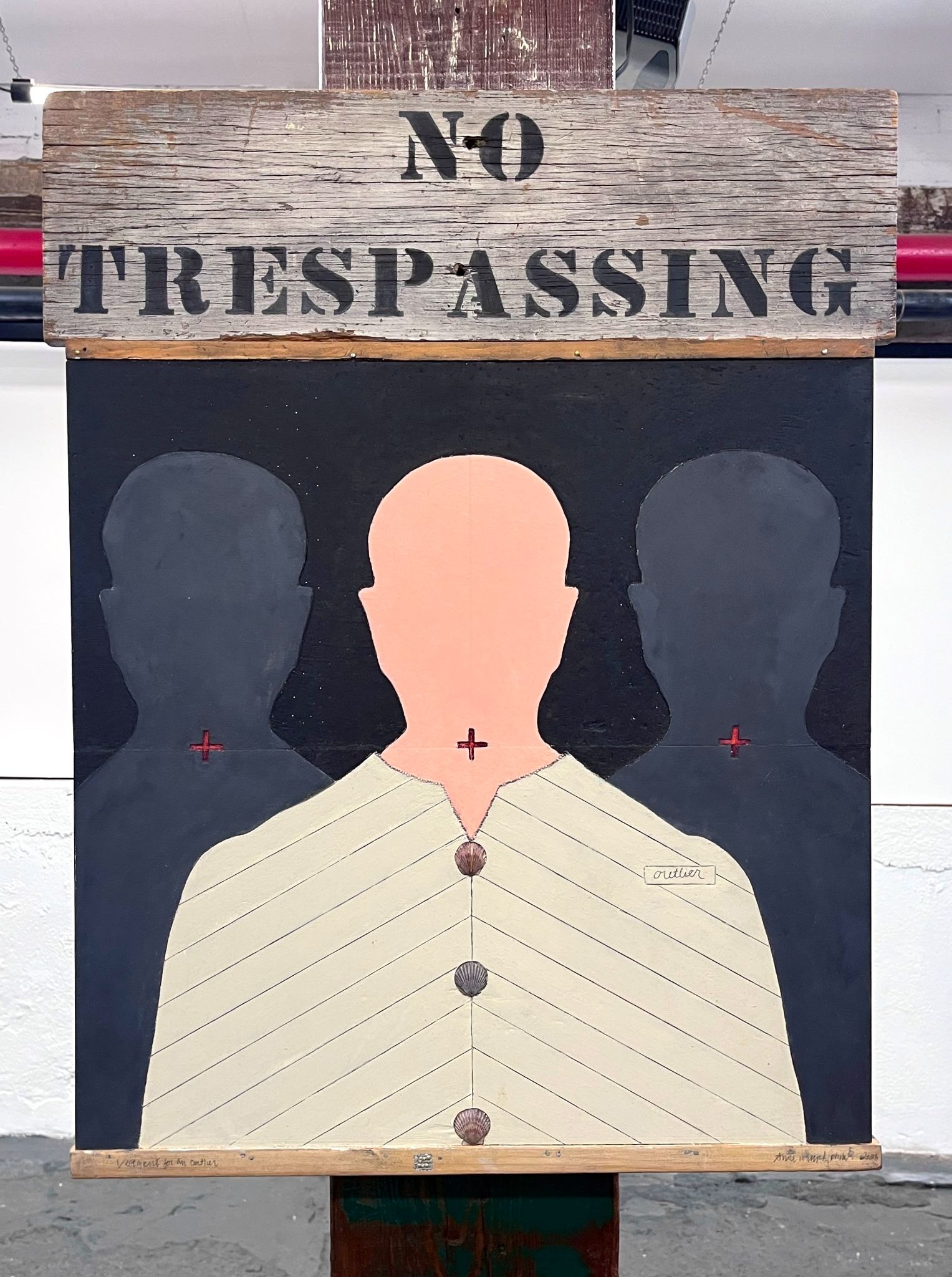
Minich takes containment somewhere else. In VESTMENT FOR AN OUTLIER, a salmon-pink figure stands before two charcoal silhouettes, all three marked with red crosses at the throat. The ‘outlier’ tag recalls Magritte, but the flat figures, each with a red crosshair, give Johns – silhouette, text and target in one gesture. The crosses read as both religious mark and shooting-range target, and the shell-buttoned garment hints at clerical dress. The weathered NO TRESPASSING sign above keeps all of this from being a well-read quotation, and makes the cool, flat painting beneath it look all the more deliberate.
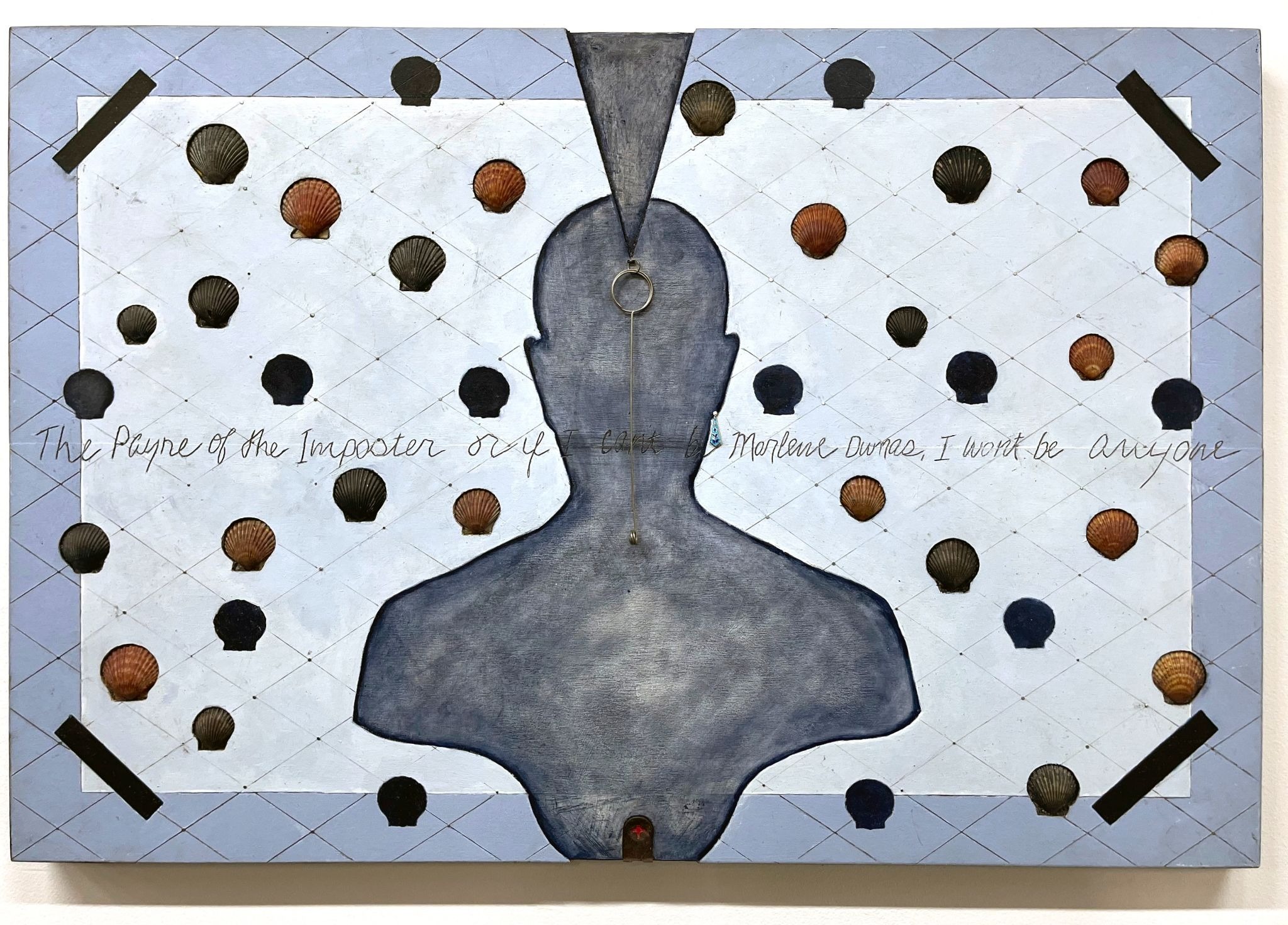
Seatpiece is quieter and funnier. The remains of a chair bear the inscription "TO THE MEMORY OF ALL THOSE WHO HAVE SAT BEFORE ME," borrowing the language of public monuments to commemorate the ordinary act of sitting. It's absurd, but also true. The arched back suggests a headstone, and a single shell sits low on the pink grid. The same shells scatter across THE ARTIST’S ARTIST’S CONFESSION, some real, some painted as dark shadows of themselves around a blue-gray bust. They recur throughout Minich's work without demanding a fixed symbolism. They're containers left behind by absent bodies, and so, in the end, is the chair.
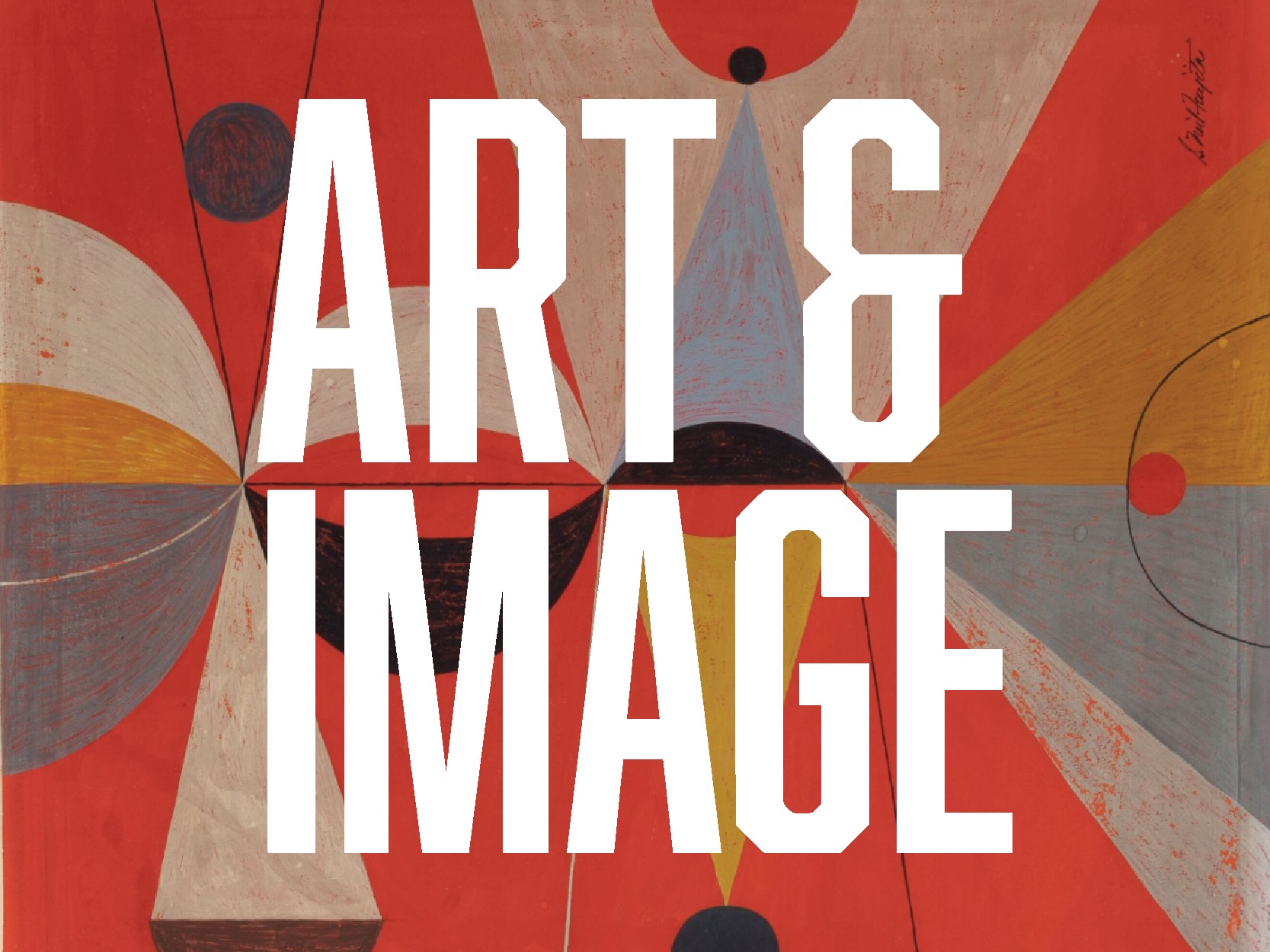
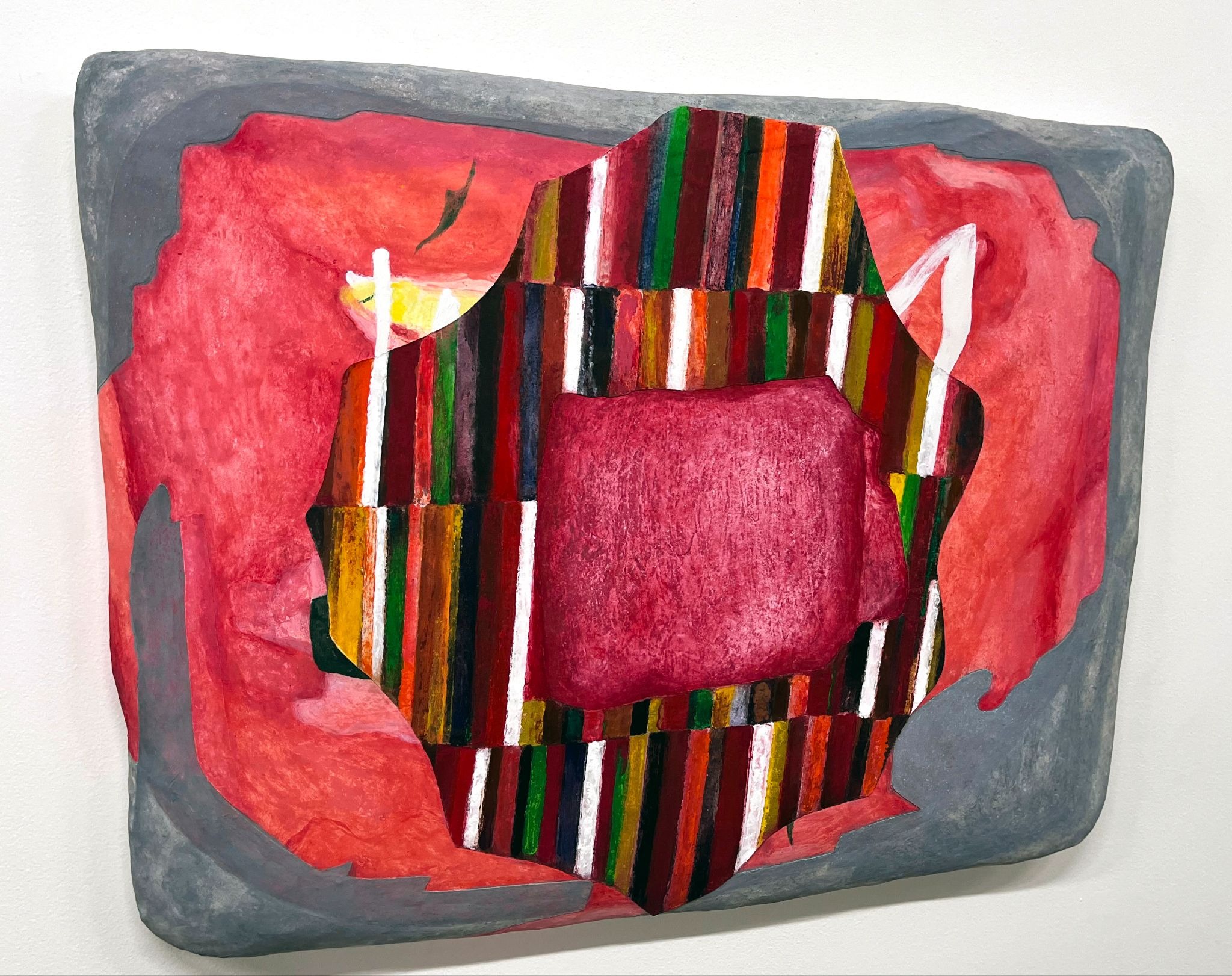
Tessler is the show's odd man out and its chromatic counterweight. Where the others offer recognizable images or objects, his shaped paper-pulp constructions give us abstraction alone, and saturated color does the heavy lifting. His supports refuse the rectangle in a way Elizabeth Murray would recognize, though his surfaces are rougher and more nervous. Impossible mirror is the more compelling of the two: a gray perimeter, a red field, a striped band, and a raised raspberry slab at the center that offers no reflection. Thorn and gall is harder to enter, and at its smaller scale it asks for more patience than the larger piece. By his own account, Tessler works with studio detritus and unsuccessful experiments, and the title fits. A gall is a growth a plant produces around an irritant, and here the irritant is the failed attempt. In Tessler's work, the support doesn't simply contain the image; its irregular shape becomes part of the image itself.
There's an assurance to these objects, a sense that each artist has teased out a vocabulary of their own from a familiar artistic vernacular. Nothing feels tentative or particularly interested in chasing the moment. These objects occupy space and time exactly where they are. The result is a satisfying well-pitched harmony across the show. Ultimately what holds this exhibition together isn't simply the scavenging of materials, but the different ways those materials hold, protect, frame, or exclude. A solid, meaty show worth pointing at.
Wicker basket and a short knife
FJORD, Philadelphia | October 10–November 14, 2026
About the Author:
Derek Ayres is a Philadelphia-based artist. He received his MFA in Sculpture from Columbia University and his BA in English and Visual Arts from Rutgers University. Derek’s work has been exhibited at ZieherSmith and P.P.O.W. in New York, Bridgette Mayer Gallery and Da Vinci Art Alliance in Philadelphia. Ayres grew up in Houston, Texas, and has lived on the East Coast for more than forty years. His current work brings together imagery drawn from his Texas upbringing, art history, architecture, landscape, and American popular culture across painting, works on paper, and sculpture.
Want to stay in the know about Philly’s visual arts scene? We’re developing a semi-regular Art & Image Newsletter - featuring interviews, articles, and reviews straight to your inbox!