Writer and educator Liz deBeer and co-author Pete Sparber, consider Just Us, an exhibition at the Barnes featuring work by artists at SCI Phoenix and justice-impacted artists from Mural Arts Philadelphia's Rec Crew.
While Just Us is a relatively small exhibition, it carries considerable weight. Displayed in a first-floor classroom at the Barnes, the show brings together original works by artists at SCI Phoenix and justice-impacted artists participating in Mural Arts Philadelphia's Rec Crew. The exhibition asks viewers to consider justice, memory and hope through the perspectives of people whose lives have been directly affected by the criminal-justice system.
The partnership between the Barnes and Mural Arts Philadelphia began in 2018, bringing Barnes educators together with participants in Mural Arts' restorative-justice programs. For Just Us, Rec Crew members studied works in the Barnes collection and participated in printmaking workshops at Second State Press, while Barnes educators met with artists working at SCI Phoenix.
That question of who gets to speak, and who gets heard, runs through the exhibition. Writing about prison art in the Prison Journalism Project, formerly incarcerated writer Bobby Bostic has described art as a way for people behind bars to communicate beyond the physical boundaries of incarceration. Just Us makes that idea real. These aren't works presented merely as illustrations of incarceration. They are works where the artist, through their lived experience, expresses and invites the viewer to make sense of the issues of justice, memory, social history and freedom.
Albert Perez's Still Fighting is perhaps the most direct. At the center stands a bloodied, muscular boxer, tattooed and poised to continue fighting. Around him, other figures suggest different manifestations of power and justice: a blindfolded woman, an apparent exchange of money, uniformed figures and, in the distance, an open gate illuminated by sunlight. The title tells us the struggle isn't over, but Perez leaves much unresolved. Is the brilliant light beyond the gate freedom, salvation or simply another place the fighter is struggling to reach? Are the people surrounding him allies, adversaries or representatives of systems he must navigate? Even the boxer's stance contains a contradiction: he appears battered, but certainly not defeated.
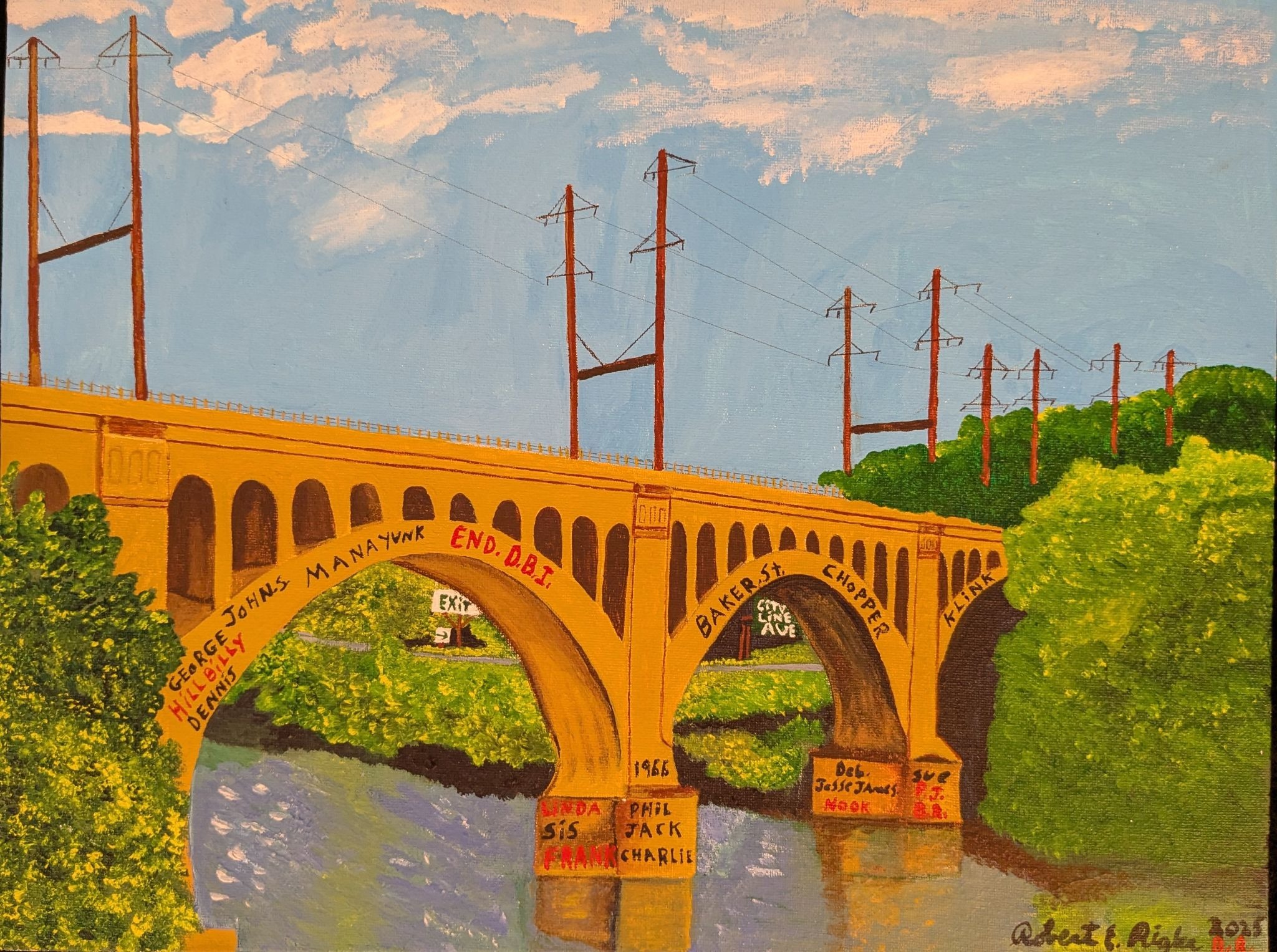
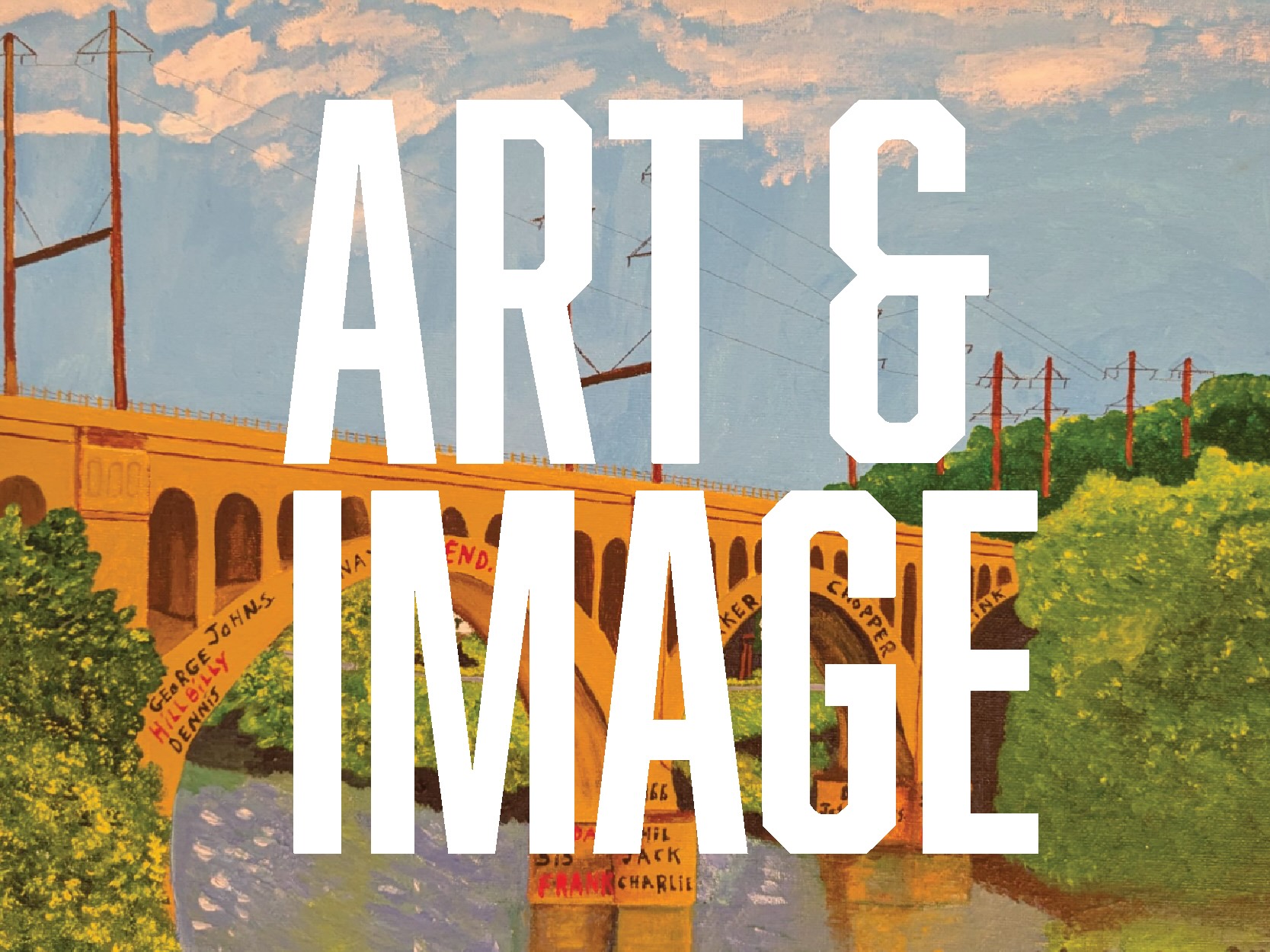
Robert Rigler's Manayunk Train Bridge takes a quieter approach. The familiar Philadelphia structure stretches across a landscape rendered in almost idyllic colors, but words painted across its arches disturb the scene. Among them is “End D.B.I.”, End Death by Incarceration, a campaign against life sentences without parole. The juxtaposition changes our experience of an otherwise recognizable Philadelphia landscape. A bridge normally suggests passage: movement from one place to another. Here that possibility takes on additional resonance. For people serving sentences that may offer no return to life outside prison, what does passage mean? Rigler doesn't answer the question; he embeds it in the landscape.
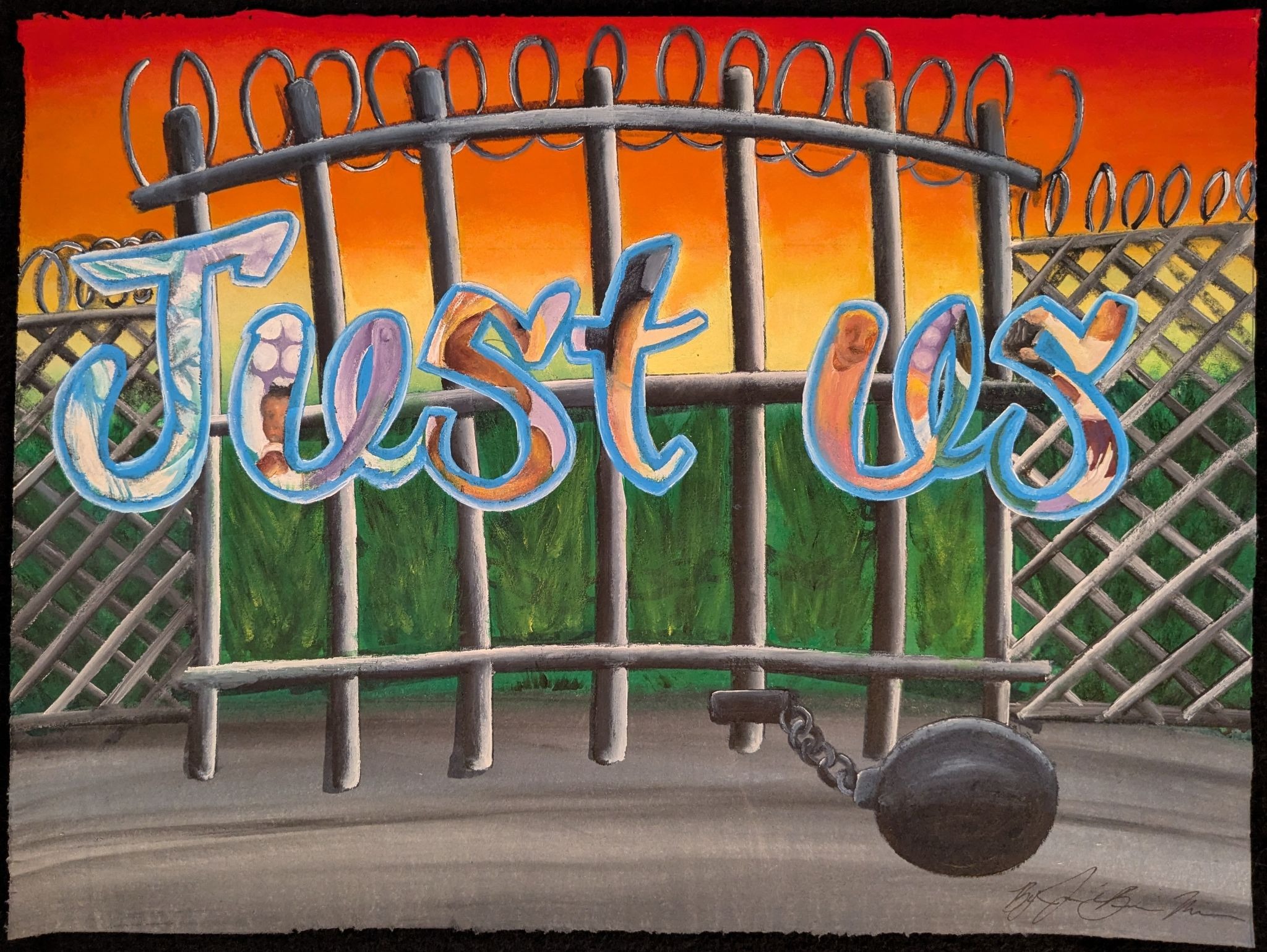
Jose Benesario Nieves’ Just Us places us with the artist in a world of grey asphalt, bars, fences, barbed wire, and a ball and chain. Beyond we see, but are separated from, a green field and a glowing sky. Nonetheless we are reminded that inside the gates it’s ‘Just Us’... that we are people too. It doesn’t make a claim about right or wrong, but presents us with the facts of incarcerated existence.
James Green's Past, Present, Future Are and Always Will Be With Us Until We Change Our Ways shows rows of brown bodies filling a dark, enclosed space, evoking the hold of a slave ship and the long history of Black bodies subjected to confinement and institutional control. Green's expansive title refuses to leave that history safely in the past. Instead, it asks us to consider how the structures and attitudes of one period survive into another. That question has particular resonance in Philadelphia during the nation's 250th anniversary, as institutions throughout the city reconsider how American history, including slavery and racial oppression, is presented and remembered.
Seen together, the four paintings demonstrate something more interesting than a single shared “message.” Perez gives us struggle, Rigler the possibility, or impossibility, of passage to freedom, Nieves the emotional pain of separation, and Green the persistence of history. Their approaches and visual languages differ, as do those of the other artists in Just Us. What connects them is the opportunity to speak for themselves.
That distinction matters. It would be easy to approach an exhibition by incarcerated and justice-impacted artists primarily as a social-service project and judge it by the worthiness of its mission. Just Us asks for something more demanding: that we actually look at the art. The artists aren't anonymous representatives of a category called “the incarcerated.” They are individuals making images, choosing symbols and asking questions about the same subjects artists have wrestled with for centuries, justice, memory, identity, freedom and hope.
That emphasis is consistent with the Barnes's long-running partnership with Mural Arts and its belief in art education as a means of developing observation and critical thought. But the exchange works in both directions. The artists gain access to education and an important cultural platform; Barnes visitors gain access to experiences and perspectives they might otherwise never encounter.
Perhaps that is where the title Just Us becomes most effective. According to Barnes curator Bill Perthes, it deliberately carries several meanings: “justice,” the fellowship among the participating artists, and the reminder that they are, fundamentally, “just like the rest of us.” The exhibition doesn't ask viewers to ignore incarceration or the actions that may have preceded it. It asks us not to allow those facts to exhaust our understanding of the people who made the work.
Just Us is modest in scale, but its proposition is not. Look closely at the work. Listen to what these artists have chosen to say. And allow the art, not simply the circumstances of its creation, to shape what you see.
Exhibition: Just Us
Location: Barnes Foundation, first-floor classroom of the Collection Gallery
On view through: October 12, 2026
About the Author:
Liz deBeer teaches and writes with Project Write Now, a writing cooperative based at the Jersey Shore, where she resides with her family. Her debut chapbook Farewell to Emptiness, a novelette-in-flash (Thirty West Publishing House), is set in the Albany, NY, area, her birthplace. Her flash has appeared in Fictive Dream, Bending Genres, Literary Garage, and other literary journals. A volunteer reader for Flash Fiction Magazine, Liz holds degrees from University of Pennsylvania and Rutgers University. She can be found via her weekly Substack A Lizard's Tale or her website: https://www.ldebeerwriter.com
Want to stay in the know about Philly’s visual arts scene? We’re developing a semi-regular Art & Image Newsletter - featuring interviews, articles, and reviews straight to your inbox!