Artist, writer, curator, and art historian Susan Isaacs reviews Citizen Artist, the current exhibition at the Delaware Art Museum exploring the legacies of the WPA (Works Progress Administration) and CETA (Comprehensive Employment and Training Act); two federally funded programs that, during the 1930s and 1970s, employed thousands of artists in service of their communities.
2026 marks the Semiquincentennial, the 250th anniversary of the signing of the Declaration of Independence. As a result, many institutions are presenting programs and exhibitions that contribute to our understanding of the history of the United States, including The Delaware Art Museum, which is offering an exhibition that highlights the diverse artists who, during two distinct periods, worked for federally funded programs: the New Deal’s various employment programs, such as the short lived PWAP (Public Works of Art Project) and the subsequent longer lived WPA, (Works Progress Administration) of the1930s and early 1940s, and the much later CETA (Comprehensive Employment and Training Act) of the 1970s.
Artists were struggling, even starving to death, during the Great Depression. The point of the PWAP was to employ professional artists to do what they already knew how to do—create artwork for interior and exterior public spaces. It was a successful program that provided income to nearly 4,000 artists. 16 regional districts headed by administrators were created, among them some familiar names including Fiske Kimball, longtime director of the Philadelphia Museum of Art, and Duncan Phillips, founder and director of the Phillips Memorial Gallery, today the Phillips Collection. It is also safe to say that the beginning of the collection of what eventually became the Delaware Art Museum took place in 1934 with a gift of 17 works created by artists of the PWAP.
The PWAP lasted less than a year, but artists continued to advocate for more government support. Artist George Biddle and Treasury executive Edward Bruce, along with many artists, pushed the young Roosevelt administration for a new program. Biddle and Bruce met with Public Works Administrator Harold Ickes who liked the idea and determined that it could be funded through the Relief Administration overseen by Harry Hopkins. The WPA was created, which, at its height, employed over 8 million people, including over 5,000 artists, many of whom had participated in the earlier PWAP. There were three WPA programs that worked directly under the auspices of the Treasury Department: The Public Works of Art Project, the Section on Painting and Sculpture, and the Treasury Relief Act. Additionally, the largest of the New Deal art projects was the Works Projects Administration Federal Art Project, under the direction of Holger Cahill.
Artists hired in these programs produced some 108,000 paintings, 18,000 sculptures, and 2,500 public murals. The printmakers in the program were the most prolific, producing in an eight-year period about 240,000 impressions from 11,000 different compositions. Prints, of course, are multiples.
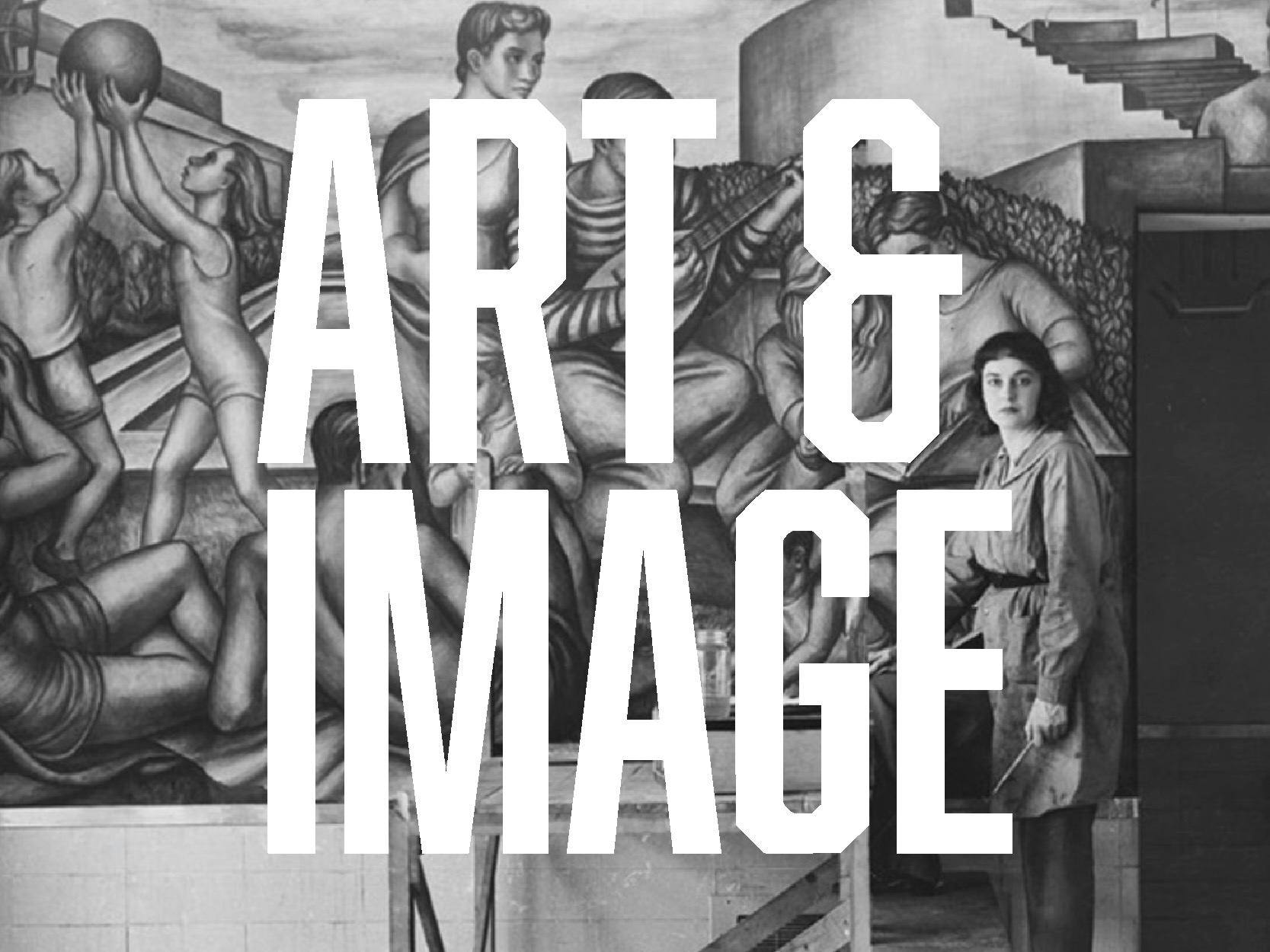
The Graphic Arts Division of the Federal Art Project played a significant role in expanding opportunities for women, artists of color, and indigenous communities. From the beginning there was advocacy for hiring women artists, with many working in the areas of painting and printmaking. Despite an attempt at equal pay, the more lucrative jobs, such as creating large murals in public buildings, often went to male artists. Unfortunately, today we have lost the identities of many of the women who participated in the graphic arts. In part, this is due to what happened to the thousands upon thousands of prints created under the WPA, which ended in 1943, during WWII. At that time, vast numbers of these graphic works were lost through destruction or reclamation of materials, obscuring the identities of numerous women artists who were very active in printmaking. Many works were distributed to institutions nationally as well, not all with careful record keeping.
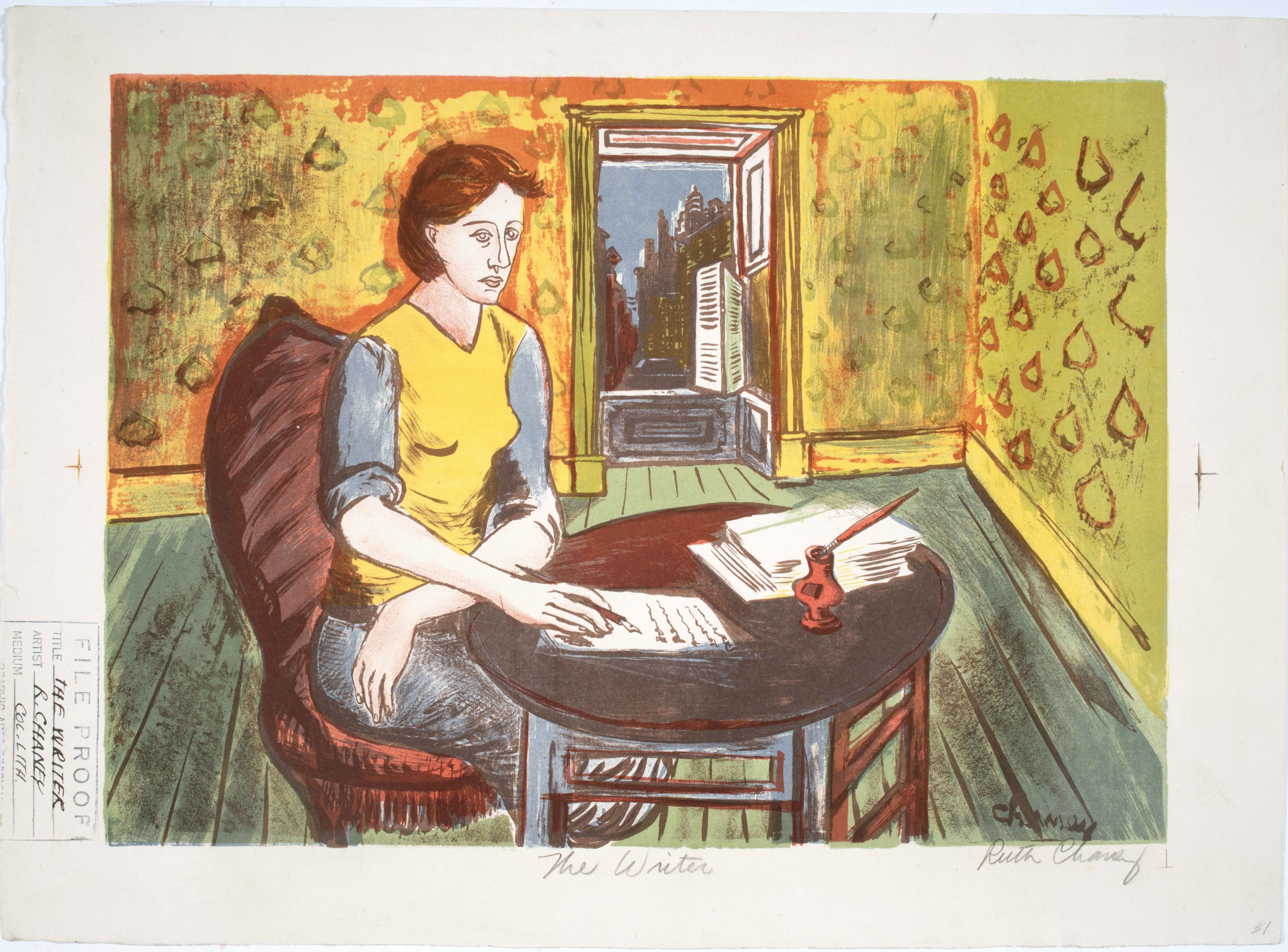
Fortunately, Citizen Artist includes a six-color lithograph from the museum’s own collection by Ruth Chaney, entitled The Writer, https://www.metmuseum.org/art/collection/search/374549
1939. Her prints for the Federal Art Project were included in the 1940 Museum of Modern Art exhibition, American Color Prints Under $10, that was subsidized by the FAP with the goal of making art ownership accessible to the average American. Chaney was also in charge of a subway art division, one of the committees established by the Public Use of Arts Committee. In fact, her work was included in an earlier MoMA exhibition in 1938, Subway Art.
Nearly 40 years later another government funded program that hired artists emerged—
CETA—which was structured in part on the earlier WPA. Thus, a direct line can be drawn from the PWAP to the WPA to CETA, making the exhibition at the Delaware Art Museum conceptually cohesive. CETA was passed by Congress and signed into existence by a Republican president, Richard Nixon, resulting in the largest investment into American workers since the New Deal. It lasted from December 1973 through to March of 1981 when it was repealed by President Reagan.
CETA was a more decentralized program than the earlier WPA with funding given directly to local elected officials across the United States. The idea was that by issuing grants within their own regions, they could create salaried positions and hire workers who could train and build skills. It was not specifically arts oriented. However, an intern with the San Francisco’s Mayor’s Office of Manpower, John Kreidler, very soon recognized that there was an opportunity to create programs and employ individuals in the arts. During CETA’s existence at least 20,000 artists and arts administrators were hired. They developed arts programs throughout the U.S. that included murals, photography, graphic design training, theater, television, and more. Programs were specific to the interests and needs of the community, providing the opportunity for artists to be, once again, in the service of the American public.
Citizen Artist is a large well thought out exhibition that includes prints, posters, photographs, paintings, publications, and even puppets. Informative labels contribute to the quality of the presentation. Two of the museum’s staff are the co-curators— Margaret Winslow, the Head Curator and Curator of Contemporary Art and Dorothy Fisher, the Lynn Herrick Sharp Curatorial Fellow. They successfully tell the story of how “artists created and transformed the physical and cultural infrastructure of the United States.” On one level, it consists of powerful visual images that draw us in and on another it is the narrative these works present about the role of democracy and the key position that artists played in advocating for it and for change that conceptually links the works. It also represents Winslow’s and the museum’s efforts to document stories that “shaped individual and collective experiences through the lens of art.”
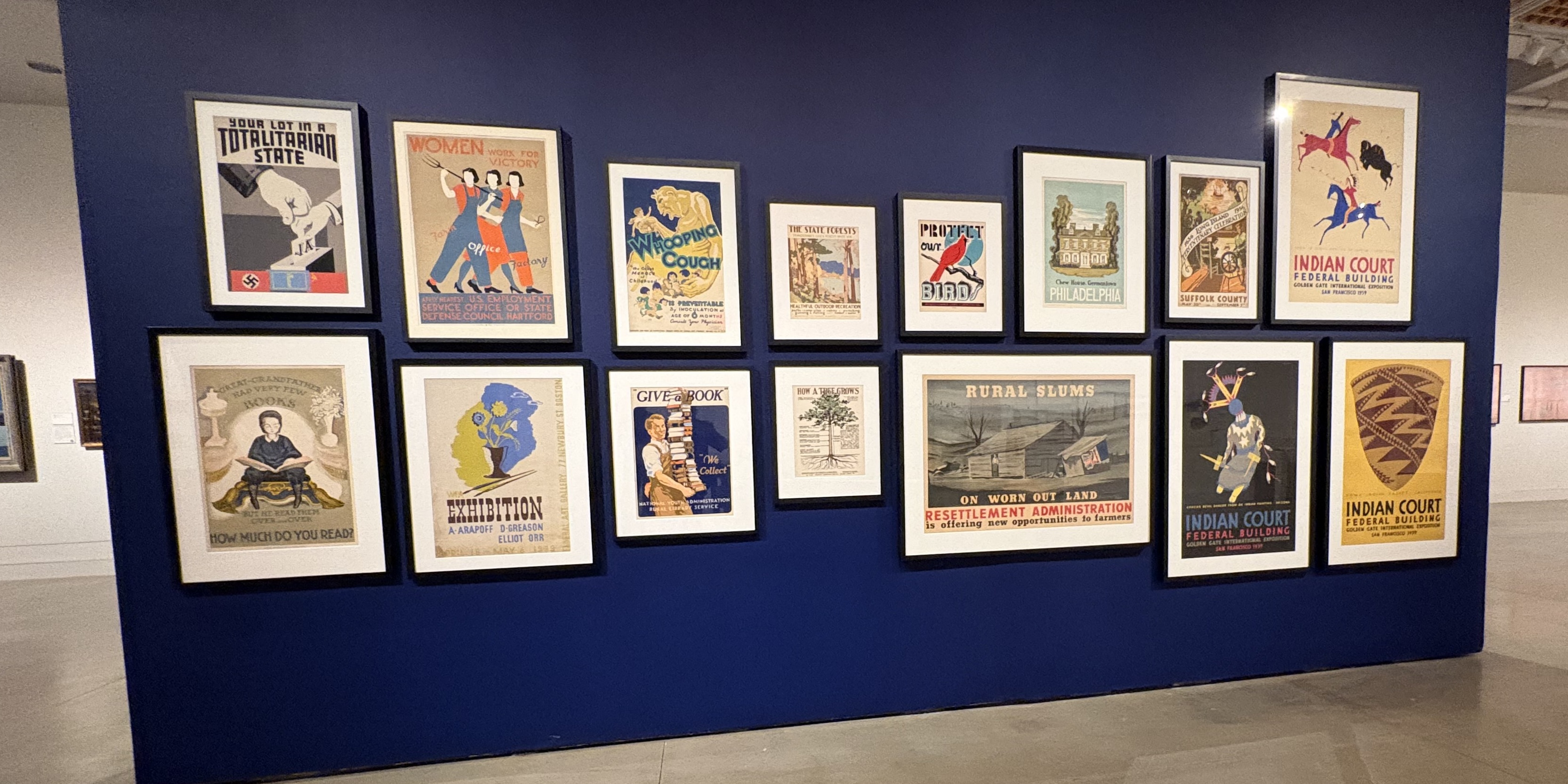
Upon entrance to the large gallery, we immediately face a wall of colorful New Deal Posters. It is instantly clear that there are parallels between the “then” and the “now.” While we are hopefully not facing a worldwide economic crash, we are in an economic downturn, with extreme contrast in earnings between the 99% and the 1%. Inflation is growing, causing a high cost of living, and war with Iran and tariffs on imported goods and materials has contributed to a concerning jobs market as well as potential shortages. Echoing the period before the 1929 Wall Street crash, the current administration has chosen international isolation. Moreover, studies show that removal of non-citizens from the job market also eliminates jobs for citizens.
The New Deal Posters, through screen prints and lithographs, addressed issues that we contend with today: fascism, women’s roles, vaccination, reading and libraries, state and national forests, rural poverty, indigenous culture. Your Lot in a Totalitarian State, c. 1930s could be applied to today’s growing centralized power and increased attempts to eliminate people from the voter rolls and possibly even end elections. These works succeed because of their very direct and often simplified forms. Women Work for Victory, c. 1941-1943, demonstrates not only artists' support of the war effort, but also women’s important position in that effort. With the controversies today over vaccines, Whooping Cough, 1935-1943, a poster created to promote public health through vaccination against preventable diseases, might be useful today as we contend with outbreaks of whooping cough and especially measles.
Libraries had an important function during the New Deal; they were repositories of knowledge that could educate the public, particularly in overlooked rural communities. Give a Book, c. 1930s, represents the National Youth Administration’s rural library service which created opportunities for work and education in a particular audience, those that were 16-25 years of age. Also, they collected books to circulate to more remote areas. Reading and knowledge are key to democracy. Today, public libraries are under duress due to book bans leading not only to increasingly hostile work environments, but also to the elimination of books in their collections that respond to the library’s clients, and often includes bans on classic, highly respected and awarded books. Today’s libraries also offer the internet.
Other posters address rural poverty, such as Richard H. Jansen’s, Rural Slums On Worn Out Land, c. 1935, There were a series of events and contributing factors including droughts, low crop prices, high machinery costs, less choice land being used, and abandoning soil conservation practices that led to the soil erosion that we identify with the Dust Bowl. Tens of thousands of impoverished farm families abandoned their land, with many going west to California. The New Deal’s Resettlement Administration, later folded into the Farm Security Administration, attempted various ways to move them, which was not always welcomed by the receiving states, nor was the government able to accommodate the vast numbers of families affected by the Depression and the Dust Bowl.
Photographs of the abandoned farms and the migrants as well as other images of the rural poor were captured by professionals working for the Historical Division of the Resettlement Administration. An image of an abandoned farm in Oklahoma by photographer Arthur Rothstein is included in the exhibition as are several images by Dorthea Lange, including the 1936, Drought refugees from Texas encamped in California near Exeter. Seven in family. https://digitalcollections.nypl.org/items/ae8450e0-82ca-0136-7047-0edb6c6b1919?canvasIndex=0 Painter and photographer Ben Shahn, working with the Resettlement Administration, traveled through Appalachia creating many historic images of the workers and living conditions of the people he met there, including one of Kentucky coal miners, in Jenkins, Kentucky, 1935 on view in the exhibition. https://digitalcollections.nypl.org/items/b8efc010-009a-0133-46b3-58d385a7bbd0?canvasIndex=0
There was an interest in the lives and art of the indigenous peoples of the United States too. Three posters, all created by California-born artist Louis B. Siegriest, advertise the Indian Court, an exhibit of historical and contemporary indigenous design on view in the 1939 Golden Gate International Exposition. Apache Devil Dancer from an Indian Painting, Arizona, 1939 is based on a work by Apache artist Wilson Dewey who, at the time, was a student at the Santa Fe Indian School in New Mexico. It demonstrates the strong abstract design elements of Apache art. A crayon lithograph by Ute artist Julius Twohy, Dance of Indian Chiefs and Medicine Men, https://www.philamuseum.org/objects/75582 1938, brings together Ute imagery and cosmologies within a modernist composition.
.jpeg)
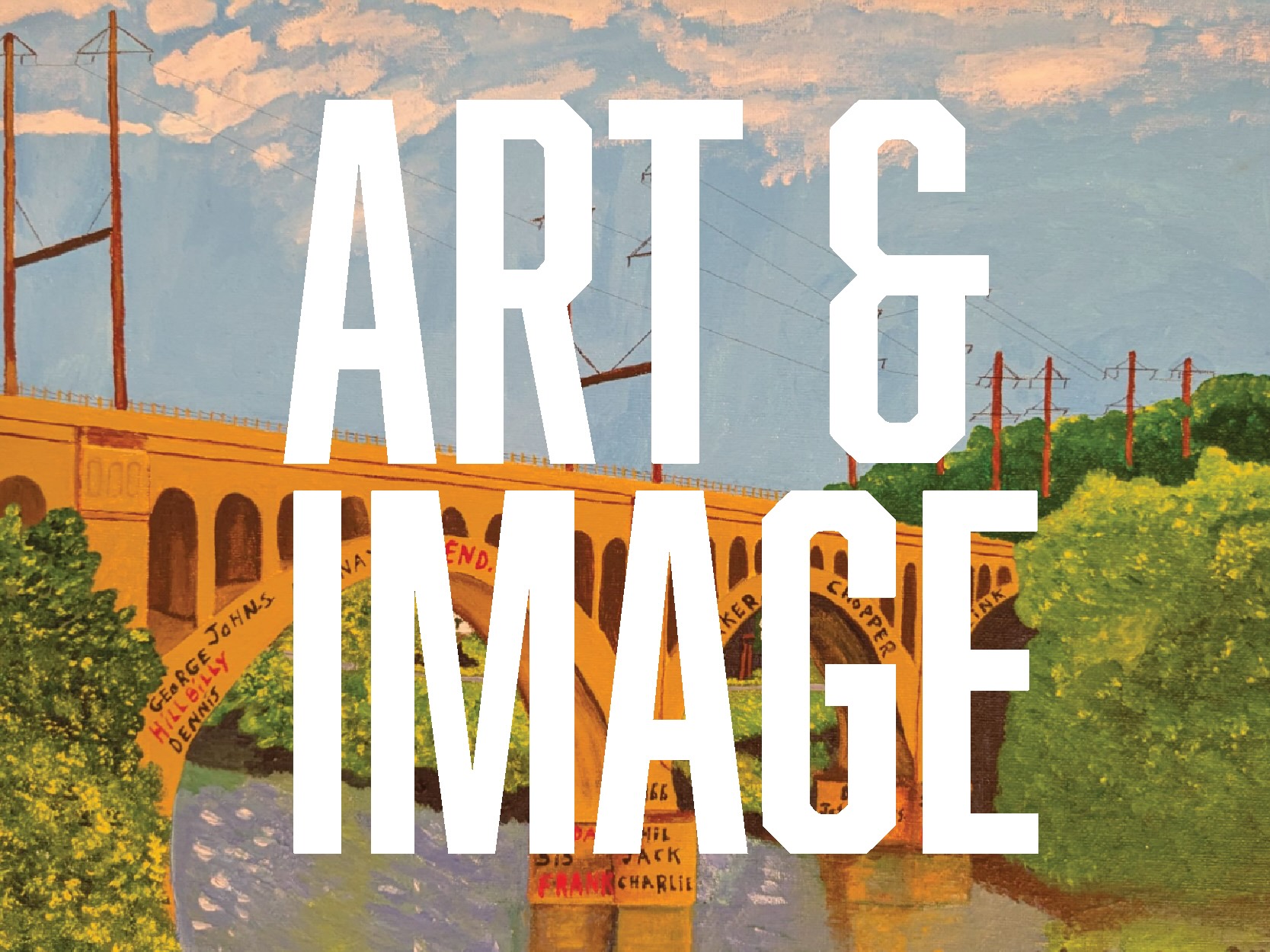
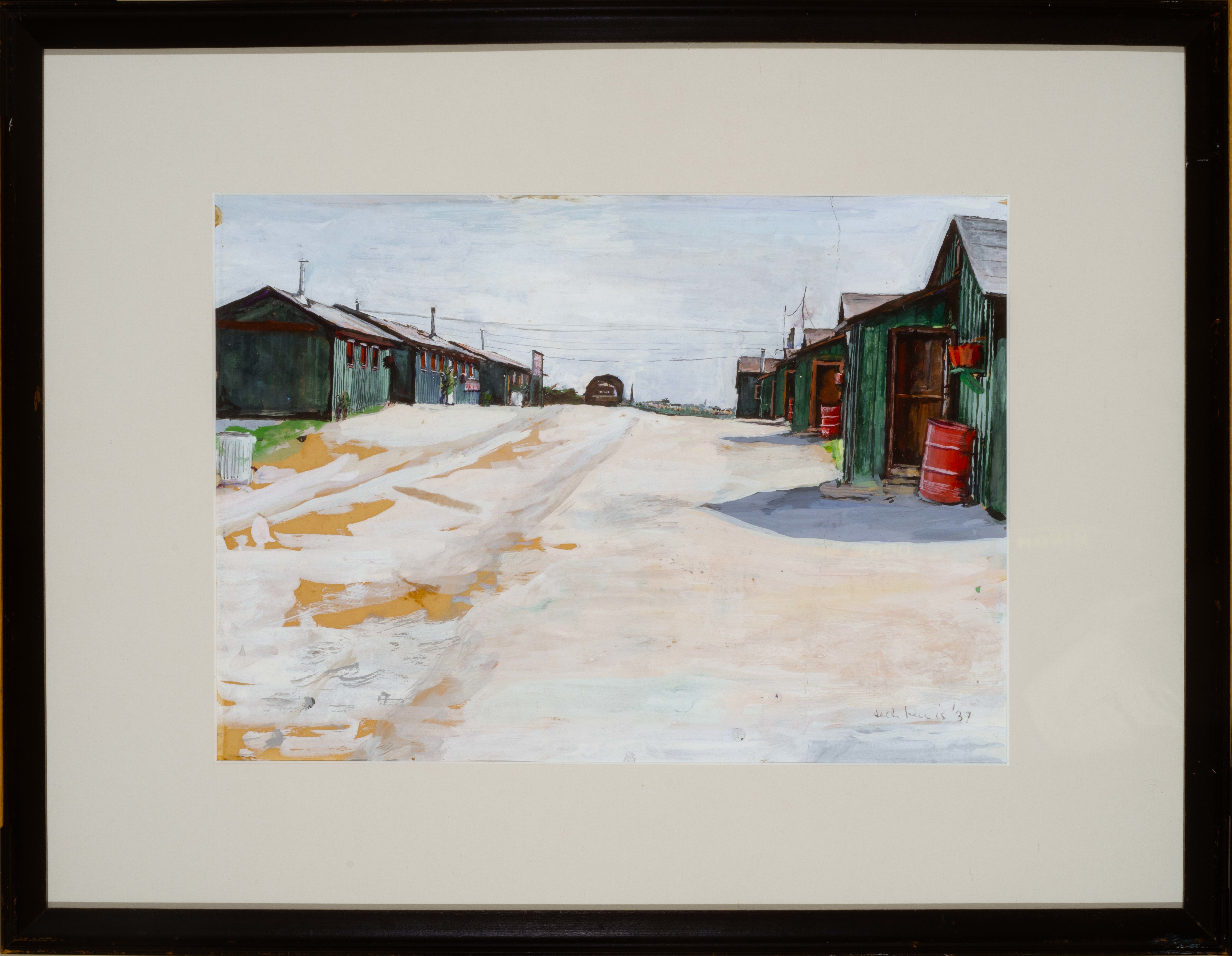
Two artists with whom I studied many years ago are included in the exhibition. Jack Lewis’s gouache on paper presents a view of the Civilian Conservation Corps Camp with its rows of barracks and buildings where the men lived and worked in Lewes, Delaware, digging ditches in Sussex County’s sandy soil. Lewis proudly remembered working for Delaware’s Civilian Conservation Corp, a part of the New Deal. Edward Loper Sr is represented by an oil painting produced for the Easel Division of Delaware’s Federal Art Project, Taking Down Clothes, 1939. An image of it was included in the important book, The New Negro in Art, by Alain Locke in 1940. Another painting, After a Shower, 1937 presents a night scene of the city of Wilmington, Delaware. While today Loper’s later modernist works impacted by his studies at the Barnes Foundation in Philadelphia are most known, his early career was influenced by the more limited color palette and representational style of WPA artists, also seen in the nearby Stuvesant Van Veen’s Steel Nocturne (Pittsburgh), 1937.
An artist closely associated with the Delaware Art Museum is John Sloan. Commissions to paint murals for Federal buildings were an important aspect of the Treasury Section of Fine Arts. Included here is Sloan’s graphite on paper study for a still extant mural, The Mail Arriving in Bronxville, 1846, created in 1939. Sloan represents the excitement of the event, so much so that now I want to visit Bronxville, New York to see the final mural in situ.
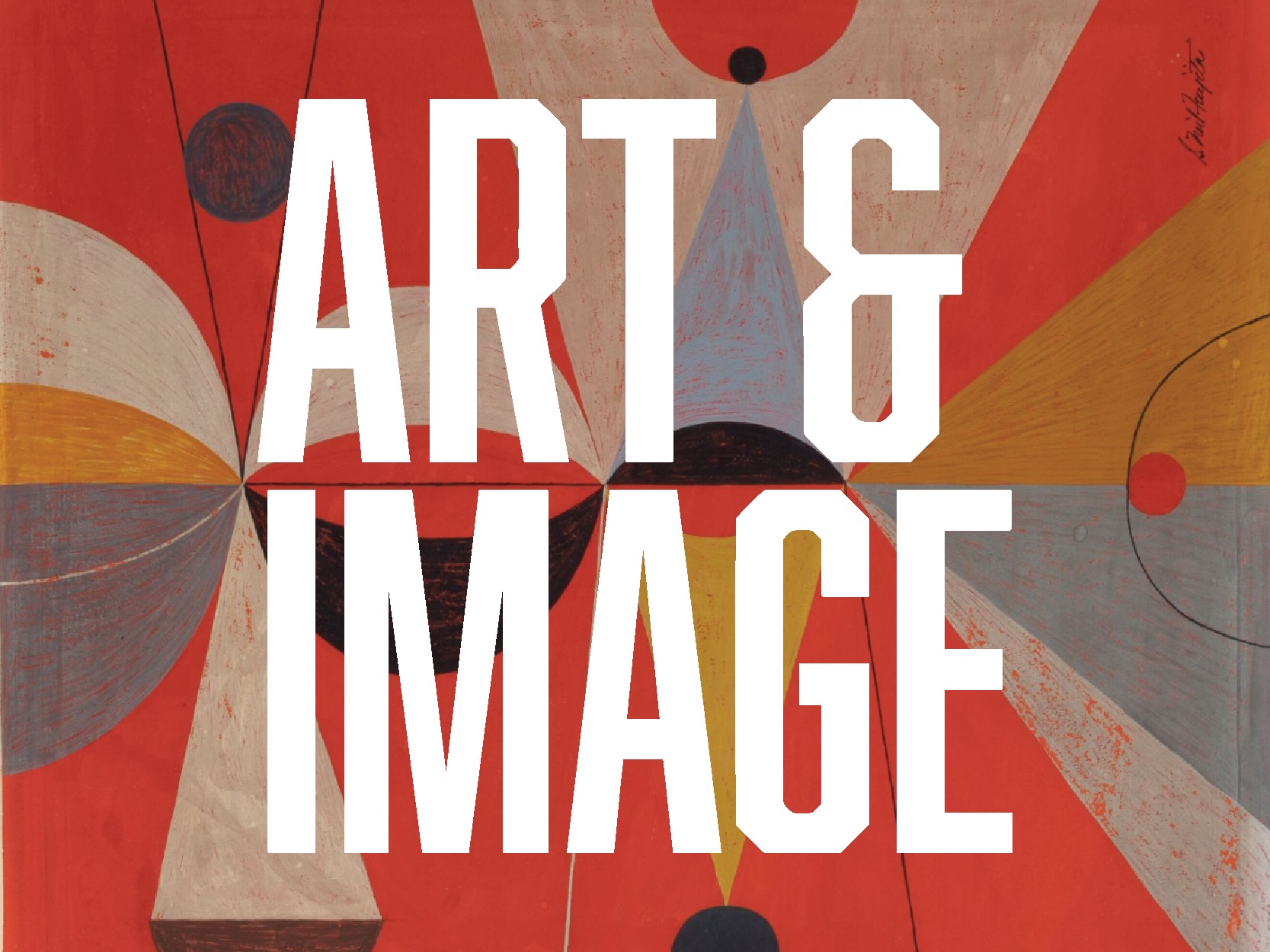
Not all New Deal paintings were representational. Included in the show is Arshile Gorky’s study https://www.moma.org/collection/works/32859 for part of a larger cycle of 10 murals painted on canvas, entitled Aviation: Evolution of Forms under Aerodynamic Limitations, completed between 1935-1937, for the then new airport in Newark, New Jersey. It is decidedly modern and abstract, impacted by European modernism, and was one of the first murals in a modernist style created and installed under the sponsorship of the Works Progress Administration’s Federal Art Project. It was typical for WPA murals to be painted on canvas and then installed later at the site.
Gorky worked for the WPA until 1938 when the rules changed to exclude immigrants. The murals were eventually destroyed in one way or another. However, in 1973, two were discovered under 14 layers of wall paint and restored, residing today in the Newark Museum of Art, calling for yet another road trip!
Also representing the more contemporary style is Charles Joseph Biederman’s String Relief (White and Blue), 1936. Biederman was not a WPA artist, but his work was well known by NYC modernist artists, many of whom were in the AAA, the American Abstract Artists organization, along with Biederman and Gorky, and many of whom, like Gorky, also worked for the WPA. Seeing both this piece and Gorky’s study reminds viewers that there were artists, both in the easel and mural divisions and especially in NYC, who wanted to create with the new modernist language learned either directly from European artists who came to the United States to avoid the growing fascism that eschewed abstraction and expressionism, or from those American artists who had travelled abroad and had direct experience in Europe with the new styles of Expressionism, Cubism and de Stijl to name just a few movements. The AAA artists were committed to geometric styles of abstraction, not Surrealism or Expressionism, and this can be seen in the Biederman and Gorky works in the Citizen Artist exhibition.
While many artists of the WPA, especially those in regions away from major metropolitan areas, worked within more figurative and representational styles, these programs, which included male and female visual artists as well as those in the performing arts, were instrumental in the blossoming of the arts in the U.S. following World War II, with New York City becoming a world center for avantgarde painting and sculpture.

Some of the WPA artists were still active when CETA was created. Many of the more established artists received funding from the National Endowment for the Arts, established in 1965, through each state’s individual artist grants. However, CETA’s decentralized approach funded and trained up and coming artists and relatively new organizations that needed a boost. Some were in Philadelphia, such as the Painted Bride Art Center, the Brandywine Workshop, and Philadanco. NYC utilized CETA funds through its Cultural Council Foundation. Well known Philadelphia artist Blaise Tobia was active in New York City at the time, part of the Cultural Council Foundation Artists Project’s Documentation Unit. Along with two other photographers and three writers he recorded performances and artist projects funded by CETA in the late 1970s in NYC. For instance, Tobia documented an exhibition curated by Ursula von Rydingsvard in 1978 in Battery Park. It showcased large-scale works by both CCF and CETA artists. One of his images is that of von Rydingsvard’s installation.
The Cultural Council Foundation operated in all five boroughs and CCF employed the most artists in NYC during the CETA period. There were subcontractors for CCF too, extending the impact of these government funds. Text in the Citizen Artist exhibition explains CETA activities. CETA arts funding arrived in Delaware in early 1975, and like in NYC, artists and administrators used CETA funding to extend its reach through collaborative programs. Photography played an important role in CETA. Artists could experiment with photographic works that were not documentary in subject and expression as well. Delaware photographer Carson T. Zullinger contributes a 1979 untitled evocative image of a nude female sitting in a chair by a window. The museum displays a work by Flash Rosenberg, a Delaware artist who has lived in NYC for many years, Bicentennial Metroscope: Portrait of the Concept, c. 1976. It is a conceptual series of images that addresses the camera’s lens and photographer’s eye, both literally and metaphorically.
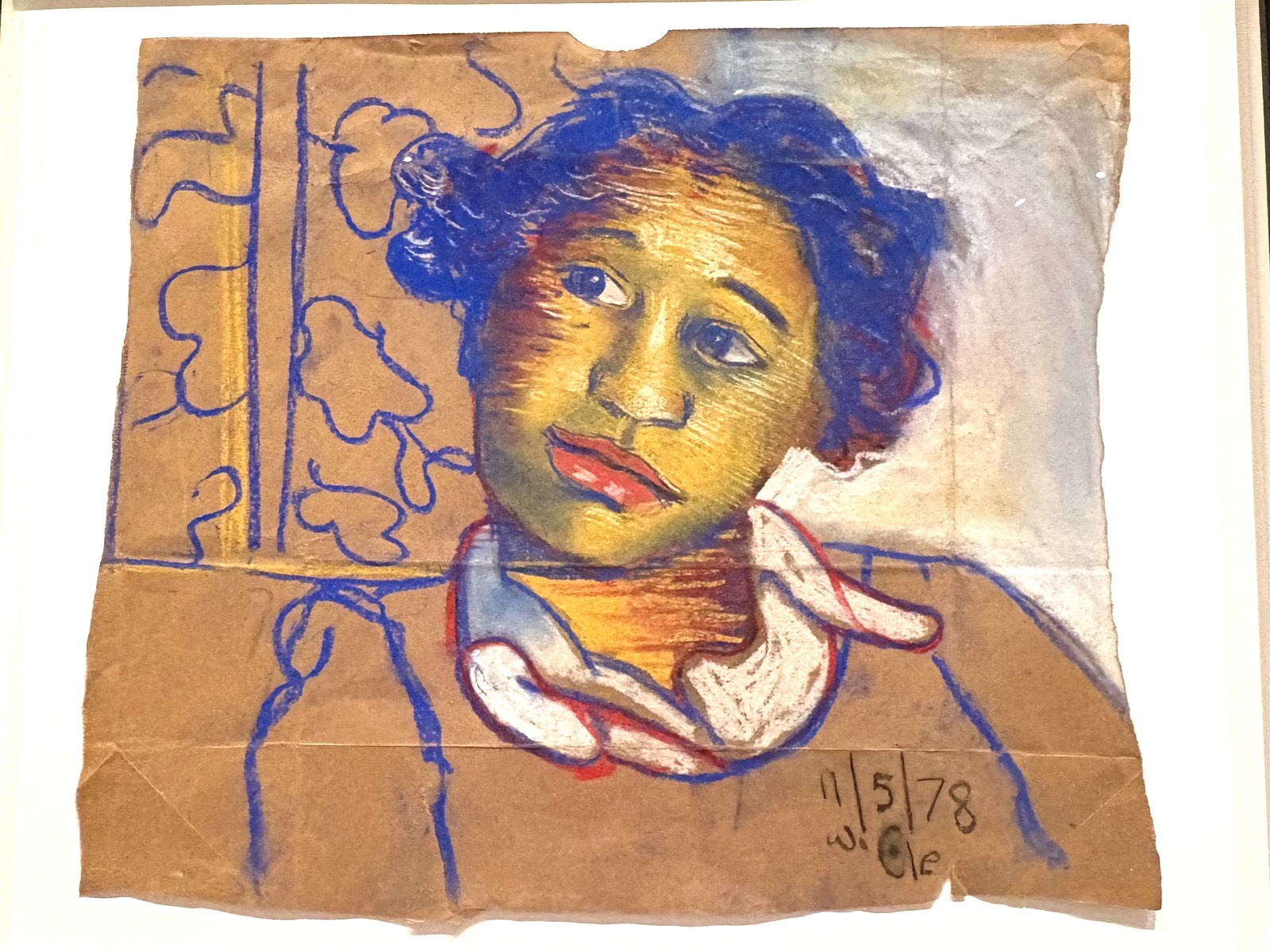
Although photography was front and center during this period, CETA also funded other forms of the arts. Willie Cole was a CETA employee in Delaware and two of his works from this period can be seen in the exhibition, one of his brightly colored pastel portraits of family and friends, that of Yolanda, November 5, 1978, and his acrylic painting, Bird on a Wire, May 1978. It was during this period that Cole lived in Newark, Delaware working for The Steppingstone Theatre Arts Company.
Because of CETA’s decentralized organization, many important stories are yet to be uncovered. Hopefully this exhibition will encourage those who participated in the CETA programs as either administrators or artists to come forward with new information.
Citizen Artist is a comprehensive exploration of the way that the arts have created community and impacted both individuals and even governments. The closing statement in the epilogue for the project is: “Citizen Artist threads the lines of creativity, innovation, and collaboration across these generations and encourages us to amplify and imagine new possibilities for artist’s roles today.” A visit to the Delaware Art Museum is well worth the journey.
Apr 11, 2026 - Jul 19, 2026
Location: Fusco Gallery, Delaware Art Museum
Free with admission
https://delart.org/event/citizen-artist/
Sign up for one, two or three day participation in the Citizen Artist Summit at the Delaware Art Museum.
Jul 9, 2026 - Jul 12, 2026 delart.org/event/citizen-summit/
“The Works Progress Administration,” American Experience, PBS, n.d.
Dulce Román, “Spotlight on Women Artists of the WPA,” Harn Museum of Art, Coffee with the Curators,” c. 2020, https://harn.ufl.edu/resources/spotlight-on-women-artists-of-the-wpa/
“WPA Art Collection,” U.S. Department of the Treasury, n.d., https://home.treasury.gov/about/history/collection/paintings/wpa-art-collection
“The Forgotten Federal Artists, CETA and Arts Employment,” January 20, 2026, https://ceta-arts.com/
Tristan Bove, “One American loses their job for every 6 immigrants removed from the workforce as researchers see ‘no evidence’ that ICE is helping the economy,” Fortune, May 5, 2026, 2:04 PM ET, https://fortune.com/2026/05/05/ice-deportations-us-born-job-losses-study/
Edward Lempinen, “Fascism shattered Europe a century ago — and historians hear echoes today in the U.S.,” UC Berkeley News, September 9, 2024,
Robert Reich, “America has reached a tipping point on fascism – and on opposition to it,” January 27, 2026,” https://www.theguardian.com/commentisfree/2026/jan/27/america-tipping-point-fascism-opposition
Casey Kuhn, “Library book ban attempts are at an all-time high. These librarians are fighting back,” April 15, 2024, https://www.pbs.org/newshour/arts/attempts-to-ban-books-are-at-an-all-time-high-these-librarians-are-fighting-back
“The Dust Bowl,” National Drought Mitigation Center, The University of Nebraska, 2026, https://drought.unl.edu/dustbowl/
“Resettlement Administration,” Wikipedia, last updated April 6, 2026, https://en.wikipedia.org/wiki/Resettlement_Administration
“Newark Airport Administration Building Murals at Newark Museum – Newark NJ,” Living New Deal, https://livingnewdeal.org/sites/newark-museum-aerial-map-mural-newark-nj/
Susan Isaacs is retired from teaching art history and museum studies at Towson University. She curated many exhibitions for the Department of Art + Design, Art History, and Art Education Galleries as well as numerous institutions across the United States and abroad. She writes and publishes on modern and contemporary art. Isaacs holds a four-year certificate of Fine Arts from the Pennsylvania Academy of the Fine Arts in Philadelphia in painting and B.A., M.A., and Ph.D. degrees in art history from the University of Delaware. Believing that it is never too late to follow one’s dream, she also completed an M.F.A. in studio art at Towson University as an interdisciplinary artist working in printmaking, books, painting, and fabric sculptures. She has shown her own artwork in venues mostly on the East Coast. Employing organic abstract forms, she creates joyful worlds with intense colors and exuberant compositions.
Want to stay in the know about Philly’s visual arts scene? We’re developing a semi-regular Art & Image Newsletter - featuring interviews, articles, and reviews straight to your inbox!