Brian Phillips on vacant storefronts, creative infrastructure, and the future of Philadelphia’s street life
Interview by Pete Sparber

Market East has been the subject of Philadelphia redevelopment dreams for decades. Plans have come and gone. Department stores have closed. The Gallery became the Fashion District. The proposed Sixers arena rose, divided the city, and then disappeared. Meanwhile, the corridor remains what it has always been: too central, too busy, too complicated, and too important to ignore.
Walking with architect Brian Phillips along Market Street, what stands out first is not emptiness, but contradiction. The corridor may be described as underperforming, distressed, or unresolved, but it is not deserted. People are everywhere: commuters, tourists, shoppers, office workers, residents from Washington Square West and Chinatown, visitors moving between Center City and Old City. “It’s too centrally located among enough things,” Phillips said. “Even if it’s underperforming from whatever economic barometer people want to hold it to, it’s a busy place.”
That tension between vacancy and vitality sits at the center of Meantime, the nonprofit Phillips founded to activate vacant storefronts with short-term creative and entrepreneurial uses. The premise is deceptively simple: while landlords wait for long-term tenants, why allow street-facing spaces to sit dark? Why not use that interim period…the meantime…to bring life, activity, experimentation, and local character back to the sidewalk?
For Phillips, who founded the Philadelphia architecture firm ISA more than two decades ago, Meantime grew out of years of thinking about cities, housing, storefronts, public life, and the changing role of brick-and-mortar space. “I think Meantime was born out of this observation that commercial space is being threatened in a certain way,” he said. “All we talk about is how tough housing is. I think commercial space is equally tough.”
The problem, as Phillips sees it, is not that landlords are unwilling to participate or that artists and entrepreneurs lack ambition. Rather, both sides are operating within systems that make perfect sense from their own perspectives. Property owners are often seeking stable, long-term leases that support the economics of their larger buildings, while emerging retailers, artists, makers, galleries, and cultural producers may need something very different: a chance to test an idea, meet an audience, host a short-term project, or prove a concept without assuming the financial risk of a multi-year lease. Meantime's role is to bridge that gap by lowering the risks and barriers for everyone involved.
In many new mixed-use buildings, the economics of the ground floor can be surprisingly secondary. A building with hundreds of apartments above may remain financially viable even if its retail spaces sit vacant. From a spreadsheet perspective, a landlord may choose to wait several years for the right long-term tenant rather than lease temporarily at a lower return. From the street, however, the cost is obvious. A dark storefront changes how a block feels. It affects whether people linger, whether they cross the street, whether they return, whether the city feels open or closed.
Phillips puts it more directly: “Street-facing storefronts don’t belong just to a building owner. They belong to the street. They belong to the community.”

That statement may sound philosophical, and Phillips is comfortable speaking in civic terms. But Meantime’s usefulness is highly practical. The organization reduces risk and complexity on both sides. It evaluates spaces, works through permitting and certificates of occupancy, helps oversee improvements, carries insurance, and creates agreements with both the property owner and the programmer. The landlord does not need to negotiate directly with a small operator. The creative entrepreneur does not need to navigate every legal, insurance, and access issue alone.
“We do all that,” Phillips said. "Meantime will handle everything from soup to nuts: evaluate the space, get a zoning permit, make improvements, help supervise improvements, get a certificate of occupancy, hold the insurance. We have an agreement with the owner, and we have an agreement with the programmer. The programmer and the owner never need to have an agreement."
That intermediary role may be the real innovation. Meantime is not merely finding empty stores and filling them. It is creating a bridge between two worlds that often cannot easily reach one another: commercial real estate and small-scale cultural production.
The initiative also differs from the familiar artist-led revitalization story. In SoHo, Tribeca, parts of Detroit, and countless other places, artists moved into cheap, underused industrial space, created cultural vitality, attracted attention, and eventually helped trigger gentrification that priced many of them out. Meantime is not that exact model. It is not about artists occupying whole warehouses or districts for decades. It is about the ground floor; the storefront as civic interface.
Phillips recognizes the distinction. In SoHo, he noted, “it wasn’t just first floors. It was literally the whole real estate.” Meantime works in a different condition: dense urban neighborhoods where residential, office, institutional, and commercial uses already exist, but where vacant storefronts undermine the experience of the street.
The question becomes: what kinds of uses make a city feel like itself?
Phillips is skeptical of the idea that every downtown should chase the same global brands. He is not against major retail. Walnut Street, he noted, can and should compete as a shopping destination. But the value of a city is not built solely through recognizable names. “People do want to feel like they’re in Philadelphia or Chicago or Toronto or Tokyo in a really genuine way,” he said. “Part of what’s on the street and who the commercial users are makes you feel that way.”
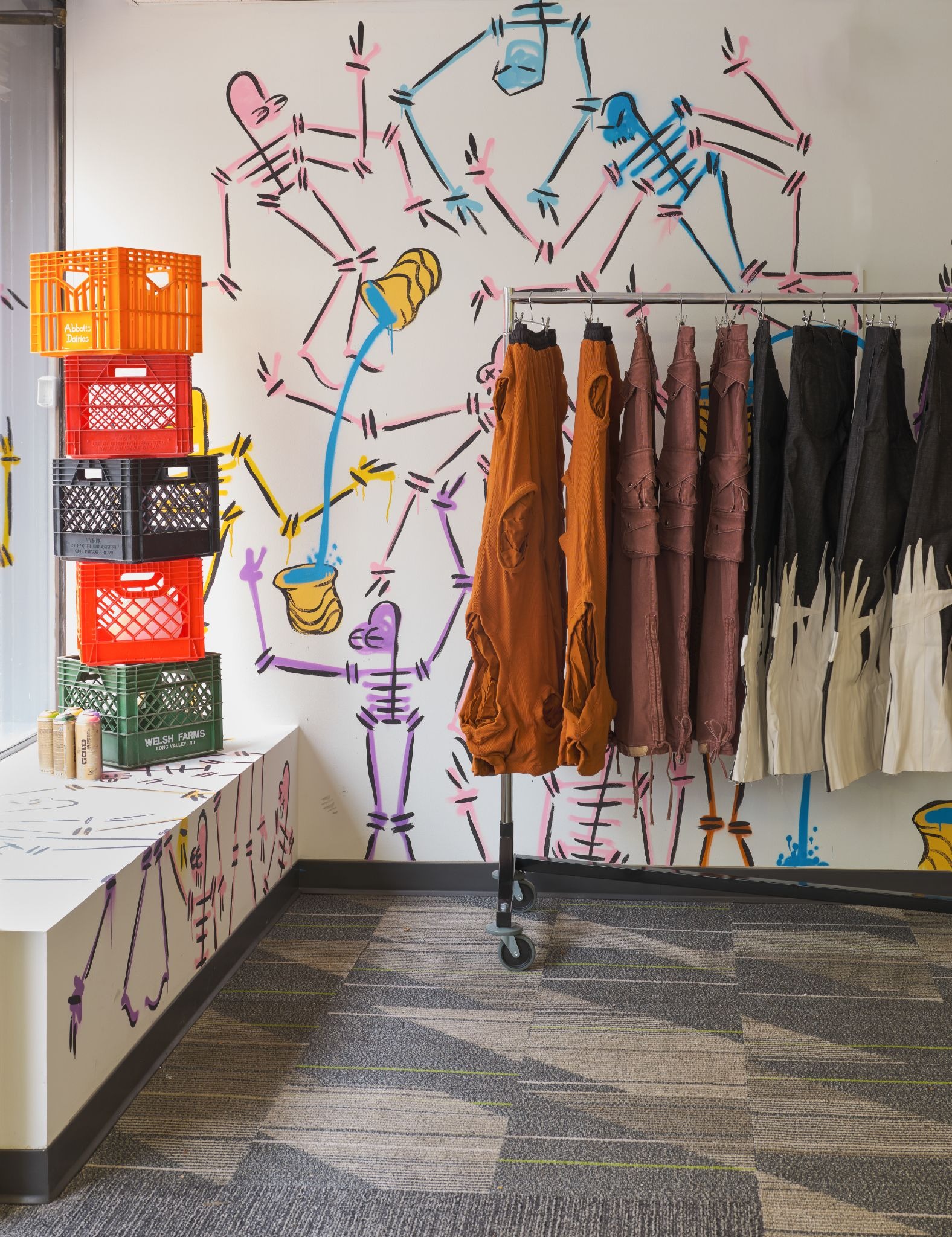
That is where Meantime becomes especially relevant to Philadelphia’s visual arts ecosystem. The project is not only for retailers selling products. Phillips distinguishes between transactional retail and what he calls “cultural producers”, people or organizations that may need public-facing space for workshops, exhibitions, performances, listening rooms, meetings, pop-up galleries, or other forms of gathering.
A temporary storefront might become a record shop and listening room, an immersive installation, an upcycled fashion retailer, a furniture showroom, a coffee concept, or an experimental gallery. It might be a three-month business test, or a one-night event nested inside another activation. It might lead to a lease. It might simply allow an artist, organizer, or collective to understand its audience better.
“There’s a difference between someone who wants to test something in a storefront as a business, versus someone who’s interested in doing a shorter add-on event or program,” Phillips said. “Are you a retailer looking to sell something through transactions, where foot traffic matters? Or are you a cultural producer looking for a place to meet the public, or to do workshops, or frankly, open an art gallery for 30 days?”
That possibility is where the initiative begins to feel less like retail strategy and more like creative infrastructure.
For artists, collectives, galleries, and cultural organizations, the implications are significant. Many have ideas but lack access to affordable space. Others may not want permanent space at all. A collective might want to mount a short exhibition. A maker might want to test direct sales. A curator might want to stage a temporary project in a neighborhood context. A musician or organizer might want a room for listening, performance, or gathering. A nonprofit might want to meet the public outside its usual institutional setting.
Meantime’s website now includes forms for three groups: programmers interested in activating space, building owners interested in making space available, and funders interested in supporting the work. Phillips acknowledged that the response has been substantial and that the organization is still catching up with the level of interest. But the invitation is clear: if you have an idea that could benefit from a short-term storefront, Meantime wants to know about it.
The timing matters. Philadelphia is entering an unusually visible period. Center City is seeing major residential and commercial investment. The semiquincentennial, FIFA World Cup, and a year of civic and cultural programming are bringing renewed attention to the city. At the same time, Market East remains unresolved; a corridor full of symbolic weight, practical challenges, and untapped possibility.
Meantime on Market, supported by city funding and launched with partners including Center City District, is a visible test case. Six storefronts on the 900 block of Market Street have been activated with local concepts, ranging from retail to art installation to food and music-oriented experiences. For Phillips, however, the larger question is not simply whether one summer’s pop-ups generate foot traffic. The question is whether Philadelphia can learn to value street-level activity as part of civic health.
The scale question is real. “Ten connections doesn’t remake a city,” I suggested during our conversation. “But a few dozen might transform a neighborhood, and a couple hundred could shift a city.”
Phillips said Meantime is already beginning to scale. Last year, the organization worked with two storefronts. This year, it has been involved with a dozen, with funding for more. “I think we’re finding a groove,” he said. “In theory, we could be at the scale of 20 this year.”
Scaling, though, is not just about numbers. It is about whether the model can preserve the local, idiosyncratic, experimental quality that makes it compelling in the first place. Phillips does not want Philadelphia to become a sanitized retail environment. Quite the opposite. He wants the city to understand and amplify what is already distinctive about itself.
He points to Philadelphia’s food scene as an example. The city did not become nationally recognized by imitating New York or Boston. It succeeded by elevating what was already here: a mix of serious talent, immigrant entrepreneurship, neighborhood specificity, affordability, and bottom-up energy. “Philly really spanked it in every food award you can imagine,” he said. “Can art and design be the next thing after food where we really get the right storytelling?”
That question connects Meantime to a much broader civic challenge. Philadelphia has extraordinary artists, makers, musicians, designers, fabricators, and cultural organizations. But its creative identity is often under-articulated, even to people who live here. The city is rich in production but weaker in visibility. It is a place where things are made, but not always a place where the story of that making is clearly told.
Phillips sees that as an opportunity. “Philly is a place where people make things,” he said. “It’s not a place where people sell. The question is what you do with that … making that visible, supporting it, making it into a thing where people are like: this is an amazing creative making city.”
That idea may be Meantime’s deeper promise. It does not solve affordability. It does not replace long-term artist space. It does not, by itself, create a mature art market or a fully supported cultural economy. But it does open a door. It creates an intermediate condition between invisibility and permanence, between idea and institution, between vacant space and civic life.
For landlords, it offers a way to activate underused property without abandoning the search for long-term tenants. For small businesses, it offers a lower-risk test. For artists and cultural producers, it offers public-facing space that might otherwise be unreachable. For neighborhoods, it replaces blankness with activity. For the city, it suggests a model of development that is lighter, faster, more local, and more experimental than the mega-projects that have so often dominated Market East’s history.
And for Philadelphia’s visual arts community, it raises a useful challenge: what would you do if the threshold to space were lower?
Phillips is not arguing that temporary activation replaces long-term cultural infrastructure. But he does seem to believe that the temporary can reveal what wants to become more permanent. In a city that often waits for perfect plans, Meantime asks a more immediate question:
What can happen now?
Or, more precisely, what can happen in the meantime?
Meantime works with programmers, building owners, and funders interested in activating vacant storefronts through short-term creative, cultural, and entrepreneurial uses.
Artists, makers, curators, collectives, galleries, cultural organizations, small businesses, property owners, and potential supporters can learn more and submit interest forms through Meantime’s website:
Want to stay in the know about Philly’s visual arts scene? We’re developing a semi-regular Art & Image Newsletter - featuring interviews, articles, and reviews straight to your inbox!