.jpeg)
June 26 - July 24, 2026
By Sharon Garbe
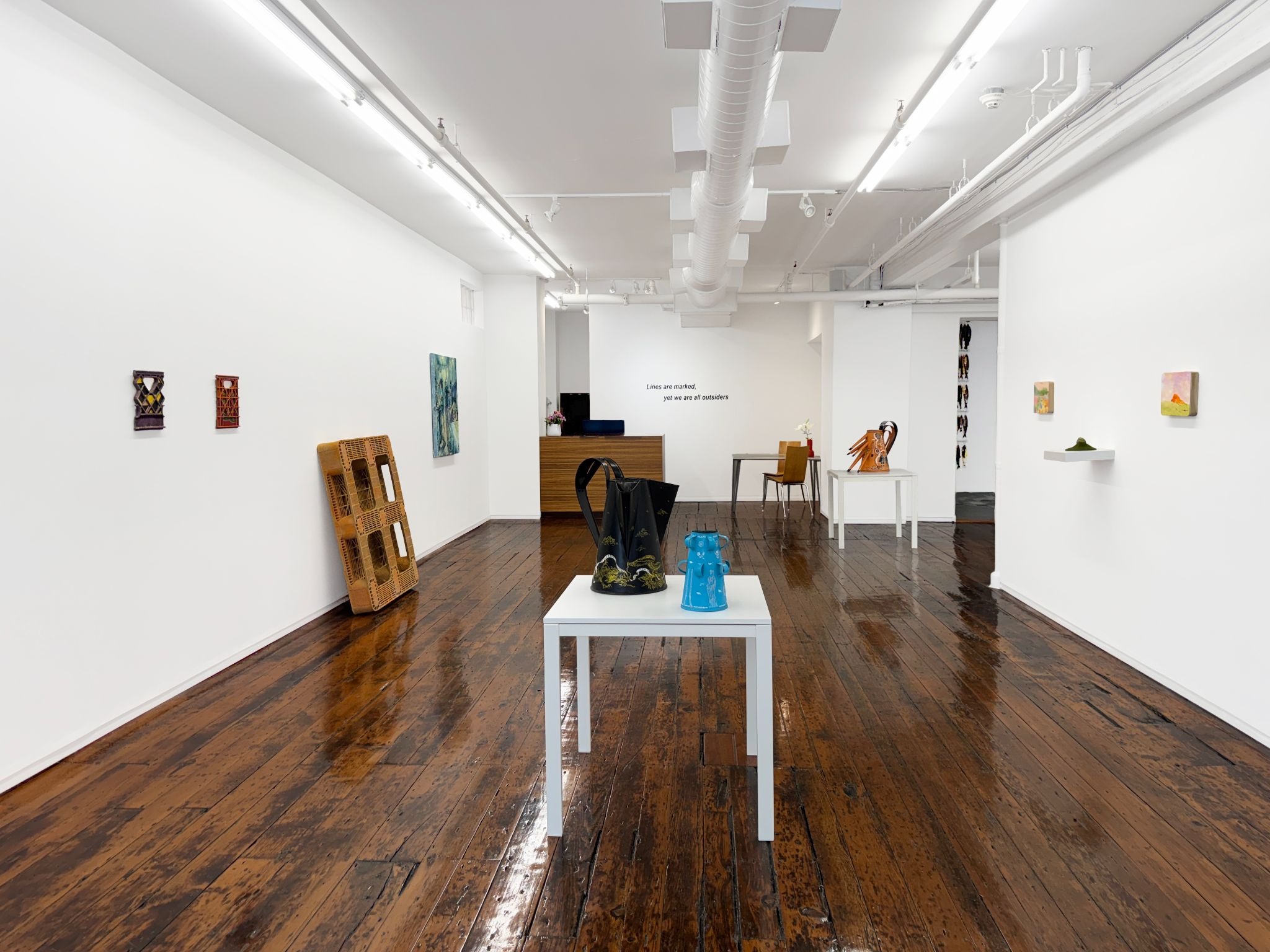
This summer open call celebrates the nation’s 250th anniversary through a survey of the diversity around us. Looking at this show of 10 Pennsylvania artists felt like wandering into a party where no one knows each other but everyone seems interesting. There are 25 works in a variety of mediums. As I looked, similarities came into focus and I started match-making.
Two artists employ flocking in their work. Jody Joyner’s transformations of a shipping pallet and crates produces a dystopian fuzzy logic about their use and purpose. Nearby, Cobi Moules’s two small sci-fi landscape paintings accompany two other works of his that incorporate flocking and silicon. All together they suggest the slow, persistent resilience of nature.
Speaking of the natural world, two other artists use floral motifs to convey domesticity and history. The paintings and sculpture of Natessa Amin merge early American piecework and South Asian ornamentation. The paintings have a mesmerizing kaleidoscopic beauty, and the sculpture, Line Dance, does just that. Kathleen Eastwood-Riaño’s paintings merge domestic scenes in time and space. She uses a technique of layering in Suegritos that is fitting in a gallery named after the phenomenon of recording memory and transformation. Her light-filled painting May is part of a time-bound conceptual practice that can span years.
There is a topsy-turvy verisimilitude going on in the works of Vincent Hron and Leslie Friedman.
Hron’s pseudo-realistic painting Common Ground is an accomplished mashup of two playgrounds, joined in the center by a dramatic sky, presented sideways. It makes you want to spin the painting or yourself.
Leslie Friedman’s delicate-looking, dangling screenprinted fish in the sculpture Smoked Whitefish are playful on multiple levels. They hang, shiny and fetching, like adornments on a rack. With admirable swiftness they invite questions of identity and belonging. Her Yaddah Floor piece made of screenprints on vinyl tile is a corner that juts into the space daring you to walk on the scatter pattern of hardware fastener heads mingled with Stars of David.
Considering the rest of the show, larger patterns emerged. I found it convenient to think about these works through party-goer categories: stars, oddballs, and observers. I'll illustrate these categories by going into detail about the work of the four remaining artists.
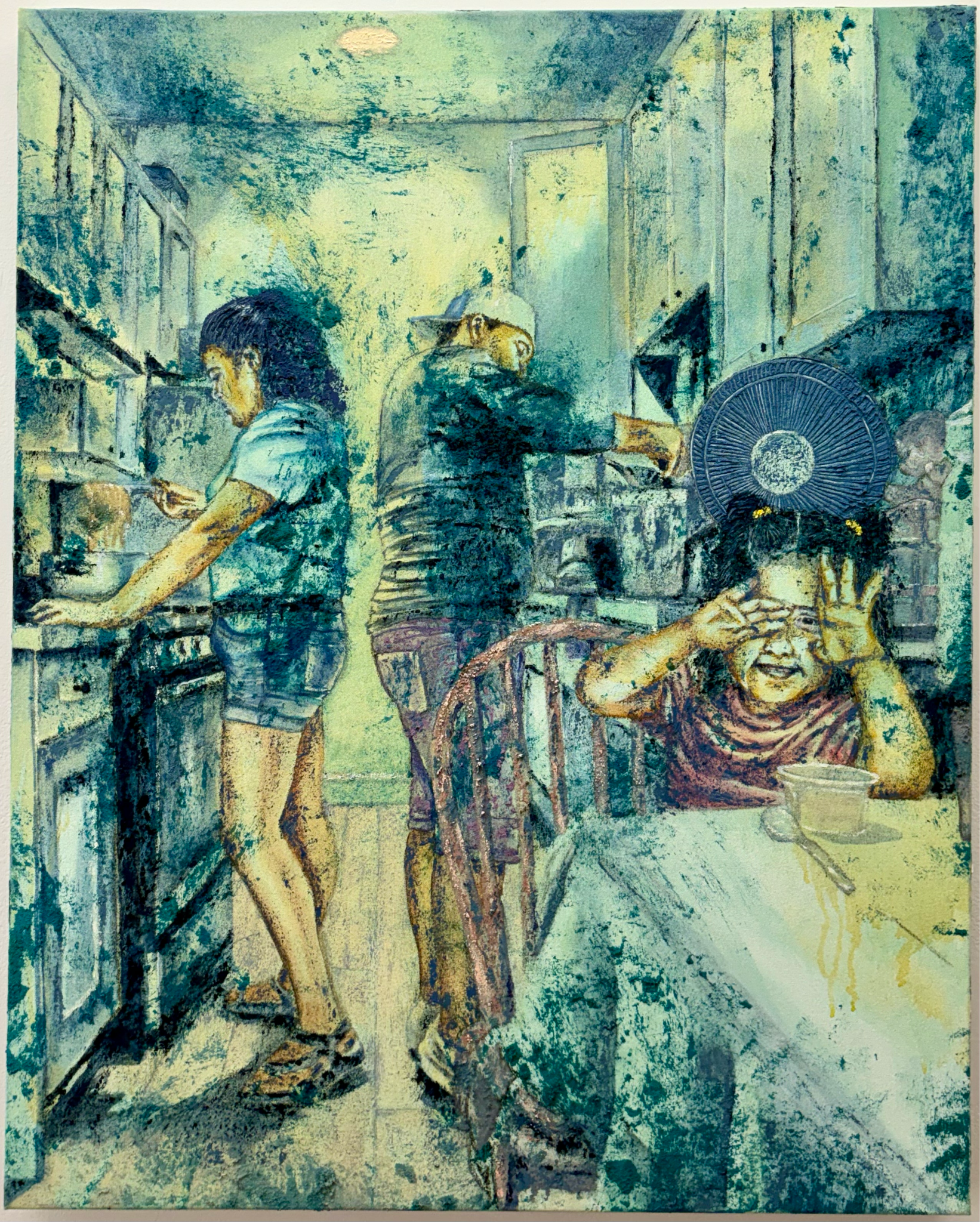
A Star
Henry Morales’s Peekaboo grabbed me and made me want to dance, even before I read that the painting’s materials include dirt from outside his cousin’s apartment in California and that he collaged news articles on immigration on the narrow edges of the canvas. The grittiness is integrated with the paint and applied somewhat randomly across the canvas. It gives the shadows literal depth while also flattening the work in an unexpected way. It calls attention to the picture plane and surface. We peer past the surface via a vanishing point perspective that draws us into a domestic kitchen where a woman and man are preparing food. The two stand back to back in easy, unspoken collaboration. The space between them glows from an overhead light and casts highlights that faithfully render the figures’ details. In the foreground a young girl engages us in a game of peekaboo. Just as actual surface and implied depth coexist, the child’s playful gesture calls to mind the concept of object permanence. People exist even when they are out of sight.
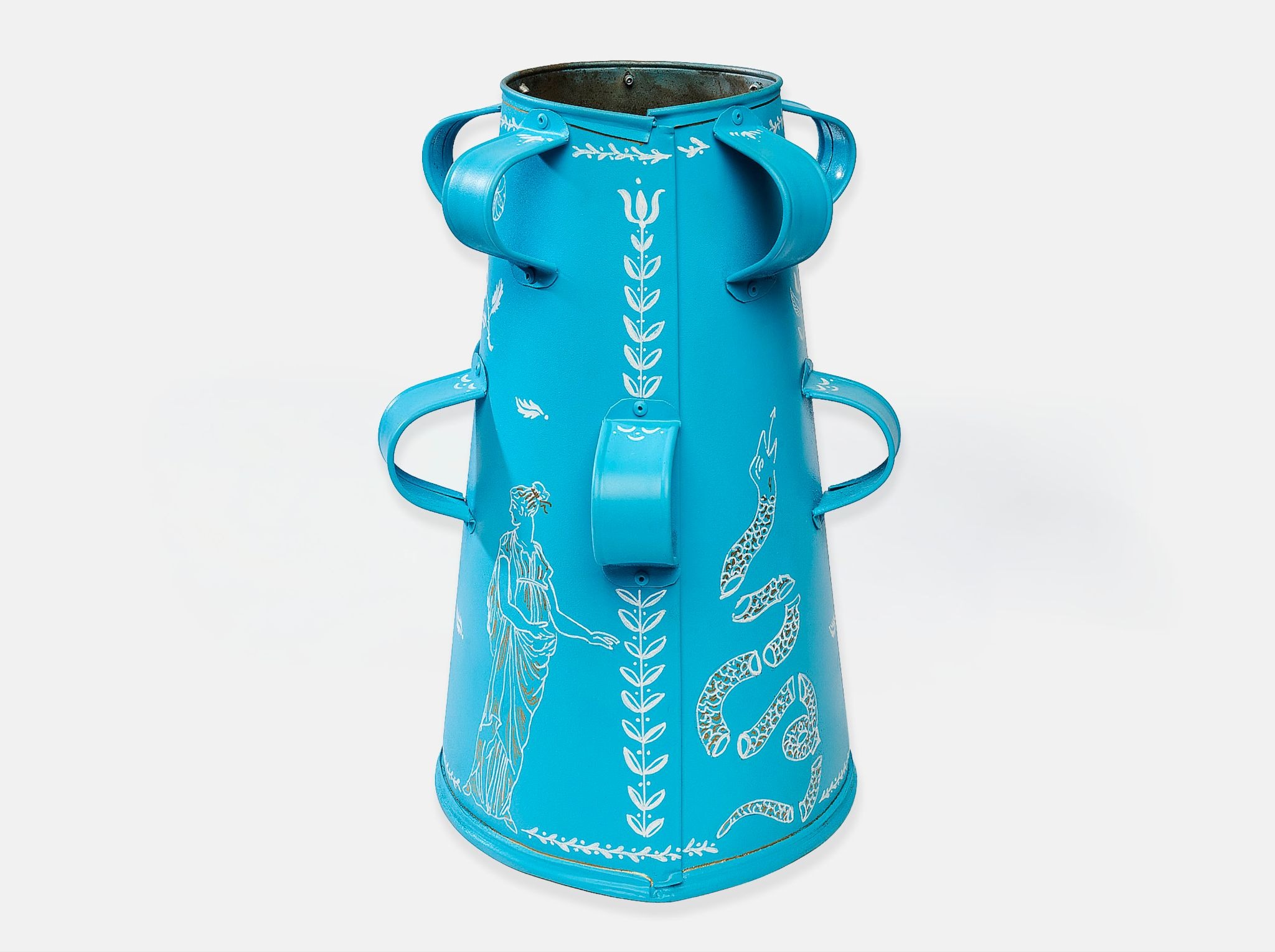
An Oddball
Jonathan Wahl’s absurdist toleware (for example, vessels with multiple useless spouts or handles; decorated with images such as Franklin’s “Join, or die” snake mingling with an ancient Greek woman wearing an elaborate chiton) is fitting for a show that slyly acknowledges the 250th anniversary of the signing of the Declaration of Independence in Philadelphia by gathering a group of diverse contemporary Pennsylvania-based artists. Wahl’s tinsmithing is part of an art niche where subversive craft uses irony and anachronisms to comment on contemporary misdirection. The work provokes feelings that nostalgia is slippery, and it would be wise to look more closely at what seems familiar.
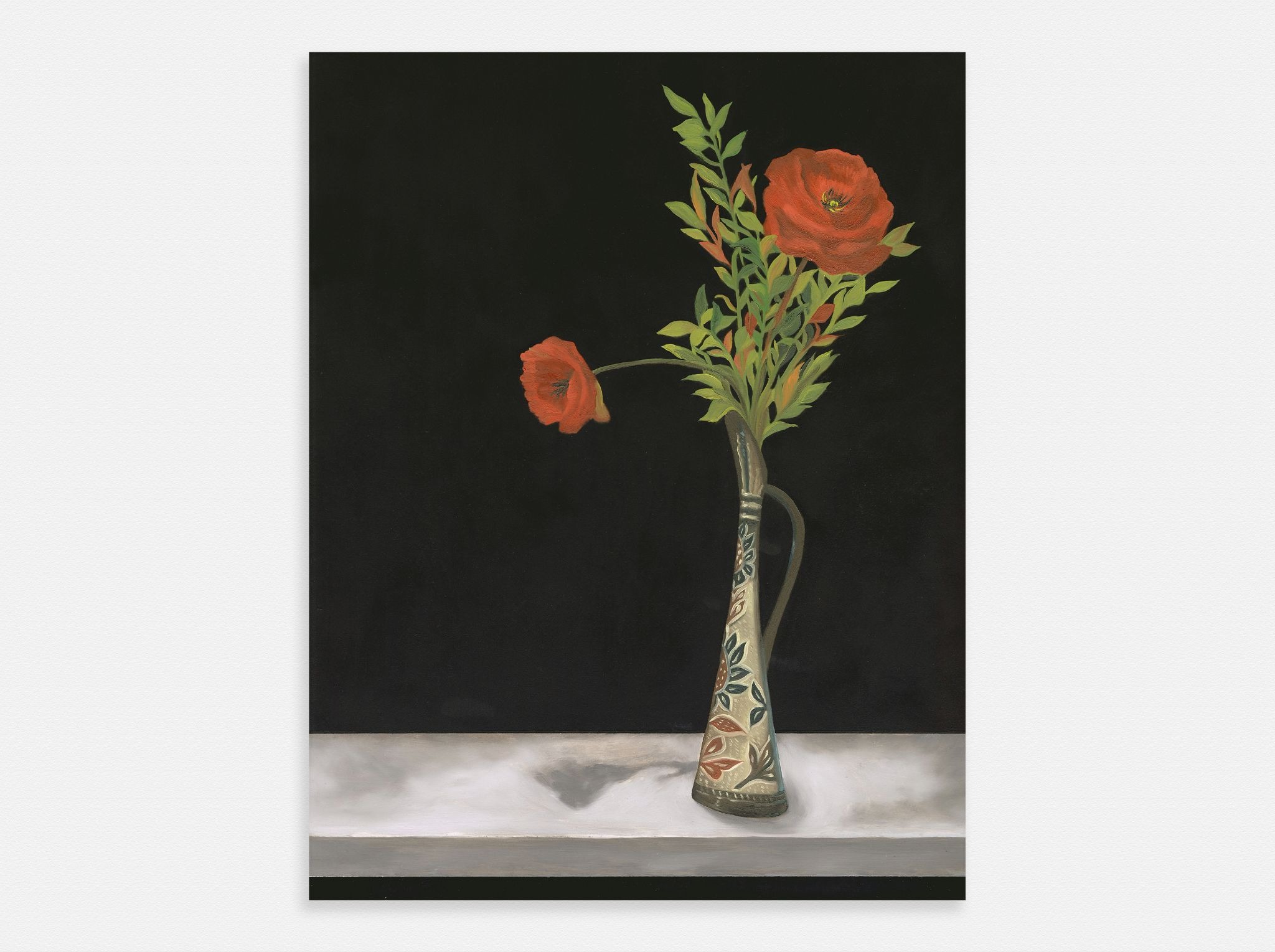
An Observer
Tania Qurashi’s painting and works on paper whisper in that way you want to lean in to understand what you’re seeing. There are three works, all are dark still lives with minimal objects. The single painting is lovely. Against a dark background, two red poppies and greenery spray out of a tall, narrow, decorated surahi vase that is off-center. Minimal shadows are cast on the light shelf or table. The painting struck me as something sweet and elegiac. Then I moved on a bit to the left and viewed her two framed colored pencil on paper pieces. I saw all her work differently. The works on paper are so hard to see. You have to get really close to them and almost reconstruct the images from impressions while looking past your own reflection. I have a bunch of photos of my reflection in the glass where I am progressively laughing more as I try every which way to shoot the image without me in it. The performance aspect of the work gave it a wonderful dimension I hadn’t expected. In the statement that is included in the exhibition materials, Qurashi mentions selecting objects that carry histories from her parents’ homelands of Pakistan and Guatemala. She mentions an interest in “how objects can be subtly personified, and become placeholders for diasporic experiences.” I don’t know if the reflective element was intentional. It doesn’t matter. It happened, and I enjoyed the immersiveness.
A Hybrid
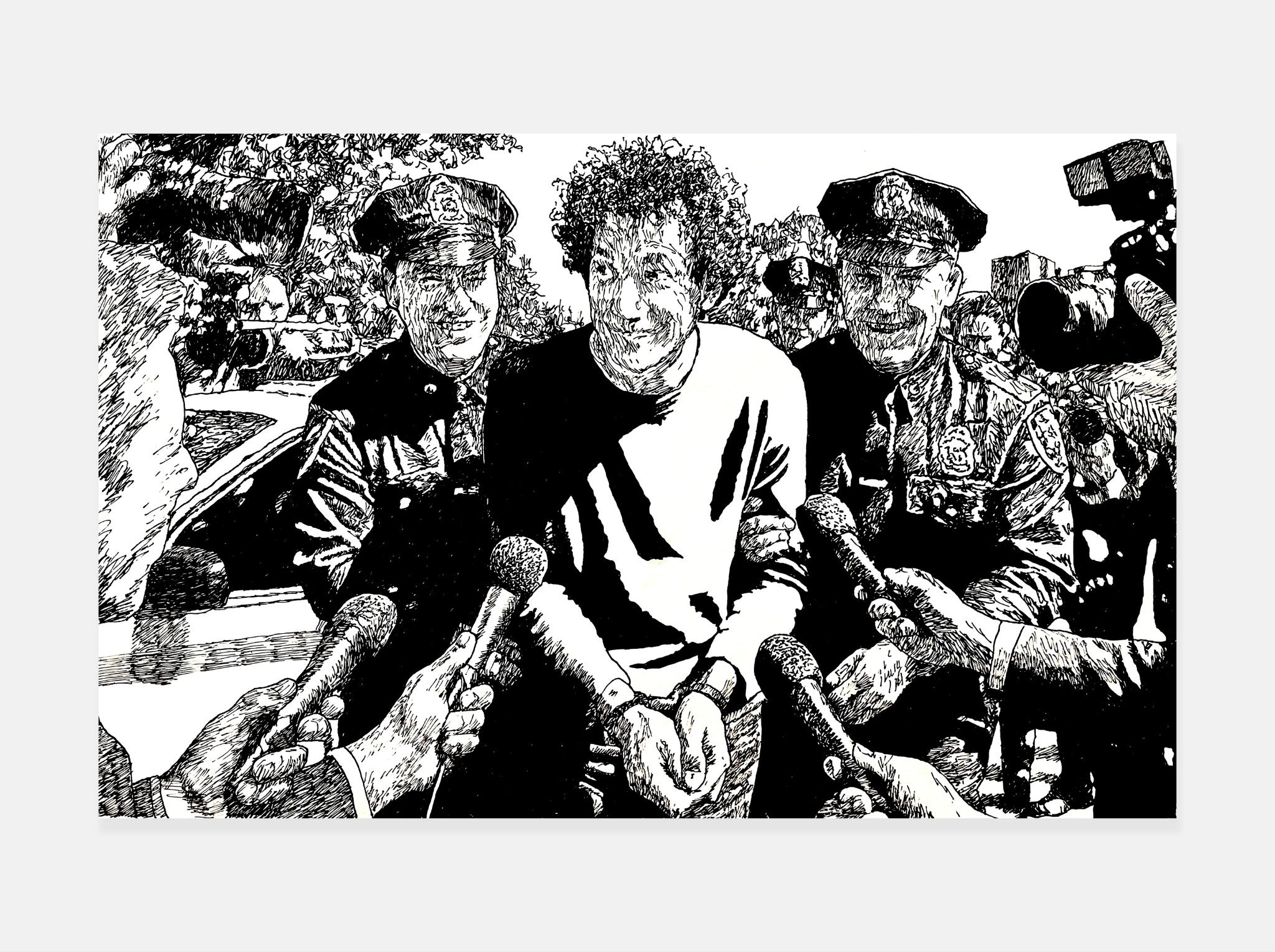
Thinking about my three categories, I try to slot the work of the other artists into them but get a little stuck with Peter Sparber’s high contrast drawings. He uses a fine line black oil pen to achieve stark renderings of media spectacles. I think that one drawing must be of Abbie Hoffman, the gleeful yippee provocateur and the unlikely friend of former president Jimmy Carter’s daughter Amy. Or maybe not? Whoever it is, our handcuffed star as well as the police flanking him are smiling as microphones are thrust at the detainee. The piece is titled The Jester. The protagonists of the other two drawings are less easy to identify, which, from reading the titles, Power and City Hall, I guess is the point. Later I confirm that Sparber is working with stereotypes, even in The Jester. (Out of curiosity, I looked at a lot of Hoffman images and saw more of a resemblance rather than a depiction.)
These works strike me as straddling all three of my categories. They are almost eye-catching but your eye never settles. Like their subject matter, their power is mediated or indirect. They are about the star-making media machine more than about specific luminaries. Sparber’s facility with the thin black line and white ground impressively captures everything from architectural details to the drapery of suits and uniforms. Despite their chiaroscuro and representational imagery, they convey a surprising flatness. Contour lines that alternate between white and black and the uni-directional hatch marks give the works a cartoon association. Taken all together, they have an obdurate oddness. And the artist’s method of assiduous marking has a quiet intensity.
Ten artists, twenty-five works, and a handful of loose categories that don't hold up under much pressure. Perhaps that’s the point of a show built around the 250th anniversary and the diversity it's meant to honor. Stars, oddballs, observers, and combinations all end up occupying the same room. Borders are imposed, and still porous.
145 N. 2nd St.
Philadelphia, Pa 19106
Sharon Garbe is an artist and writer who lives in NYC and visits Philadelphia often.
Want to stay in the know about Philly’s visual arts scene? We’re developing a semi-regular Art & Image Newsletter - featuring interviews, articles, and reviews straight to your inbox!