Artist, writer, curator and art historian Susan Isaacs conducts an in-depth discussion with Blaise Tobia and Virginia Maksymowicz, curators of a City Hall exhibition documenting the CETA initiative, a program that provided federal funding for artists in the 1970s.
Attention arts professionals in the Philadelphia region!
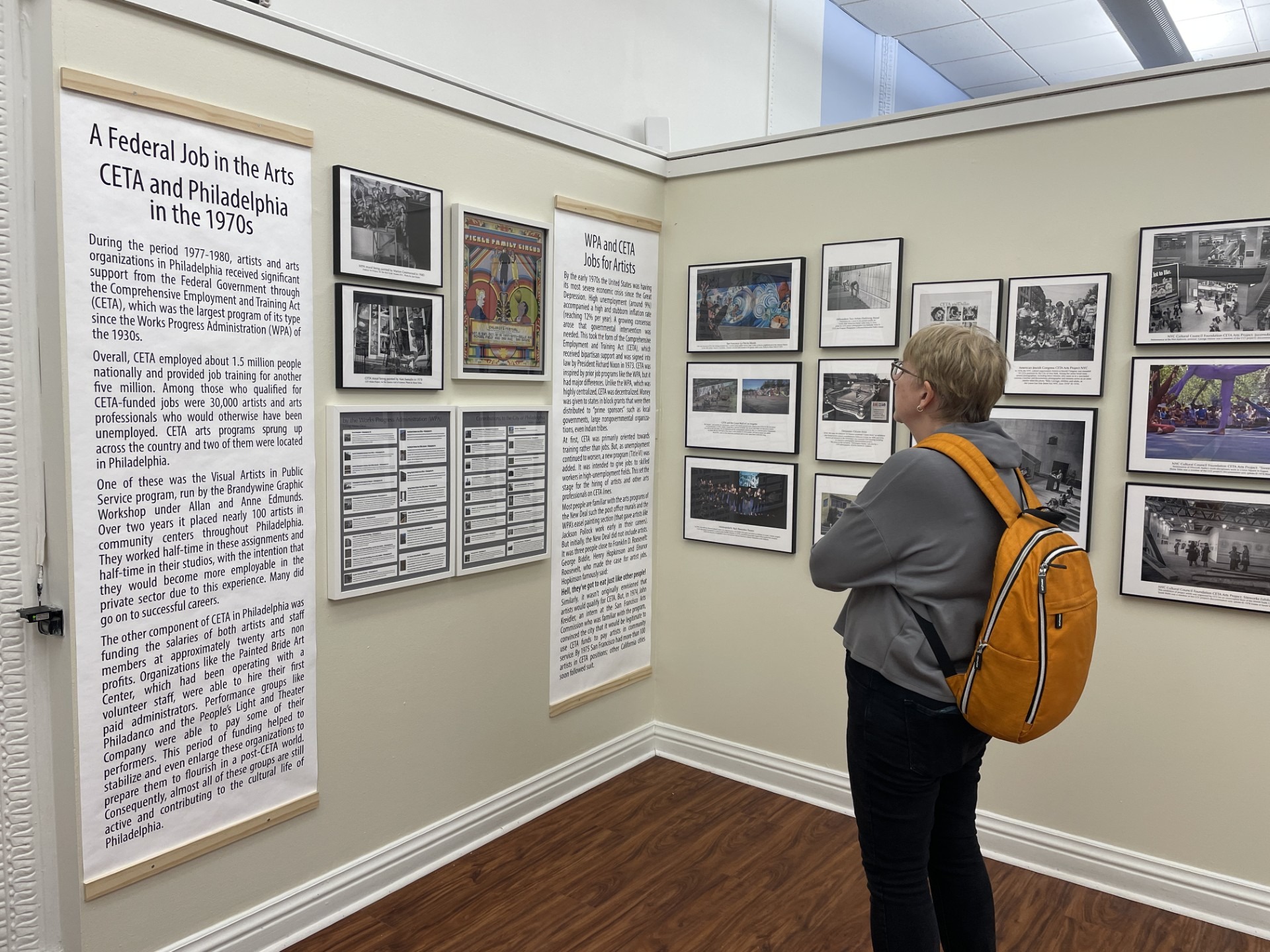
Creative Philadelphia’s Art In City Hall program is presenting an important exhibition, “A Federal Job in the Arts – CETA and Philadelphia in the 1970s,” curated by Blaise Tobia and Virginia Maksymowicz of the CETA Arts Legacy Project. The exhibit highlights the significance of the Comprehensive Employment and Training Act (CETA), the largest federally funded artists employment project since the Works Progress Administration. The WPA took place during the Great Depression under the auspices of the Franklin Delano Roosevelt administration. CETA was established under President Richard Nixon in December of 1973 and was ended by President Ronald Reagan in 1981.
Today, many people know of the WPA but have never heard of CETA. This is due in part to CETA’s decentralized approach, which did not make record keeping easy. In New York City though, five large CETA-funded projects coordinated by the Department of Cultural Affairs, with the largest employing 325 artists and administered by the Cultural Council Foundation (CCF), provided a more centralized structure than in Philadelphia and many other places. CETA funded and offered professional development to artists and organizations that needed a boost. Some of the arts organizations that received funding in Philadelphia included the Painted Bride Art Center, the Brandywine Graphic Workshop, Philadanco, and even the Philadelphia Museum of Art. Many important artists and arts professionals in a wide range of disciplines began their careers through CETA programs.
The exhibition at City Hall, “A Federal Job in the Arts,” features documentary photography and prints, and includes artworks from local CETA artists, some of whom were part of the Visual Artists in Public Service (VAPS) program run by the Brandywine Graphic Workshop, and others who worked under CETA in different cities and regions before eventually moving to Philadelphia.
Susan Isaacs interviews the curators of the exhibition, Blaise Tobia and Virginia Maksymowicz.
Susan: My first question is how did this exhibition come about?
Blaise: Well, first, the CETA Artist Legacy Project came into being around 2011 or so, when a group of us who had been in the Cultural Council Foundation project in New York City, thought, “Why isn’t more known about CETA? Why haven’t there been celebrations of it? Why wasn’t there a 25th anniversary event about it?” So, we decided we needed to get active, get the word out, and keep it from being lost to history. We met many times and we made trips to the Municipal Archives to search for documentation. Eventually we created a website under the name “CETA Arts Legacy Project.” We also wrote two Wikipedia articles, which really paid off. Two weeks after we posted to Wikipedia, we got a call from the New York City Department of Cultural Affairs (DCA) saying, “It was really interesting to read about this; we’re writing up a cultural plan for Mayor de Blasio and we’d like to include your project as one of the case studies. Can you provide us with some photos?”
So, we provided them with some photos, but then we said we really should come up to New York and talk to you. We met with them in person and found out that nobody, including Tom Finkelpearl, who was the Commissioner of Cultural Affairs at the time, knew that the DCA had been partners on the CETA arts projects in NYC.
Virginia: They were co-sponsors back in 1978, ‘79, and ‘80. We gave them a copy of the yearbook of the project which they had lost. We happened to have two copies because we had both been on the project.
Blaise: Then we launched into this whole promotional campaign — getting interviewed and writing articles. We’ve done several College Art Association panels and, luckily, we’ve been able to partner with City Lore and Artists Alliance in New York. They jointly did an exhibition about CETA three years ago. We’ve also partnered with the Living New Deal, which did a webinar with us and then sponsored a WPA and CETA arts conference in San Francisco last year.
Virginia has been collecting everything she can find — documents, articles, videos, audios, whatever — which is a challenging process because CETA was totally decentralized and there are no central repositories. She has been putting these in a Google Drive that now has over a thousand digital files in it. It’s an open access archive meant to support research, and it’s housed at the library of Franklin & Marshall College, where she taught.
Virginia: We also have physical objects from the CETA project and have lent them for shows: Citizen Artist at the Delaware Art Museum and Art/Work, recently opened at the James Gallery of the CUNY Grad Center in NYC. The curators of both of these exhibitions also utilized the Legacy Project’s digital archives in researching their exhibitions.
Blaise: About three or four years ago, Margaret Winslow, Head Curator and Curator of Contemporary Art at the Delaware Art Museum, was already thinking about doing an exhibition involving CETA artists. She brought us and the NYC curators, Molly Garfinkel and Jodi Waynberg to Wilmington to brainstorm about both that exhibition and possible additional coordinated exhibitions. She thought that 2026 would be a good year to mount these exhibitions, given possible tie-ins to the Semiquincentennial.
So, in fact, three exhibitions did actually come about this year. Given their professional staff and successful fundraising (and the WPA works they have in their collection), the Delaware Art Museum’s Citizen Artist show was excellent, as was the “Citizen Artist Summit” that concluded it. The expansive Art/Work exhibition also received significant funding and has been supported by the professional staffs of City Lore, the Artists Alliance and the James Gallery. Our exhibition at City Hall had almost no institutional support; consequently, it is more modest, but we’re proud that it’s of museum quality.
As the Wilmington show is more Delaware-focused and the James Gallery show is somewhat NYC-focused, we thought it was important that our show should highlight what CETA did for the arts in Philadelphia. All three exhibitions do include substantial material on the national scope of CETA to provide context for the local material.
Virginia: Our Philadelphia exhibition had started out as a larger project that would be supported by the art history and museum studies programs at Drexel, as well as by the Drexel Collection. It was going to take place in the Centennial Bank (the Frank Furness building at the corner of Market and 32nd Streets), which would strengthen the Semiquincentennial tie-in. But then, on April 2, 2025, came the “Friday Night Massacre” email that notified Drexel (along with hundreds of programs around the country) that their already-committed NEH and IMLS funding had been rescinded because their programs “did not align” with the priorities of the Trump administration. As a result, we were told that Drexel could no longer support the development and display of our planned exhibition.
We thought it might be off. But Tu Huynh, Curator of Exhibitions and Programs for the Creative Philadelphia Art Gallery, said: "You guys should do it here at City Hall. I trust you to do a good show." And we eventually landed on these dates. So that’s how the show evolved. Once we committed, we had a huge amount of work to do because we were not experts in what had happened under CETA in Philadelphia. And, since we then no longer had the direct link to Drexel, we lost the ability to work with Drexel faculty and students. It’s basically been Blaise and me.
Blaise: But there was a little precursor to this which we actually don’t mention in the show. About five years ago, since we had gotten to know Stephan Salisbury pretty well (who wrote on art and culture and society for The Inquirer), we convinced him to do an article about CETA and its role in Philadelphia, which he did. So that article is an early version of the show and covered a lot of the same history. Of course, we’ve gone into it in much more detail in the exhibition.
Susan: I worked for the Girls Club in Wilmington as an art teacher in the mid-70s for less than two years, and I didn’t realize it until recently, but they apparently had CETA funding; I have a feeling I may have been funded through CETA. I don’t know.
Virginia: Oh boy. It’s just so funny. CETA artists keep coming out of the woodwork! But this happens a lot because sometimes the funded organizations got just a few CETA positions, and often the people they hired didn’t realize that the money came from CETA. This is unlike the Brandywine Graphic Workshop, which knew it was CETA money and called Visual Artists in Public Service (VAPS) a CETA program.
Blaise: Actually, Boys and Girls clubs were definitely involved with CETA in Philadelphia. One of Barbara Bullock’s assignments, as part of the Brandywine program, was at the Nicetown Girls Club.
Virginia: Your experience really brings up one reason why this research is so difficult. Even major arts organizations, like the Philadelphia Museum of Art, which had 38 CETA lines for five years, has no institutional memory of that fact.
Blaise: You know the concept of dark matter?
Susan: Yes.
Blaise: Well, it turns out a lot of CETA jobs were essentially dark matter, probably including yours. For example, for a long time we thought there were just 500 CETA arts positions in New York City — 300 in our project and another 200 in four affiliated projects. Turns out there were about 620 in total — and those additional 120 were in essence dark matter. There was money going directly to borough president’s offices, money going directly to some small nonprofits. It’s made even more complicated by the poor recordkeeping that was done!
Blaise: Coming back to the work of the Legacy Project, one of the younger people we managed to inspire is Mary Okin, Associate Director of the Living New Deal. She came to our 2023 panel at the College Art Association, “Art History in Search of a Historian.” (We titled it that because we really want to get somebody to write a book about CETA’s history!) We didn’t hook any art historians to write the book, but we hooked Mary (who is an art historian) to take up the cause. She came to see that the CETA art projects absolutely were close relatives of what happened in the arts in the New Deal.
Virginia: One thing that Mary did was to organize a Living New Deal webinar on CETA, that we helped to design and participated in. We had Judy Baca talking about all the CETA money that supported the painting of the Great Wall of Los Angeles mural, and Lou Bellamy, founder and artistic director of the Penumbra Theatre Company in St. Paul, Minnesota.
Blaise: And then Living New Deal organized a “convening” in San Francisco the following spring that got funding from the Terra Foundation. Mary is really an incredible person. She has recently become a point person in the effort to prevent the demolition of the original Social Security Administration headquarters building in Washington DC. (It contains amazing murals by Ben Shahn, Philip Guston, and others.)
Virginia: We did two earlier panels at CAA, in 2019. One included Blaise and several other CCF project artists. It took place at the Hilton, at lunchtime, so that it would be open to the public. The other took place at Hunter College and included Tom Finkelpearl, Ted Berger, Steven Dubin and Rochelle Slovin, who had been the director of the CCF CETA Arts Project, and Howard Singerman, who was the chair of the art department at Hunter and had himself been a CETA artist!
It took a lot of effort to get those panels accepted by CAA. When we went through the regular proposal process, we kept getting rejected (People didn’t actually say this, but the attitude was “CETA – never heard of it. Can’t be important!”) Finally, we managed to get it on the schedule through someone I had been on a committee with!
Blaise: While all these panels, webinars, articles and exhibitions are great, CETA’s contribution to the arts won’t really get the attention it deserves until a book is published. The WPA’s arts programs weren’t widely known until Francis O’Connor’s two books on the subject came out in 1972 and 1973, 29 years after the WPA ended. We’re now 45 years after the end of CETA and still waiting for the first book!
Susan: The CETA show at City Hall has a catalog.
Blaise: The concept we are currently working on is, in fact, an anthology.
Virginia: To describe the exhibition: we have the gallery and we have the two vitrines just outside the front door to the gallery.
Blaise: The first text panel of the exhibition is an introduction to what CETA did for the arts in Philadelphia. The second panel describes how arts projects became part of the WPA in the 1930s and how artist employment became part of CETA in the 1970s. This wall includes photos of the WPA and of CETA. Apart from art, the WPA did many construction projects in Philadelphia, including major buildings like post offices and high schools. An example is the Ben Franklin Bridge, which was improved and enlarged.
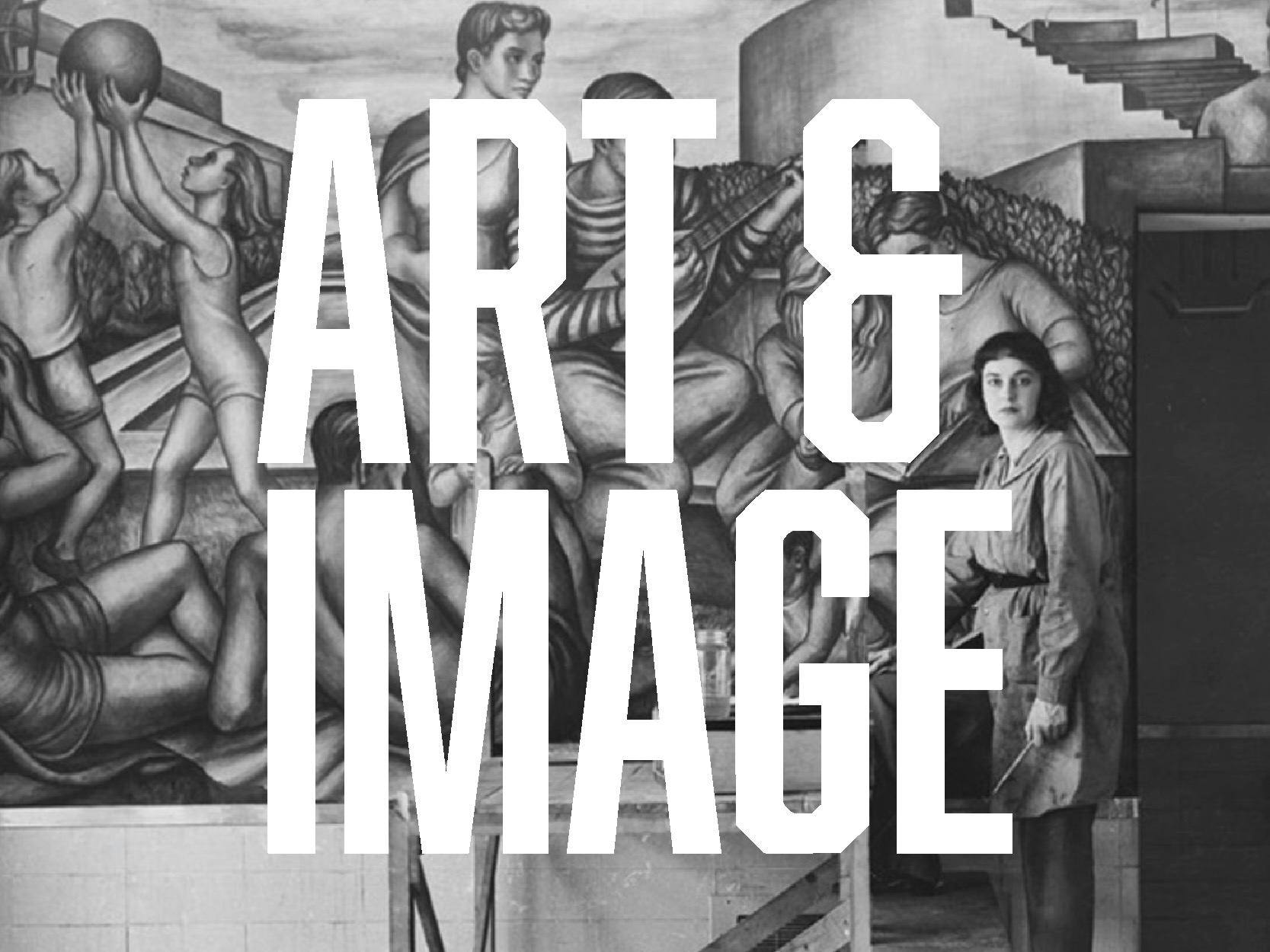
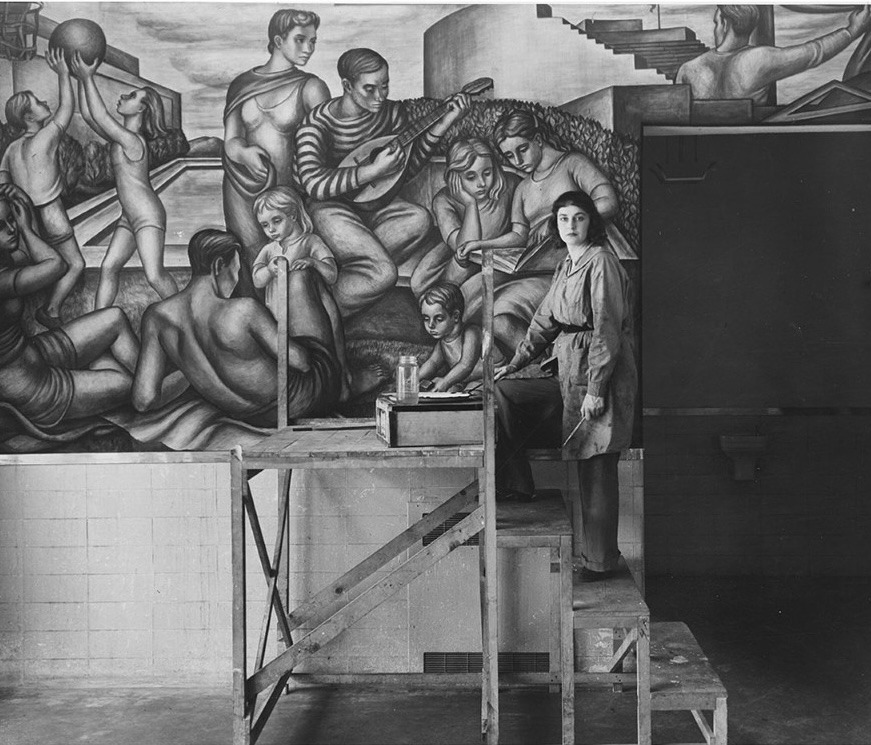
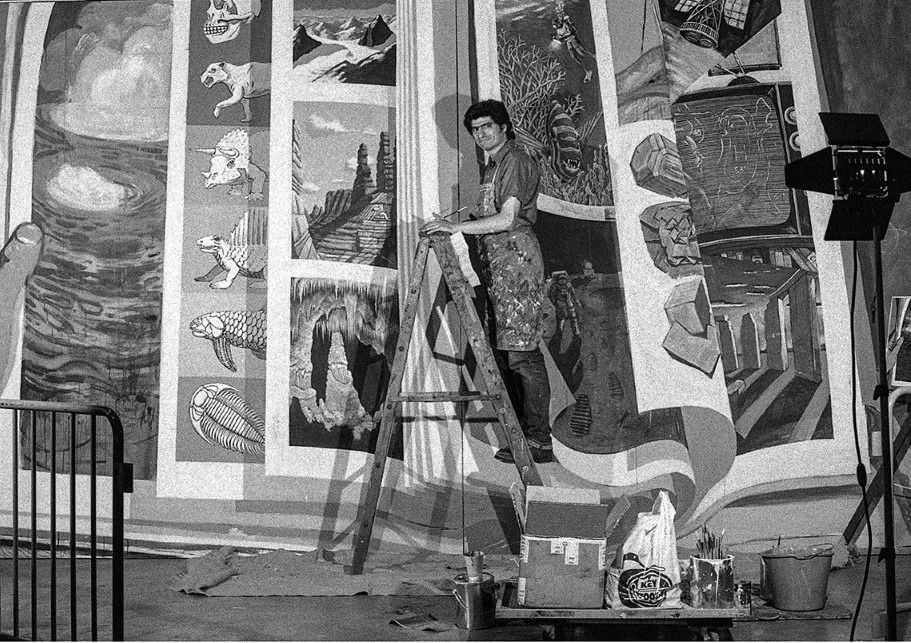
There are two contrasting photos that show a WPA muralist and a CETA muralist standing almost in exactly the same position. There is also a poster that looks like it could be WPA, but it’s actually a CETA poster from the Bay Area from around 1975, that was created for the Pickle Family Circus in San Francisco. Two of the Circus’ CETA performers were Bill Irwin and Peter Coyote who both went on to major careers.
Virginia: And Irwin and Coyote really emphasize how important CETA was. There are two videos in our archive where they talk about how CETA started them in their careers, which might not have happened without CETA.
Blaise: The third panel, on wall 2, describes how the first CETA employment of artists happened in San Francisco and then spread across the country. This wall includes photos that depict the Great Wall of L.A. mural, the Precita Eyes murals in San Francisco, and murals in Milwaukee and New Haven, CT. Also represented are documentary books put out by the Dallas and Chicago CETA programs. Several large photos cover the NYC CETA arts project that we both worked for.
Virginia: The last photo on that wall depicts a major mural — done by CETA artist Cynthia Mailman in 1979 — that was made for the escalator bank to the PATH trains under the World Trade Center. It was destroyed in the first WTC bombing in 1993. That mural has been forgotten, along with four other CETA murals in the WTC destroyed in the 2001 attack.
Blaise: The next three walls in the exhibit tell the story of the Visual Artists in Public Service (VAPS) CETA project administered from 1977-99 by what was then the Brandywine Graphic Workshop. Anne Edmunds, who had previously been at the Print Club, had been asked by James N. Wade, Secretary of Administration for the Commonwealth under Governor Milton Schapp, to design and manage a CETA arts project in Philadelphia. In one image, he’s presenting her with the commission. And it’s actually inscribed by him, wishing her good luck. There are also photos of her meeting with potential community sponsors like the Boys and Girls Clubs, of an early staff meeting, and of the first, 1978, cohort of the project, which was 18 artists.
Virginia: An interesting tidbit is that, after two years, Allan [Edmunds, Director of Brandywine] didn’t want any more CETA money for the VAPS project because the Philadelphia Manpower Office wanted him to hire artists based solely on their financial need and not also on their competency. And he wasn’t going to deal with that! So, he and Anne kept the VAPS program going for a while with other sources of funding. New York was a little different because we had arts sector advocates and we had a Department of Cultural Affairs that was able to run interference for the program’s administrator, the Cultural Council Foundation.
So, again, it’s interesting when you’re doing research that it’s a little mushy. An artist might say to me, "Oh, yeah. Well, you know, I was a VAPS CETA artist in 1981." Well, no, there wasn’t any CETA money for Brandywine Workshop in1981, but it was essentially the same program, just with different funding. It does underscore, though, that initial CETA funding seeded programs for a while, and afterwards they continued, many of them until the current day.
Unfortunately, the VAPS artist who was charged with being the documentary photographer for the project, Kenley Gardner, died a while ago. To give a sense of the work he was doing documenting the project, there is a trifold piece produced by Brandywine that describes VAPS and all the benefits it was providing to the community. There is one of his photos of the opening of an exhibition of student work at a community center, and the invitation for the exhibition. Also included is a work done by a student of Barbara Bullock’s in one of her classes at the Girls Club.
Virginia: Visitors can see a list of the artists and all the community centers that participated in CETA.
Susan: Did you two do all the framing yourselves for the City Hall show? You’re like chief cooks and bottle washers.
Blaise: We are. We keep a stock of about 50 frames, black metal and wood frames that we use for this kind of purpose. In fact, the first time there was a CETA show in New York, almost five years ago, I did almost all the printing and we did all the framing, lending them the frames which we eventually got back.
Susan: I recognize some of the CETA artists as those I have worked with as a curator.
Blaise: I think it shows that the artists they hired were professional, good artists. A lot of them went on to continuing careers. Also on view is a listing of which community groups artists were assigned to. Another document is a job description (that is, what his assignment entailed) for one of the artists, Vince DiPersio. And then there is a facsimile of a form evaluating DiPersio after he gave his assigned workshop. Original artwork is also on view, including a collage by Richard Watson. He is an African American Philly artist. Pretty well known. His “day job” has involved working in a series of administrative positions at the African American Museum.
Virginia: He became a curator there. You’ll probably recognize him because he’s very tall, now has a very distinctive salt-and-pepper beard, and he always wears a cool hat.
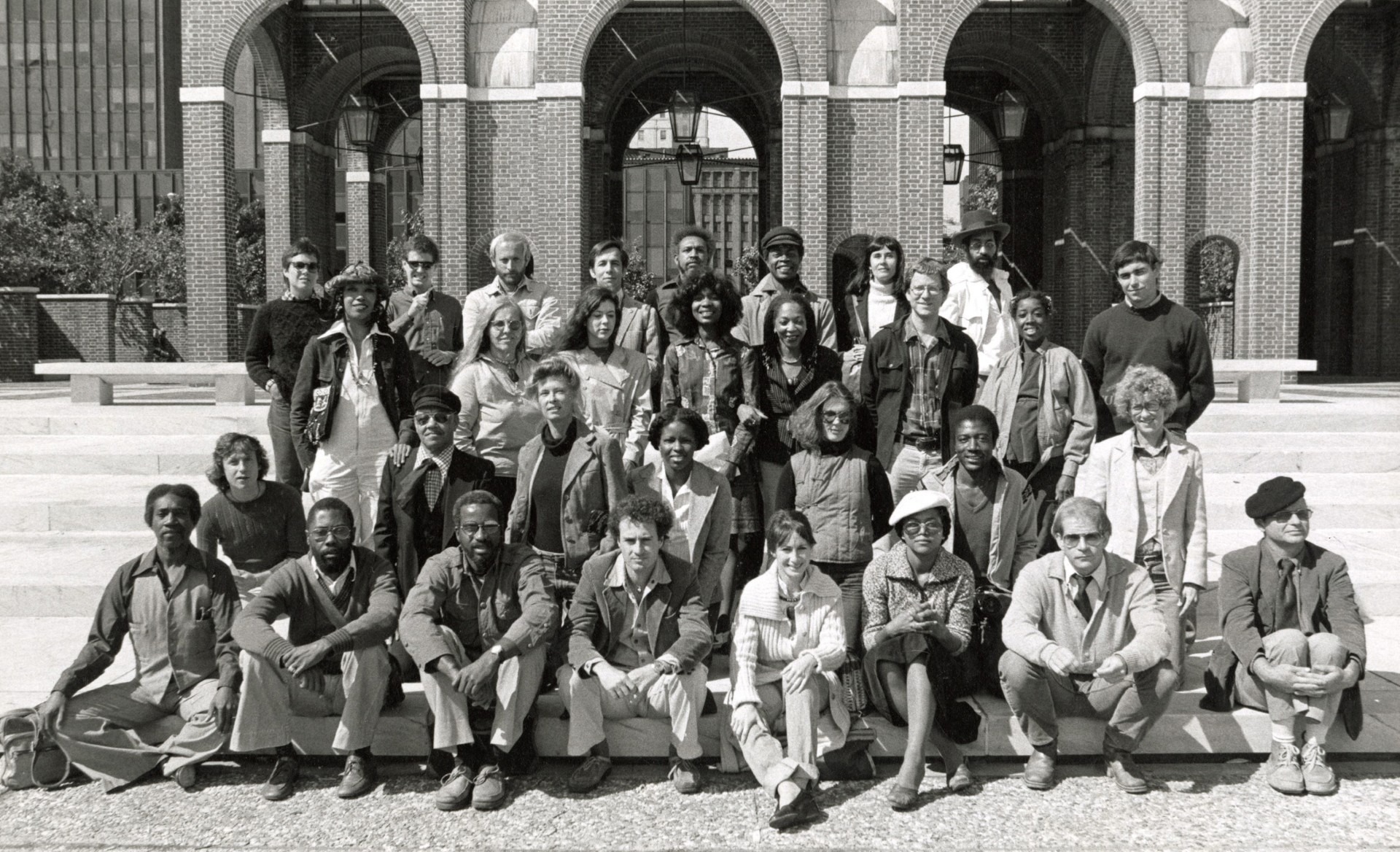
Blaise: There is also more information about the Brandywine VAPS project. We have included a group photo from the second year when there were about 40 artists in the program.
Virginia: We don’t know who all the artists are. Blaise and I could recognize a few like Richard Watson.
Blaise: And we recognized Barbara Bullock and Rebecca Rose Metzger because we know what they look like. Allan Edmunds remembered a few and a couple of other people remembered a few. So, what we did was display another copy of the same photo, but with a number on each person, and posted a response form that names can be entered on by anyone who recognizes other artists in the photo.
Susan: I encourage people to go see the show and help identify the artists in the group photograph.
Blaise: Three photos show subsequent works by some of those artists. One is David Tothero, who became a well-known public sculptor and we include an image of Bonsai, his piece in Palumbo Park next to the Flesher Art Memorial. Another artist from the group, Kathy Hopkins, became known for doing commissioned sculptures, including a statue she did for Presbyterian Hospital. And there is a collage we made of movie posters for Vince DiPersio, the artist I mentioned earlier, who later went out to Hollywood and became a successful film director.
We include a text panel that tells about the other way CETA money was used for the arts in Philly, which provided funding either for staff lines or performers in a wide variety of small nonprofits. For instance, The Painted Bride received six part-time staff lines.
Susan: I have a very basic question. I know you know you were both CETA artists, but what made you have the passion for this project? I mean, this is a big project.
Virginia: Because we think it’s really important! And as Blaise said, when we started on this, it wasn’t just Blaise and me talking about it. We’re still friends with a number of CETA artists and we all know how important our experience was. In our project in New York, the planners and administrators were brilliant. Ted Berger has recently died, but some of the other ones are still alive. They not only saw this as a community-centered work program, but they made sure that we would be paid one day per week to work in our own studios. They were also offering us a different way to think about a career as an artist — one that is community-centered. It was not about competition; it was about collaboration.
Every other Friday we would have to go pick up our paychecks in person, and we got paid for that time too. It was like a high school assembly: maybe a poet would read, maybe somebody would show slides of their work, maybe musicians would play, maybe dancers would perform. So, we met and worked with artists across disciplines. A bunch of us, maybe on the 10th year anniversary, thought “Gee, you know, we should really do something.” And then it was the 25th anniversary and we started to worry that people were going to forget about this remarkable program.
Our current support group is really passionate about CETA, and people help whenever they can, but as Blaise describes it, the two of us are like Velcro. Responsibilities stick to us! We both have writing skills; Blaise has photo skills. We know how to frame. In high school, I trained as a secretary so I can type anything really fast. We’ve been the ones pushing it forward the most because we don’t want CETA to be forgotten. But we also don’t have boundless capacity for doing all the work by ourselves. Plus, we’re trying to do our own art! We’re happy that we have gained partners like Molly Garfinkel, Jodi Waynberg and Mary Okin who are a lot younger than us and really jazzed about CETA. They’re getting the word out and I think the last big hurdle is to get that first book published.
Virginia: We want people to know that CETA arts was a great program and that it remains a good model. Even today, with government money virtually unavailable, it has been influencing culture-sector recovery experiments. The Creatives Rebuild New York project, which took place at the end of the pandemic, was funded mostly by the Mellon Foundation, for $125 million. One of the first things the newly hired director, Sarah Calderón, did was to set up a Zoom and consult with Blaise and me about CETA. They wound up basing a big part of what they did on the structure of the CCF CETA project. So, it’s not just looking back at history. It’s a good model for the future, but very few people know about it.
Blaise: We also include in the exhibition a beautiful WPA-style poster for a brand-new movie called Workers of Art. It is about Creatives Rebuild New York, which successfully employed and/or gave grants to 2,700 artists around New York State. The filmmakers travelled the state talking with CRNY artists and looking at the impact the program had on local communities. The film’s director, Marc Levin, was a media artist in the CCF CETA project along with us, and his wife, Ellin Burke, was the director of my documentation unit.
Susan: How can people watch this movie? Is this the one that was at the Delaware Art Museum?
Blaise: Yes, it premiered there and the filmmakers will be doing the Philadelphia premiere before the end of our show. They expect that it will be publicly available in the near future.
We really are passionate about this, Susan. I have to tell you that, during the COVID shutdown, everybody was talking about the cultural crisis. People were concerned that artists, especially performers, couldn’t work and make a living. Then they would say that the government hadn’t funded artists since the 1930s. And we would jump up and down, scream, yell at the computer screen, and shoot off some emails saying, “Sorry, sorry. There was a more recent project almost as big as the WPA but in the 1970s. Obviously, you haven’t heard of it. Here’s the information; go to the website.
Virginia: And we’d add, “Unlike those who created and participated in the WPA, we’re still alive. Talk to us!”
Blaise: Some of them would respond and some wouldn’t.
Blaise: Over 20 small arts nonprofits in and near Philly got funding from CETA, either to pay staff or to pay performers. Philidanco got money to pay 12 young dancers for their “B Company” performances. And People’s Light and Theater received a lot of money. They were really on top of things, getting their first CETA funds in 1975, and ending up — overall, not all at one time — having 16 CETA positions which included administrators, technical help and performers.
Virginia: Artmobile staff salaries were funded for the first 5 years by CETA. It was a project of the Bucks County Community College and it’s still going today.
Blaise: Our number one example of a successful CETA artist is Jane Golden, who learned how to paint murals in a CETA project in Los Angeles. She was nice enough to send us some photos of her early murals in Santa Monica and Malibu for the show, which few people have ever seen.
Terry Fox, the dancer who runs the Philadelphia Dance Project, was hired by Brandywine to run dance workshops. It was separate from the VAPS program. Other CETA and/or VAPS artists represented in the show include Simone Spicer, Rebecca Rose Metzger, Claire Owens, Lawrence Salzmann, Willie Cole, Michael Williamson, Jerry DiFalco and the poet Charles Bernstein,
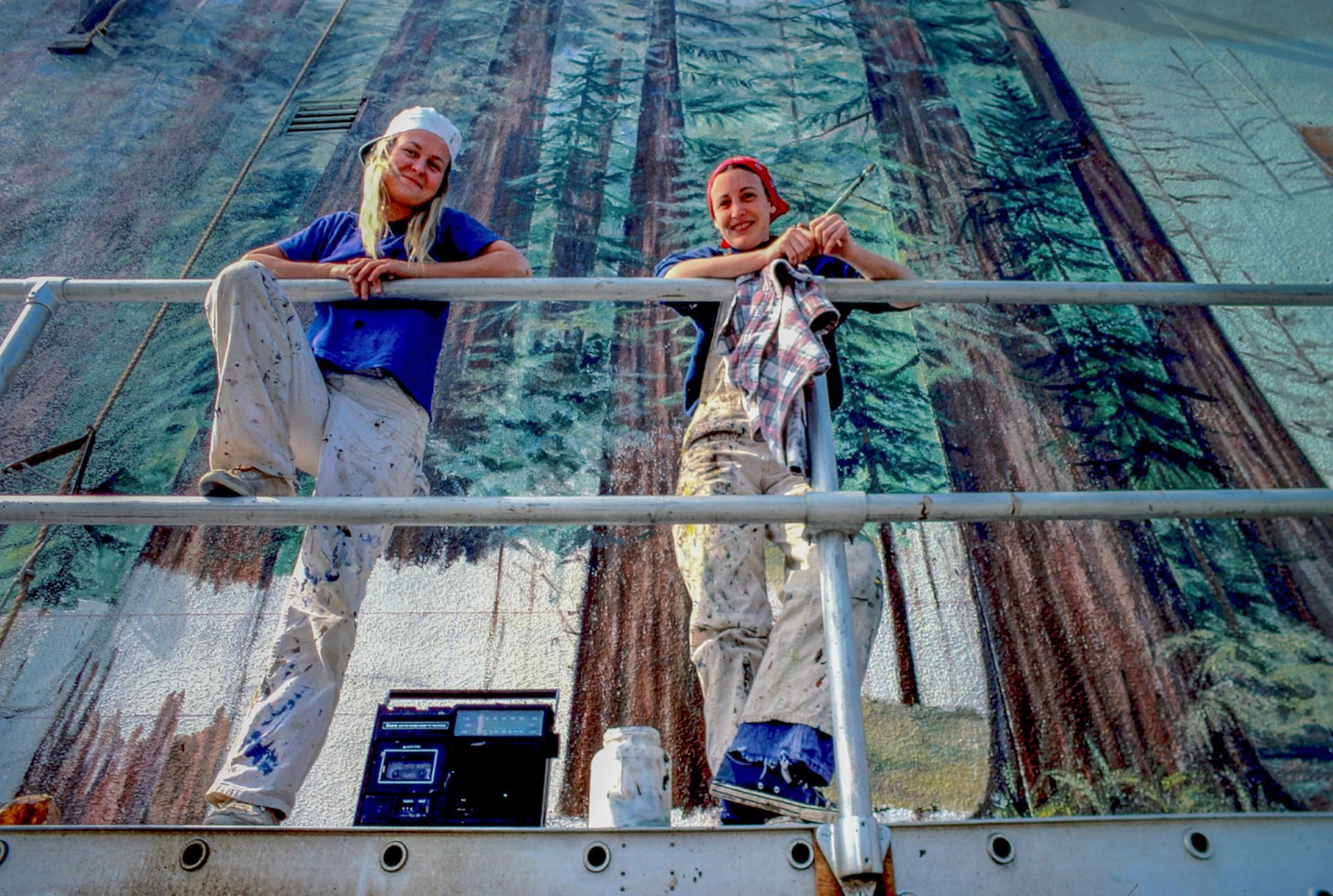
Blaise: Virginia beautifully wrote the final text panel for the show which addresses all these issues. Why is CETA important? What did it do? What can it still do?
Susan: Thank you both for talking with me. I really appreciate all that you do. I’m a great admirer of your scholarship, your intelligence, your artwork, and your commitment to the arts. I really encourage people to go see the exhibition and learn about one of the most successful public programs to support artists.
A Federal Job in the Arts – CETA and Philadelphia in the 1970s
Curated by Blaise Tobia and Virginia Maksymowicz
August 3, 2026 - October 2, 2026
Philadelphia City Hall
Creative Philadelphia Art Gallery, Room 116
Panel Discussion and Reception: September 18, 5-7p
https://www.creativephl.org/exhibition/a-federal-job-in-the-arts-ceta-and-philadelphia-in-the-1970s/
About the Author:
Susan Isaacs is retired from teaching art history and museum studies at Towson University. She curated many exhibitions for the Department of Art + Design, Art History, and Art Education Galleries as well as numerous institutions across the United States and abroad. She writes and publishes on modern and contemporary art. Isaacs holds a four-year certificate of Fine Arts from the Pennsylvania Academy of the Fine Arts in Philadelphia in painting and B.A., M.A., and Ph.D. degrees in art history from the University of Delaware. Believing that it is never too late to follow one’s dream, she also completed an M.F.A. in studio art at Towson University as an interdisciplinary artist working in printmaking, books, painting, and fabric sculptures. She has shown her own artwork in venues mostly on the East Coast. Employing organic abstract forms, she creates joyful worlds with intense colors and exuberant compositions.
Want to stay in the know about Philly’s visual arts scene? We’re developing a semi-regular Art & Image Newsletter - featuring interviews, articles, and reviews straight to your inbox!