Artists and writer Ted Mosher interviews Pragya Gupta about her personal journey, her artwork, and her current exhibition, Chrysalis, at the University of Pennsylvania’s Annenberg Center.
Pragya Gupta’s work is on display at the Annenberg Center for the Performing Arts at the University of Pennsylvania through December 13, 2026. Gupta is a Philadelphia-based artist who has previously shown at the Awbury Arboretum and the Manayunk Arts Center, as well as in multiple group shows. The title of the Annenberg Center show is Chrysalis and its theme is transformation and the process by which one attains self-knowledge.
Gupta was raised in the Punjab and had limited contact with the arts early in life. She completed her schooling in India and then spent two years in Philadelphia while obtaining a degree from the Wharton School. Art did not enter her life until she moved to London and started work as a management consultant. It was then that she started going to the National Gallery on her own and, as she puts it, “it just completely shifted something for me.” Following London, Gupta moved back to Philadelphia and began taking art lessons, first at Abington Art Center and then at PAFA and the Art Students League of New York.
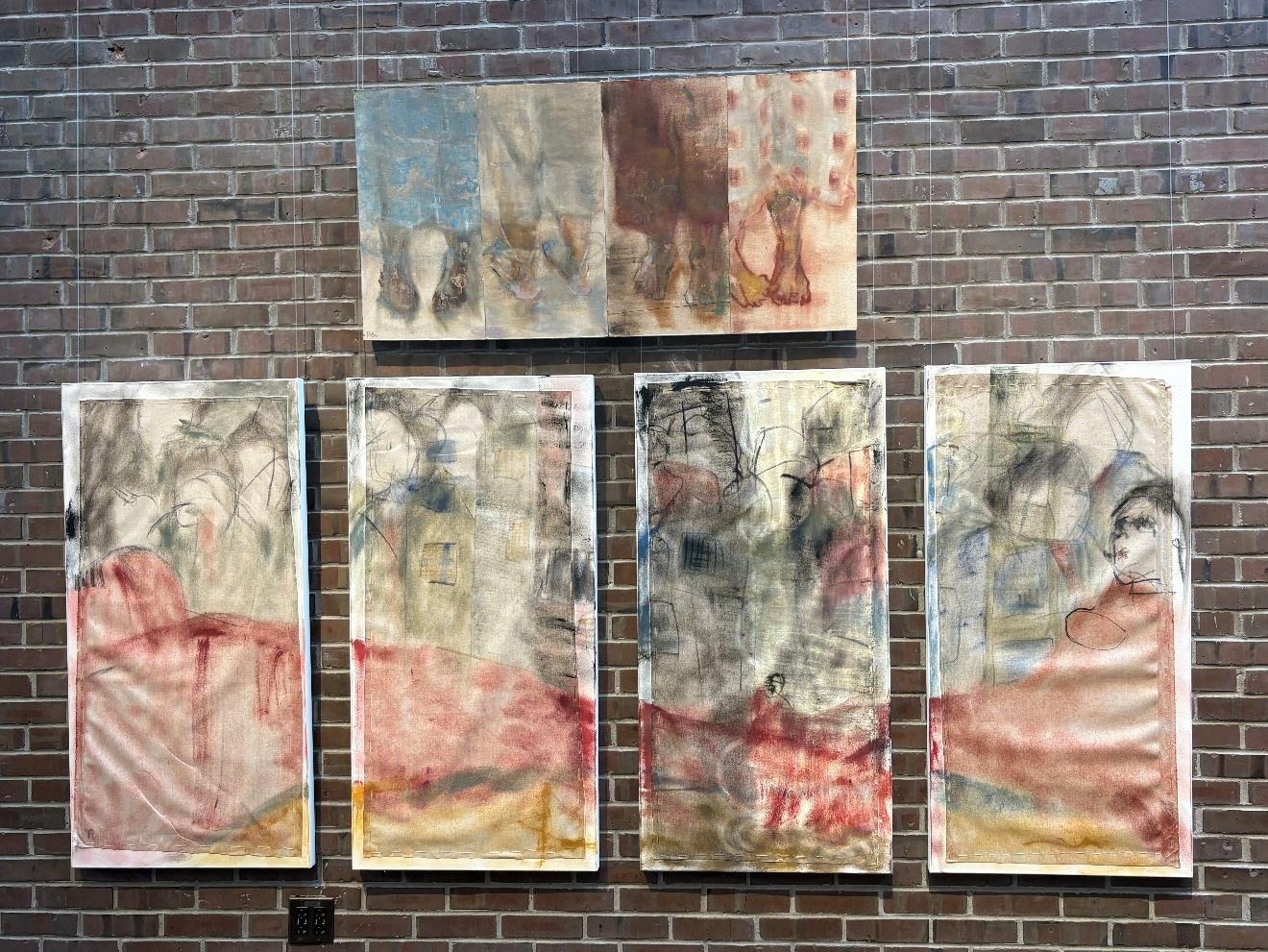
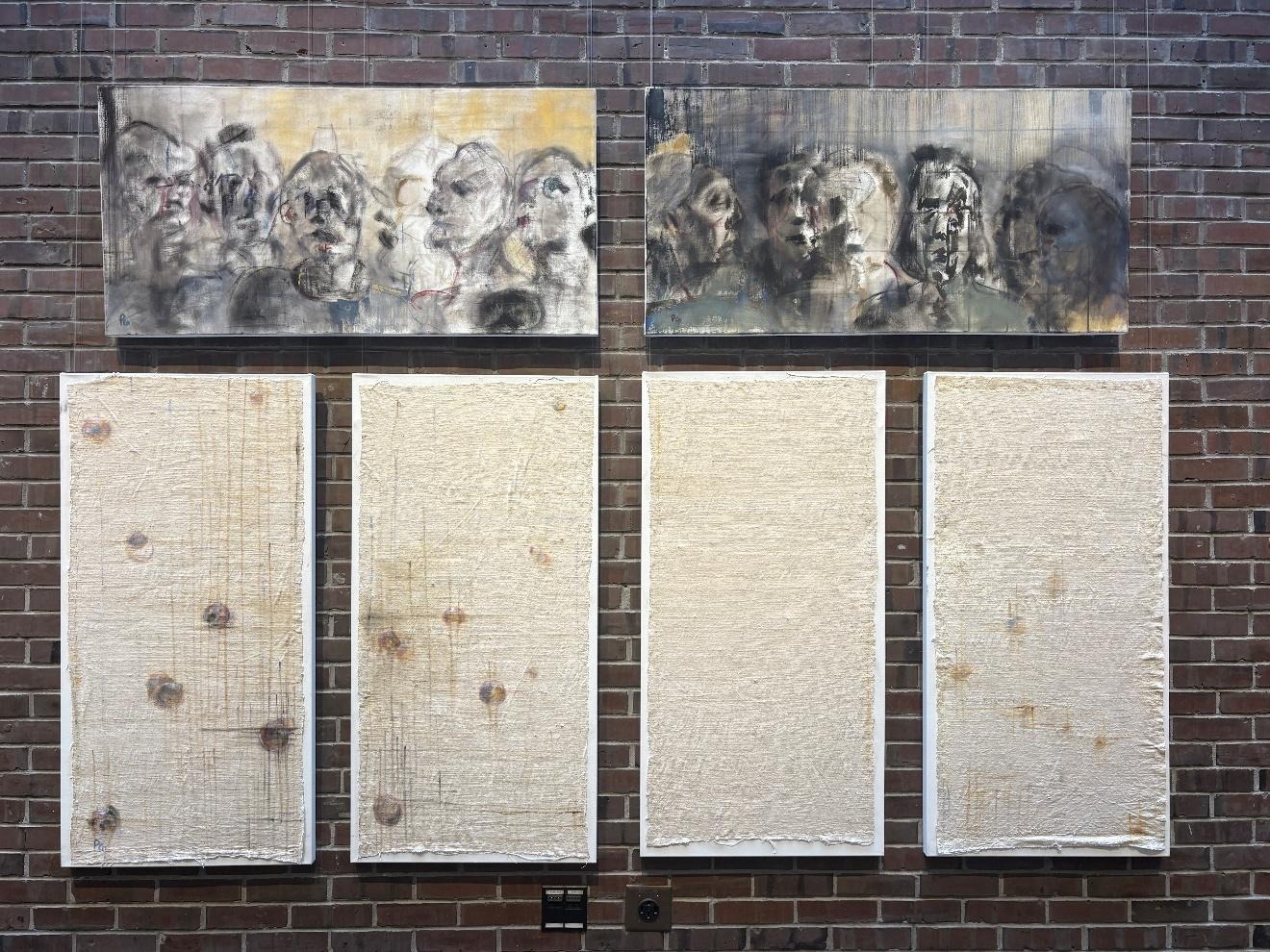
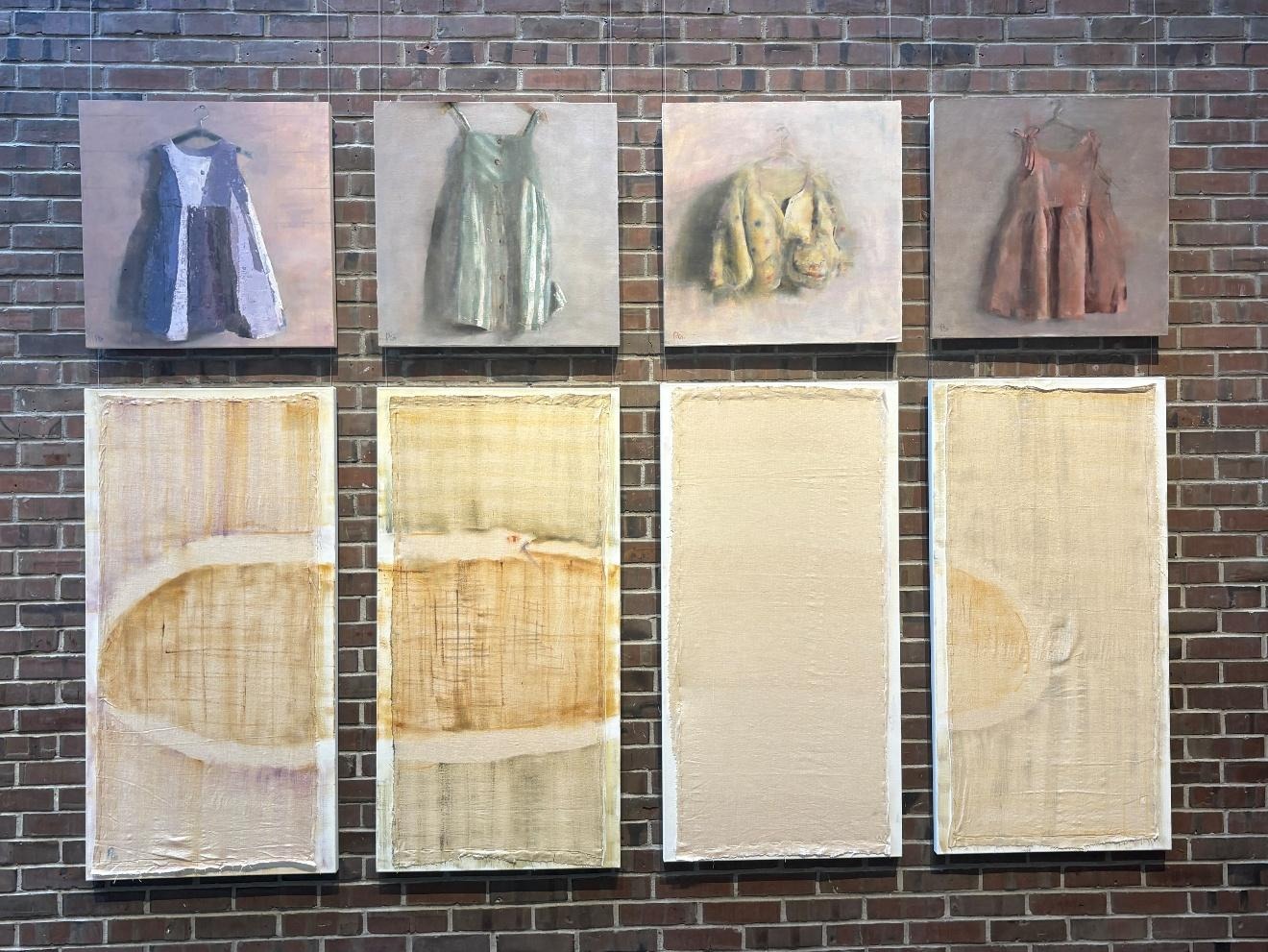
For “Chrysalis”, Gupta has assembled multiple canvases, including five tetraptychs (four paintings grouped together) and one diptych (two paintings side by side). The subject matter of the paintings is universal and at times mythic. There are four paintings of standing girls, each cropped to show just legs and bare feet. A horizontal diptych shows just faces, loosely rendered and crowded together. In another tetraptych a row of girl’s dresses hang empty against a wall, and in the paired tetraptych below a snake is caught in the act of swallowing its own tail.
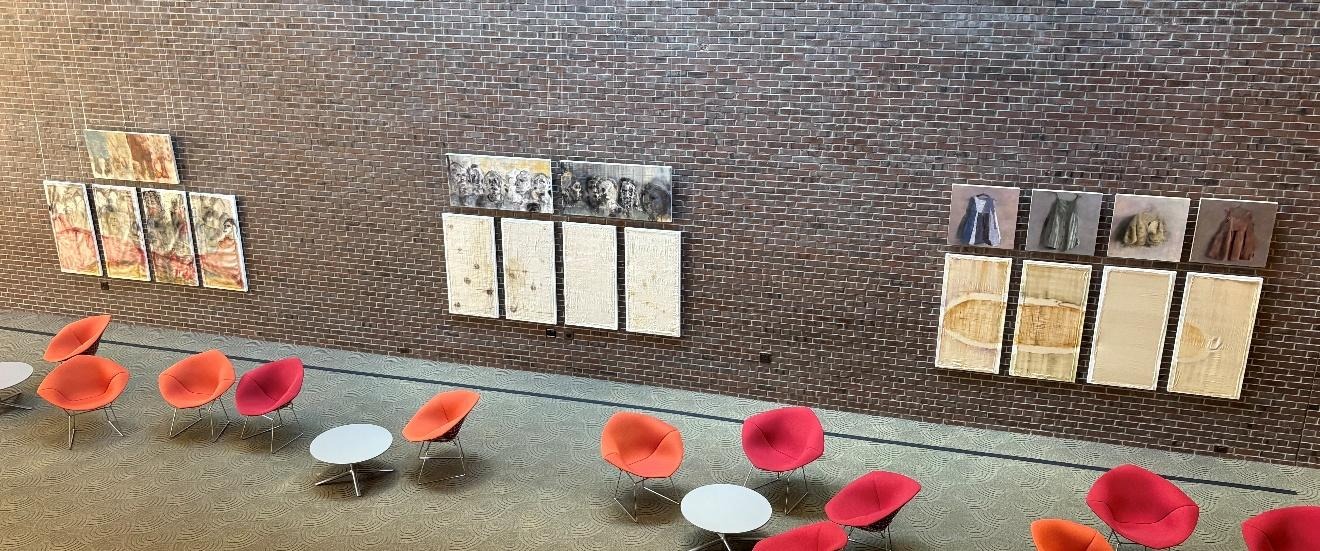
The works coalesce around Gupta’s skillful paint handling. The personal significance of each work’s subject resonates in her expressive and often provisional mark-making.
The varying grounds used in Chrysalis also inform the subject matter. For each of the three larger tetraptychs, Gupta has painted on a differing type of unstretched fabric, then stitched that fabric onto a pre-stretched cotton duck canvas. The choice of fabrics is significant: Belgian linen, machine-woven Indian cotton and khadi, vintage hand-spun, hand-woven Indian cotton cloth. The story of the specific length of khadi used in Chrysalis emerged in the interview; it has personal significance going back generations in Gupta’s family.
Gupta spoke in October 2026 with Ted Mosher of Art & Image about her work and the path that led her to painting.
Ted: How did encountering museums later in life, particularly in London, influence your understanding of painting?
Pragya: "Till I was 29, painting didn't exist in my world. I grew up in a smaller town in India, and art museums or even art classes at school were not part of my vocabulary. In that place and time, art was considered a waste of time. Even sports or reading fiction were not encouraged. Growing up in the 1990s in a smaller town was very different from growing up in Bengal, with its rich art culture, or in Mumbai or Delhi.
After graduating from Wharton, I was working in London and went to the National Gallery because it was right in the center of the city and free. It completely shifted something for me. I spent so much time going back and forth between paintings, just looking. I was curious: How does this work? It sparked not so much a desire to paint as a curiosity about creativity.
I started reading books about creativity, including The Artist’s Way [Julia Cameron, 1992]. At the time, I was working in finance and would wake up at five in the morning to write for three hours. I still write for one to two hours each day. It's a huge part of my life and artistic process.
That first encounter at a museum really sparked in me this very deep curiosity about creating and how that feels inside."
Ted: Were there any specific works at the National Gallery that you found significant?
Pragya: "The one I really remember was Monet's Water Lilies, Setting Sun. I feel like I've almost lost that experience now, because I can look at a painting and understand a little bit about how it's made. But then, it was just these few strokes, and they looked like light and lilies and water. It was amazing, like being a child and seeing magic. I remember it because it was so sparse, so minimal, so intriguing."
Ted: In what ways, if any, does your financial training inform how you think about your art or guide you within your process?
Pragya: "It's a question I've asked myself many times. I studied engineering, worked as a management consultant, got an MBA, and then worked in investment management. It's so much a part of me that I probably can't separate it from the way I think and work.
I'm not using my finance knowledge directly, but with this new work, I'm putting vintage fabric on commercial canvas and leaving the canvas exposed. When I first did that, the thought that came to mind was that the commercial canvas was like optimized time, a little like working in finance. And the khadi was textured time. It's a completely different way of looking at time. I wouldn't have that perspective if I hadn't worked in that world."
Ted: Is there any element of critique in your practice, given your extensive knowledge of and experience in that financial world?
Pragya: "There are two elements to that. There's definitely a tension between the optimized and the textured, not just in the canvas but also in my own inner ways of doing things. I'm still trying to find the right balance.
But there's also the question of giving myself permission to paint. Given my cultural and family background, there was an expectation that I would follow a traditional career path. In high school, I really had only two choices: medicine or engineering.
After the National Gallery experience, once I started writing by hand in the early mornings, a whole new world opened up, one that hadn't been allowed—not just by the external world, but even within me. I was about 29 when I went to the museum, so I'd spent decades in a very fixed mindset, already on a particular path. It was destabilizing at first.
My last solo show in March 2026 was about identity: Who am I? After working on that body of work for two years, I realized that my identity was very fluid. Probably that's true for a lot of us. Then the question shifted from "Who am I?" to "How do you actually live in a way that feels true to you?" That's where this new work came from.
As for critique, I have friends who love working in consulting or finance. It agrees with their inner nature. For me, after the learning curve in my role as an investor was starting to flatten and my student loans from MBA were paid off, I started losing interest. I wasn't learning that much anymore, and I would sneak out at lunch to read Whitman in St. Paul's Church. Something had to give. It just didn't align with my inner nature and that was starting to become quite apparent to me."
Ted: What do these works tell us about that part of your identity or that part of your experience?
Pragya: "It's funny—I work a lot with grids, and I started using them as I began painting less representationally. They gave me an entry point into a canvas. I'd take a ruler and draw the grid first. It always felt comforting, and I think that goes back to the mathematical, analytical part of my brain.
There's a lot more geometry in the new work. There are three large works, each a tetraptych. The structure is the same, but the visual language and palette are quite different. One has grids and bubbles, another has figures, and the third has a serpent. The question was: How far can I push the visual language while keeping the structure the same, and still have it read as one body of work?
The four-panel structure is deliberate, as is the decision to leave the commercial canvas border exposed. The border represents finance-optimized time, while the fabrics bring in a different kind of time - a textured time which I myself don't quite understand yet and want to explore in future work."
Ted: How did you source the fabrics used in “Chrysalis”?
Pragya: "Some of it began when I was visiting my family in India. I go once a year. This spring, after my last show, I was home and found my dad's copy of Gandhi's autobiography on his shelf. I was reading the chapters about how spinning had nearly disappeared in India in the 1920s. Machine-made British textiles had displaced much of the Indian textile industry, and Gandhi worked to revive hand-spinning. The spinning wheel is part of the Indian flag, so it's an important symbol.
I asked my grandmother, who is 88, about khadi. She brought out a very long piece with its own story. My grandparents had a spiritual teacher, the only guru they ever had. This cloth had been woven in his village, and he gave it to them as a gift. It was the only thing they had from him. His picture still hangs in my grandparents' house; he was a very important part of their lives.
My grandmother didn't know what to do with the fabric. It was thick, not really something you would make clothes out of. It was cream-colored and full of irregularities. When you look closely, you see little bits of brown and all the variations in the weave. It's beautiful. She gave the whole piece to me."
Ted: So you have the base of the commercial fabric and then the superstructure of the handmade fabric?
Pragya: "Yes. Each work has a commercial canvas, and on top of it I've hand-stitched the handmade fabric. One is khadi, one is raw linen, and the third is handspun cotton, which is thinner and different from khadi. Three different fabrics, but the geometry is the same and the visual languages are different.
When I came back from India, I just had the khadi and didn't know what I was going to do with it. I started painting more figures, as I had been doing before. And then—this is kind of crazy, but do you ever have recurring dreams? The same dream over and over?"
Ted: Oh, yes.
Pragya: "Really? That doesn't happen to me often. I can remember maybe two dreams from childhood that have repeated. But after I got back from India, I kept having this dream of being trapped in a box, or of a hand trapping me. I had it four or five times, and I remembered it. I just knew it was a sign that I needed to take a bigger risk in what I was doing.
It gave me the courage to work with the khadi in a different way. I moved from figures to very geometric marks. In each work, one panel is completely empty, which felt like a huge risk at the time. One morning I had the idea of what to do, and I did it on this precious piece of khadi from my grandmother.
That piece of fabric changed my whole way of working, and also what the current show Chrysalis was going to look like."
Ted: Do you see the current work as coming back to ground, in a way, or coming back to where you came from?
Pragya: "That's interesting, because I hadn't actually thought about it that way. The way I see the current work is really around transformation. Each of the three works looks at change on a different timescale.
The first, Is This It?, is about transformation within a single human life. You see the story of one person. Opening has these bubbles, rising and dissolving, each of which can represent a life. It's a broader way of looking at ourselves, across many lives. And the third, Uncoiling, is about eternal time. It goes round and round.
For this work, I was thinking more about change and time than identity. In Opening, the khadi work, the grids vary. In some places they're very dense, and the bubbles are heavy and opaque. That's a tougher time, perhaps. As the grids get lighter, questions start to emerge, like "Who am I?" Then the third panel is blank. Sometimes we experience these moments of clarity, but in my experience so far they weave in and out; they're not permanent. In the last panel, some of the grid and bubbles return. Instead of painting the bubbles, I've only left an oil stain. I've stained the fabric with linseed oil. You have these condensing memories, but they don't have such a hold on you. They begin to vanish; things move through more easily. You're not so stuck in them.
The fact that I am painting on vintage handspun fabric with a family history does suggest that there is a pull towards change and also a pull towards something already known. Something anchors it."
Ted: There's a structure to the way the works are hung. What can you tell me about that?
Pragya: "To talk about the newer work first, the idea was to have the same four-panel structure, with the fabric mounted on the commercial canvas and its border left exposed. They're all built on that structure, and they're all about transformation. There's a deliberate movement from the figurative to the more abstract and conceptual.
I always struggle with distinctions like figure versus still life versus landscape. In reality, when we live, it's all one, right?"
Ted: When I first saw the tetraptych with the snake, I read the image as a boat.
Pragya: "Oh, wow, that's so interesting. A boat—that suggests a final passage. I was concerned that the image might be too literal, so I'm glad you read it as something different. The idea is to have this form with no beginning and no end, eating its own tail."
Exhibition: Chrysalis Pragya Gupta
Location: Annenberg Center, 3680 Walnut Street, University of Pennsylvania
On view through: October 15 - December 13, 2026
https://sachsarts.org/event/chrysalis-pragya-gupta-exhibition/
For more information about Pragya: https://www.pragyaguptastudio.com/about
About the Author:
Ted Mosher is a multi-disciplinary artist based in Philadelphia. Mosher is a member of BYO Printmaking Collaborative and currently serves on that organization’s board. From 1998 through 2013 he was a member of Highwire Gallery, and was president of that gallery from 2001 through 2007. He has exhibited in multiple venues in Philadelphia and beyond. His work is held in several collections, including the SGCI Archives at the Zuckerman Museum of Art, the Free Library of Philadelphia, the University of Wisconsin at Madison and the Westtown School.
For more information about Ted Mosher https://tedmosherart.com/about
Want to stay in the know about Philly’s visual arts scene? We’re developing a semi-regular Art & Image Newsletter - featuring interviews, articles, and reviews straight to your inbox!