







Finding a Way Home
The artists in Finding a Way Home explore themes of home, displacement, and place-making in ever-changing environments. The idea of a “home” is most commonly defined by a permanent domicile, but the artists in this exhibition show that it can be much more than that. The sense of belonging is influenced by heritage, connection, and self-agency just as much as by years spent in one place. Through paintings, sculptures, and photographs, the artists’ work traces the root cause of belonging and home-making.
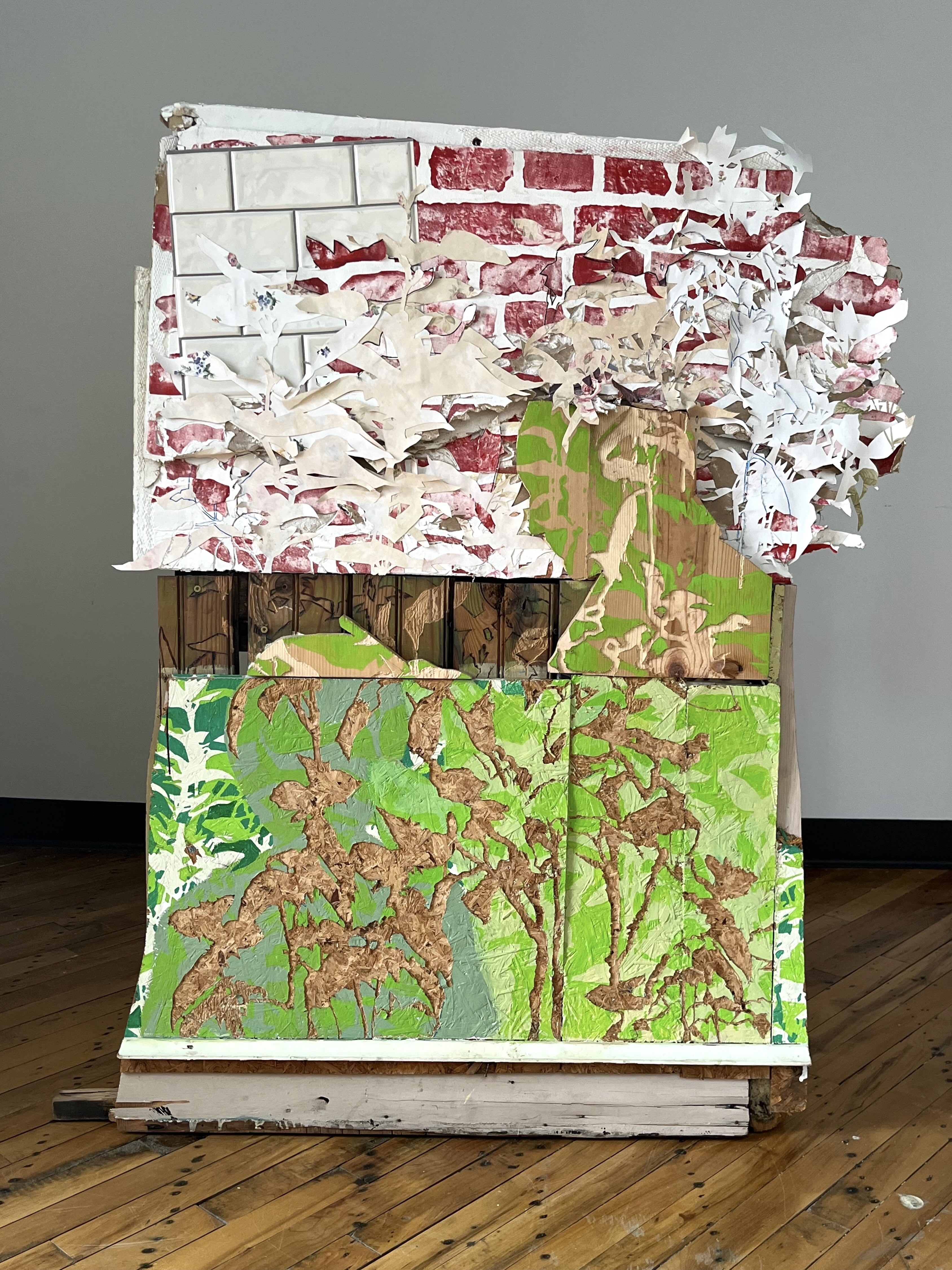
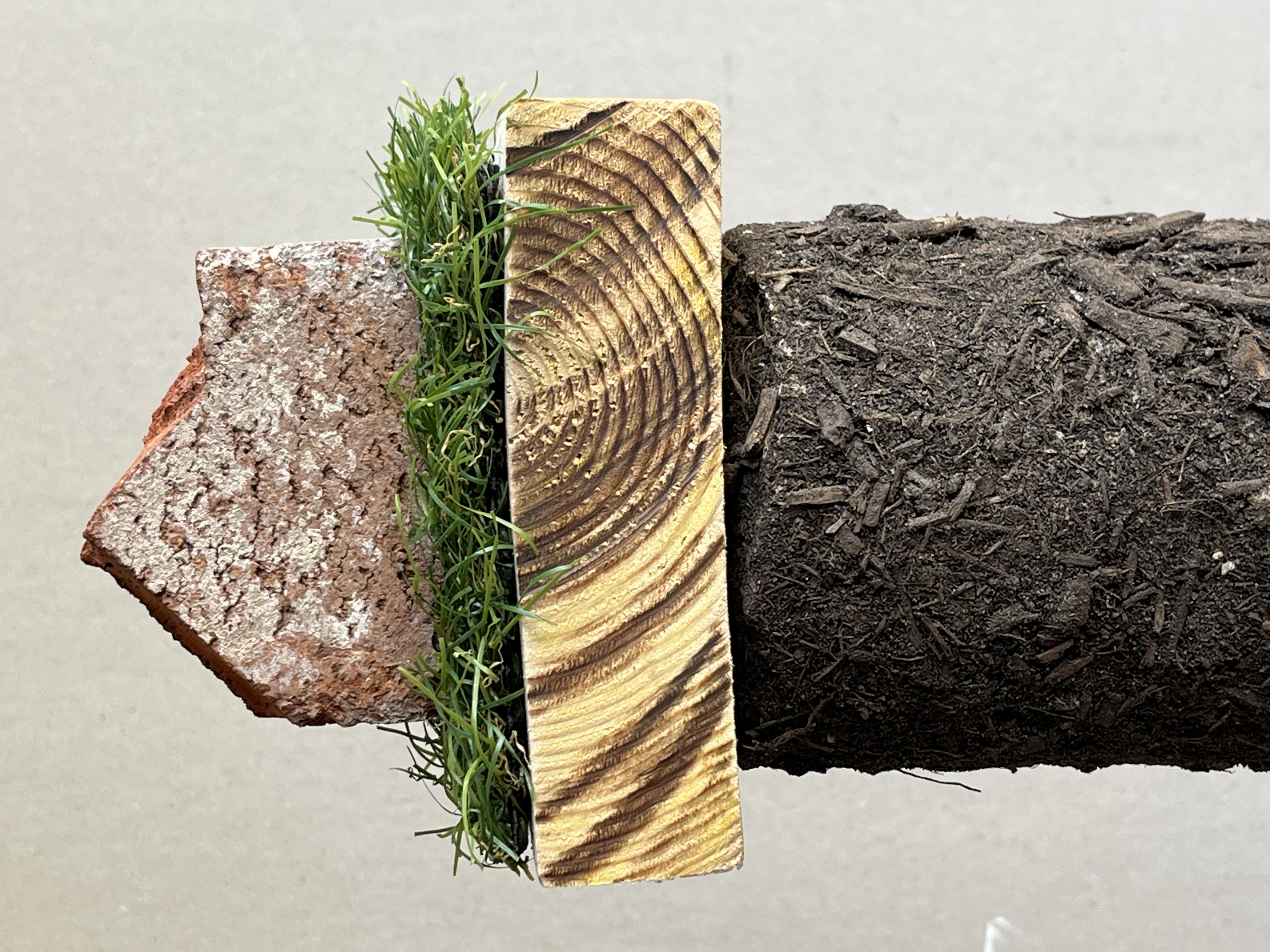
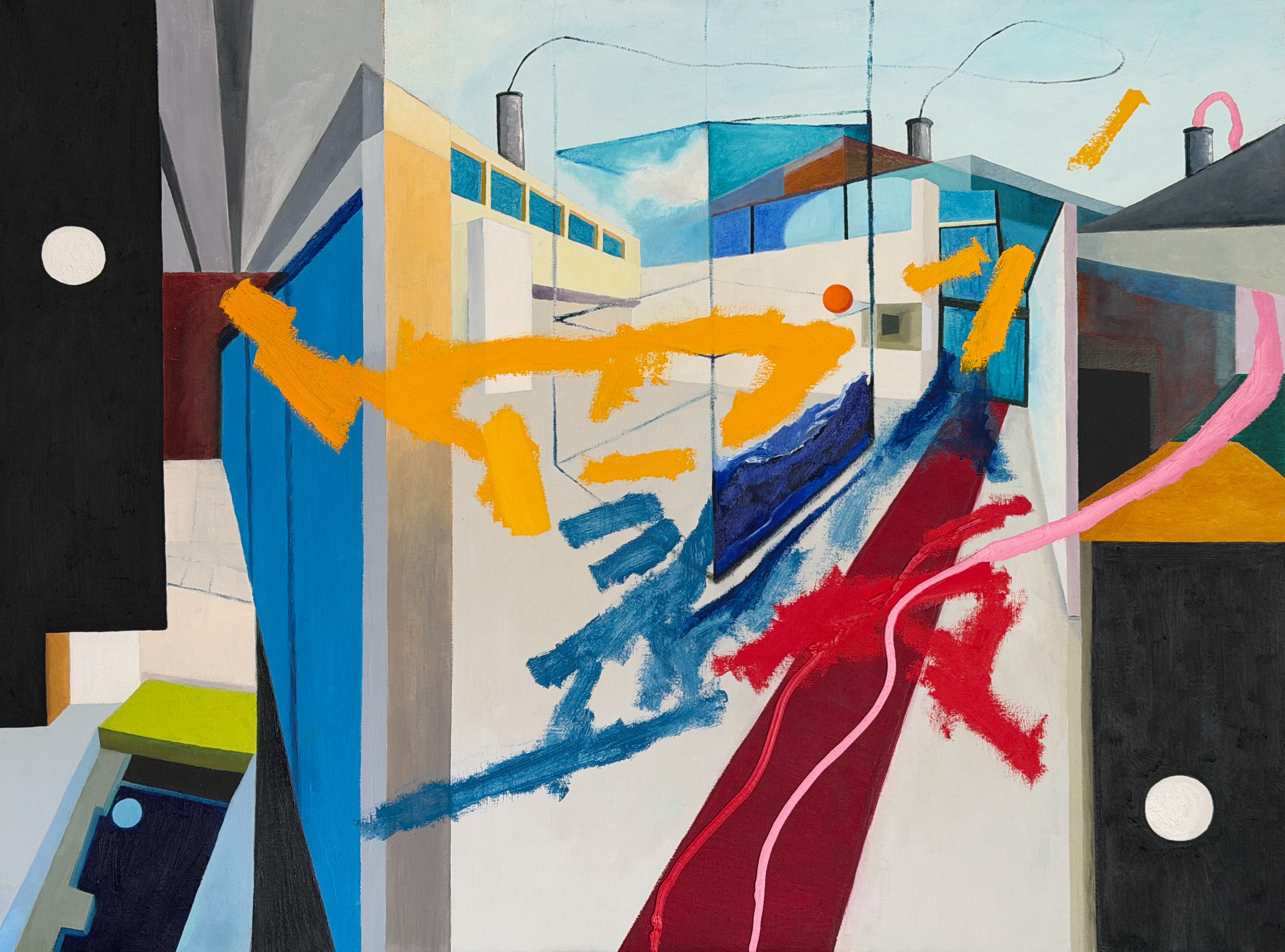
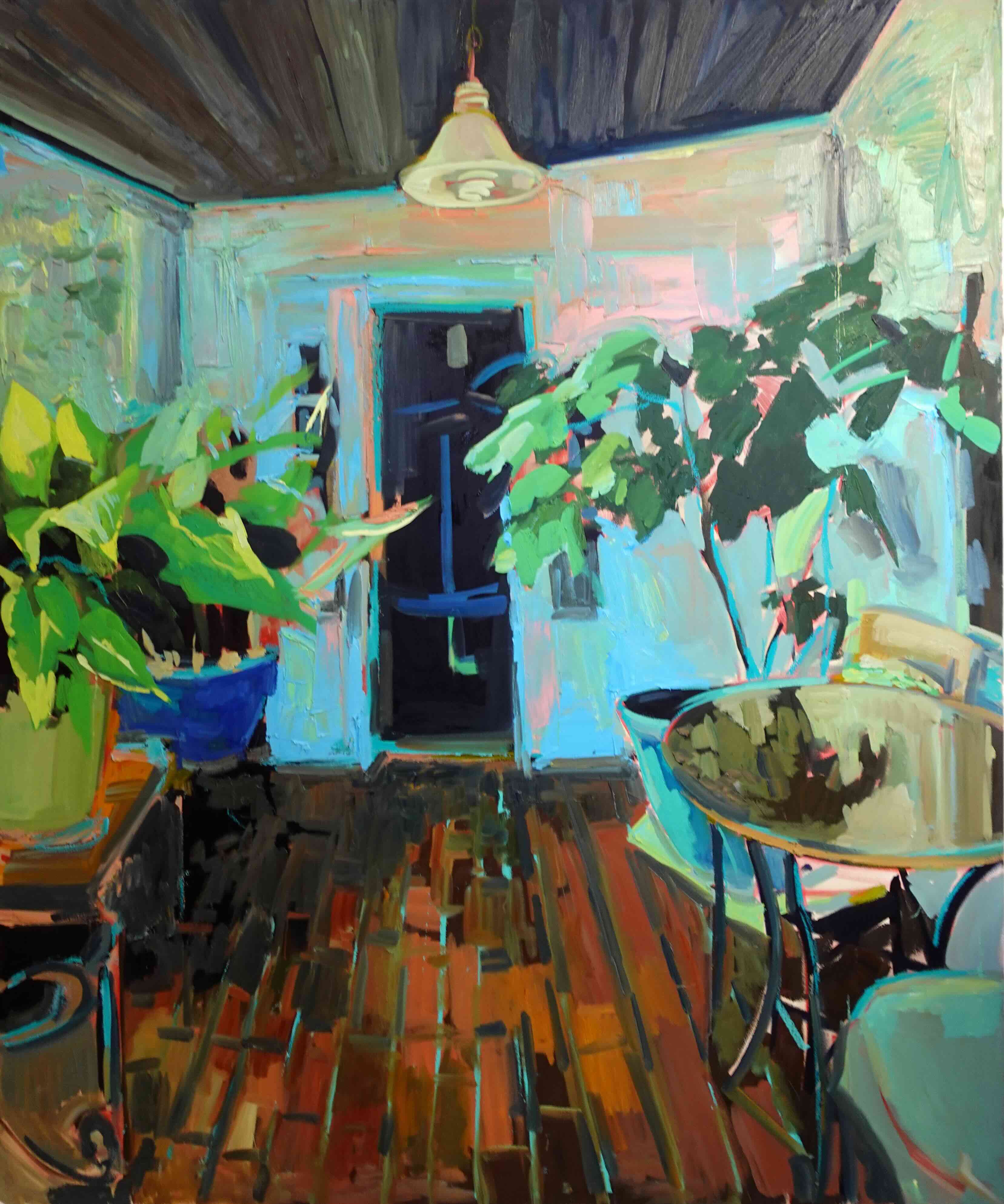
Nicole Maynard and Mia Fabrizio abstract and deconstruct familiar imagery and domestic materials to present spaces in flux; they expose common threads of recognizing a space as a “home” by exposing the foundations of the idea. Complementary to these is work by Ekaterina Popova, whose paintings show the quiet side of settling down, and how a room can become an everyday safe haven for self-reflection through constant observation and stillness. The pursuit of comfort and familiarity quickly transforms a new residence into a sanctuary for self-actualization.
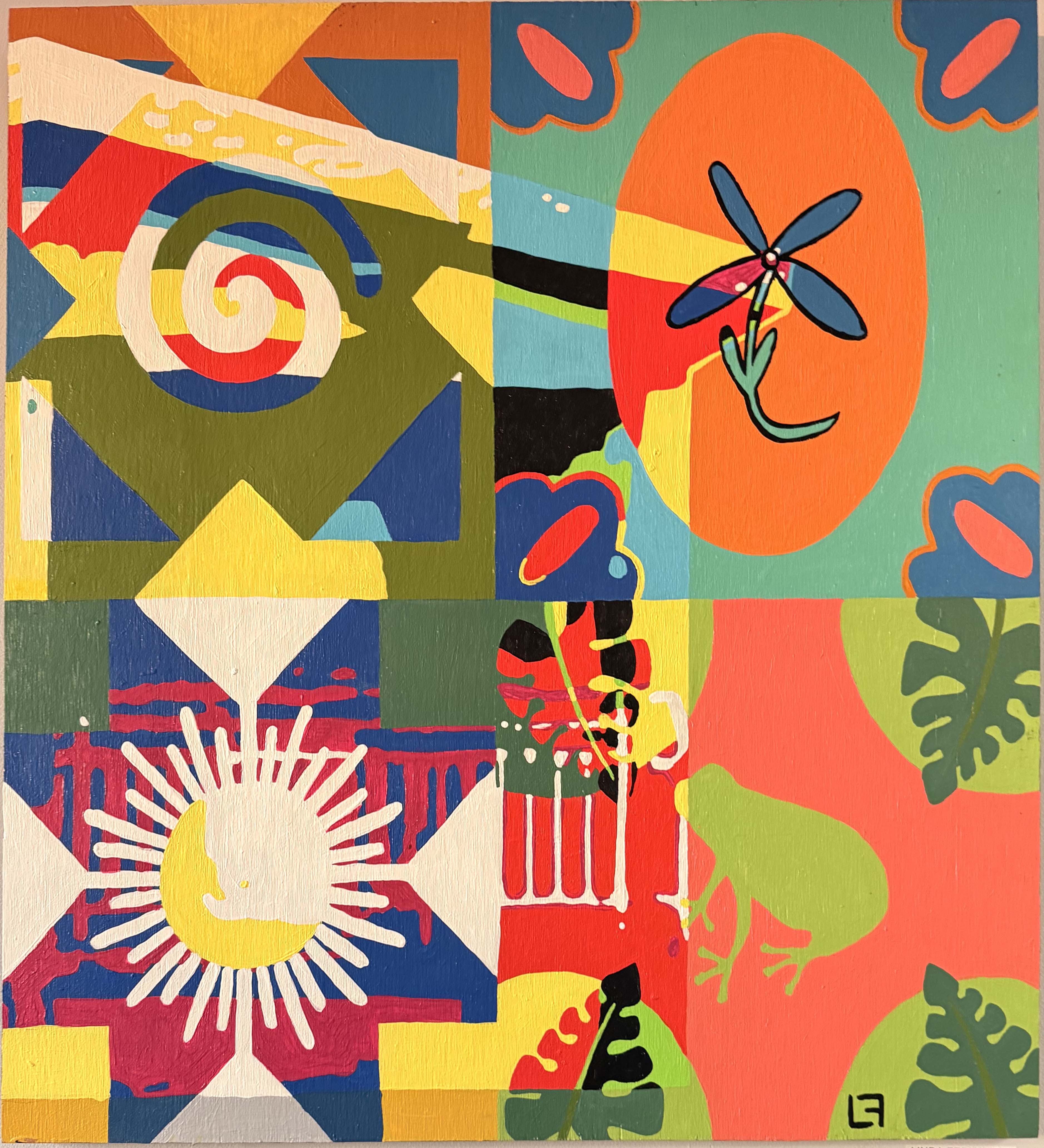
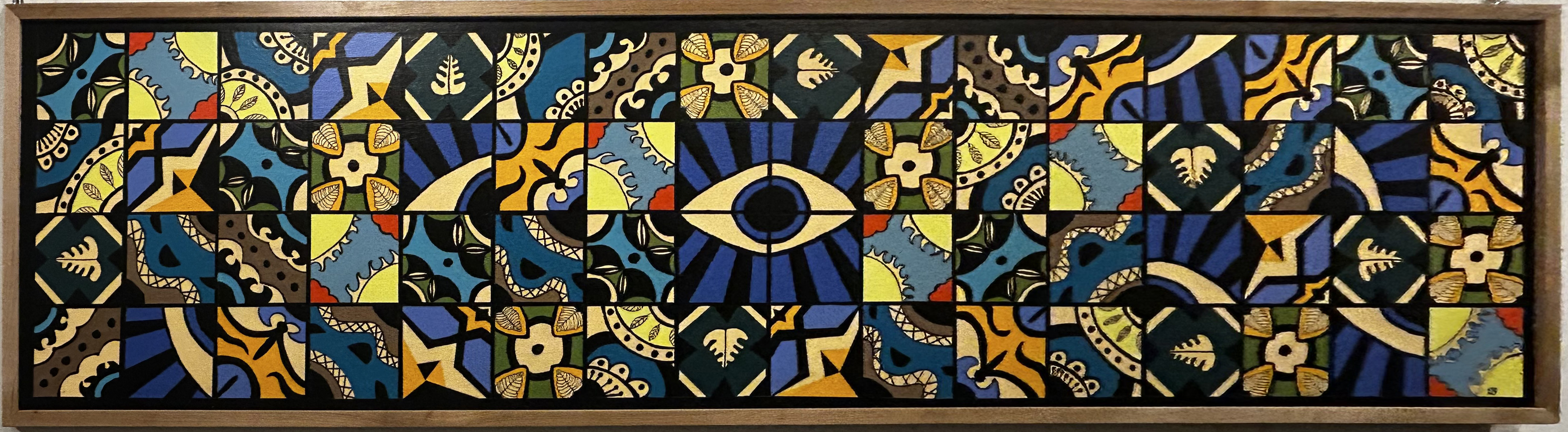
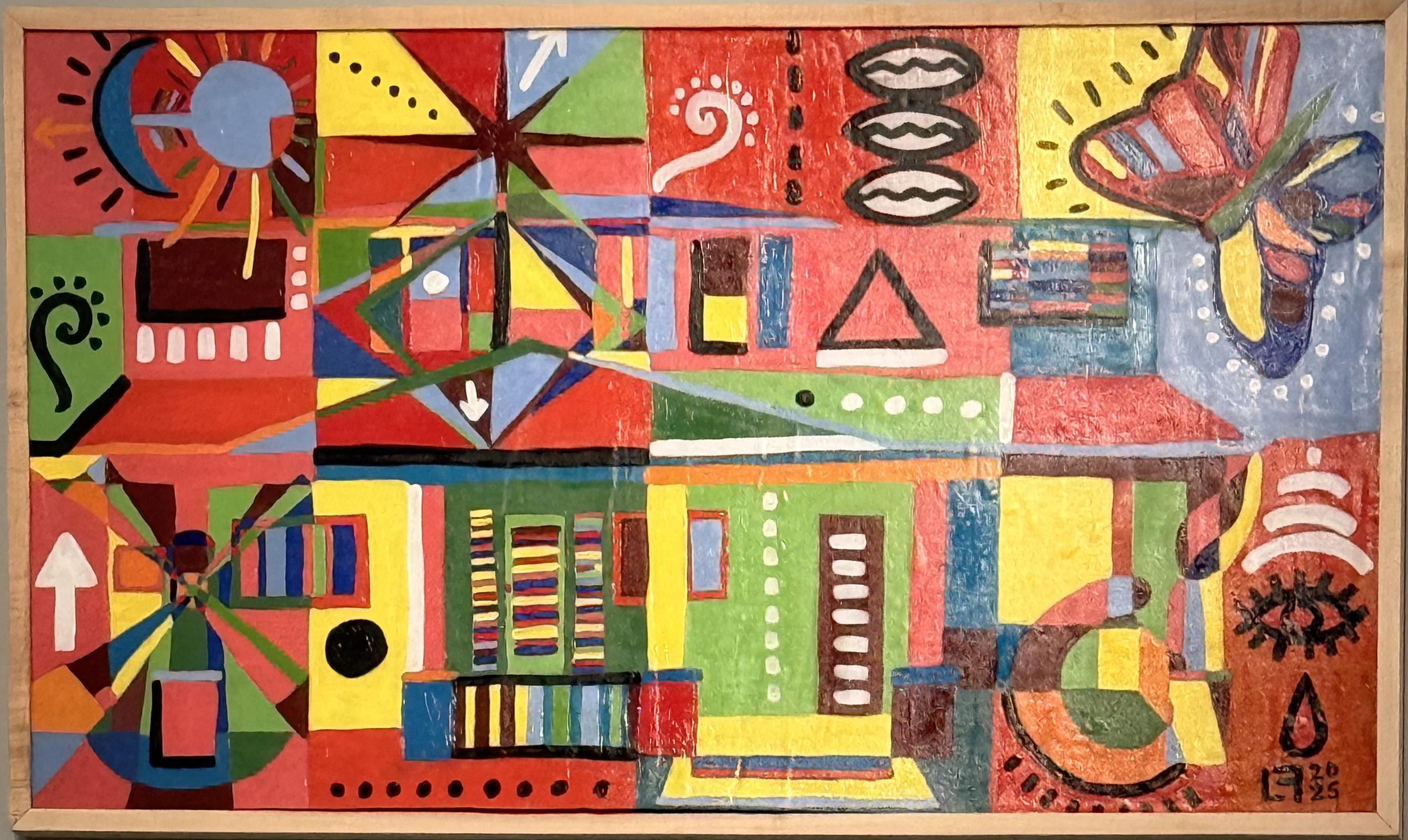
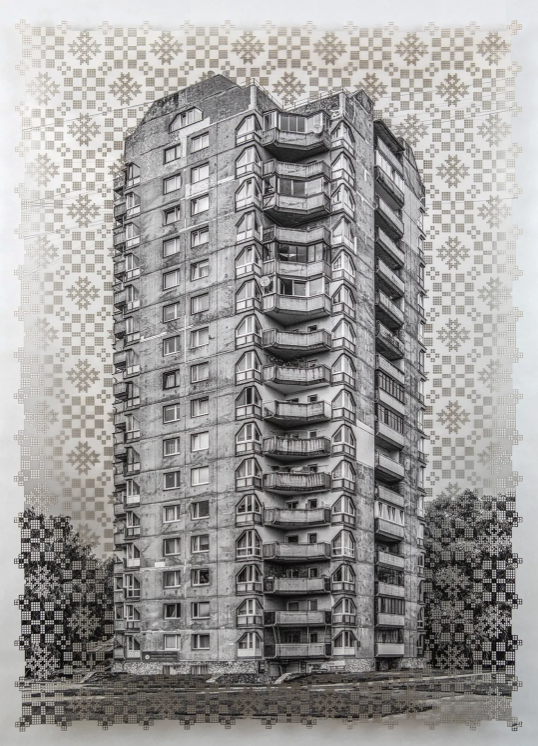
Krista Svalbonas and Linda Fernandez’s multi-layered pieces explore heritage through a diasporic lens. For Linda, imagery popular in Latin America, introduced through Spanish colonization, serves as a visual reminder of the paradigm of home and displacement. Familiar symbols of comfort simultaneously lack rooted origins. Krista layers images of Soviet era buildings with weaving patterns kept alive by craftspeople enduring displacement in a post-war regime. The efforts to pass on their heritage despite cultural oppression are what brought a sense of familiarity and belonging to their temporary abodes.
Work in this exhibition examines the foundations of home-finding in a multitude of ways, each unique and sincere, encouraging viewers to turn inward to find the markers of their “home”. Whether it be longevity, familiarity, safety, or something else entirely, “home” tends to find its way into our lives in one form or another.
Mia Fabrizio
Bio
Mia Fabrizio (b.1979) is an interdisciplinary artist and educator based in Pennsylvania whose work explores identity through mixed media painting, sculpture and installation. Drawing from domestic spaces and building materials, her practice examines social constructs and the fluidity of perceived binaries between public and private, masculine and feminine, and tradition and modernity. She earned a B.F.A. from Tyler School of Art (2002), an M.Ed. from Arcadia University (2006), and an M.F.A. from the School of the Museum of Fine Arts at Tufts University in 2020. Fabrizio participated in several artist residencies including MASS MoCA (2021), The Philadelphia Residency (2023), InLiquid, and West Chester University, PA (2025). Her work has appeared in exhibitions throughout the Northeastern US and she currently teaches at West Chester University, PA.
Statement
“My work is rooted in an ongoing investigation of hidden and exposed structures, both physical and psychological. This inquiry stems from the framework most familiar to me, the house in which I grew up. The contradictions within that space: what was visible, what was concealed, what was protected, and what was left unresolved, continue to provide inspiration and inform my interdisciplinary art practice. Drawing from the visual language of home and the ethos of the handmade, I paint, adhere, carve, and chip away at materials such as wood, drywall, and paper. My process moves between deconstruction and preservation, simultaneously dismantling and memorializing personal and family histories. Through these physical acts, I consider how the places we inhabit shape our understanding of identity, belonging, responsibility, and one another. Familiar materials become a way of examining the emotional and cultural histories embedded within domestic spaces.”
Linda Fernandez
Bio
Linda Fernandez is a Philly based artist and muralist whose work features bright colors, designs and symbols that reflect her Caribbean heritage. She's inspired by the ways in which nature, architecture and history weave together to tell stories of people and the places they call home. Her work merges themes of identity and home across physical, social and cultural divides by exploring Caribbean heritage through a diasporic lens. She is a founding member of Amber Art and Design, an artist collective that creates public art murals and creative installations through engagement with people in communities. She is also a co-founder of Site and Story, a women owned artist collective that creates public art with a focus on healing and wellness. Linda has earned a Bachelor’s degree in Art Education from Tyler School of Art, a certificate in Contemporary Art from Metafora Escola de Arte Contemporaneo in Barcelona, Spain, and a Master’s in Public Administration from Austin W. Marxe School of Public and International Affairs. She is an alumni of Community Arts Education Leadership Institute, National Urban Fellows and the Caribbean Cultural Center African Diaspora Institute’s Intercultural Advocacy Fellowship. She has received notable grants including Philadelphia Cultural Treasures, Art is Essential, and Leeway Foundation Art & Change grants and has been a featured artist at the Philadelphia Museum of Art.
Statement
“My artwork explores the theme of home. Not only as a physical place, but as a feeling of connection to people, memory, and the natural world. I’m interested in how home can exist within us, across landscapes, and through ancestral memory. As a multicultural artist of Caribbean heritage, I draw inspiration from Latin American tilework, vibrant color palettes, and organic patterns that reference nature’s rhythms. These visual elements become metaphors for identity, migration, and the layered histories of the diaspora. I’m inspired by Spanish tilework, which became popular throughout Latin America and the Caribbean through colonization of these lands. In response to this colonial influence, I create tile inspired paintings with symbols to remix the status quo and proclaim identity. By using the tile as both symbol and structure, I reimagine forms rooted in colonial history as spaces for reclamation and healing.
Through painting, textiles, and participatory workshops, I invite others to reflect on what makes them feel at home and what spaces, memories, or connections foster a sense of belonging. In collaborative settings, I guide participants to design their own symbols that represent identity, resilience, and care. These collective symbols become part of larger works that honor the power of shared authorship and the many ways we construct home together.”
Nicole Maynard
Bio
Nicole Maynard is a contemporary painter who blends architectural precision and painterly abstraction to explore how social systems, chance, and human agency define the concept of home. Maynard's unique style bridges the gap between strict geometric calculation and assertive brushwork by using traditional European perspective and Modernist color theory to construct landscapes that she then intentionally disrupts.
Originally from Boston, Massachusetts, Maynard earned an MFA in Painting with a minor in Printmaking from the University of Pennsylvania in 1996. Career highlights include exhibiting extensively in group and solo shows throughout the Northeast and Florida, featuring seven solo exhibitions at the Bowery Gallery in New York City, and completing a long-term artist residency at the Bakehouse Art Complex in Miami. She currently resides and works in New Jersey, positioned between the major art hubs of Philadelphia and New York City.
Statement
“My paintings examine the concept of home as a condition shaped by agency, chance, and broader social systems.
Using abstracted architectural forms, shifting landscapes, and recurring motifs such as houses and moving boxes, I create images that exist between abstraction and representation. Geometry and color structure the work, while these forms function as metaphors for environments in flux—reflecting displacement, transition, and self-determination. Using traditional European oil painting devices such as perspective with Modernist color theory, I construct then disrupt this exactitude with brash gestural painting.
The work considers the psychological dimensions of home in relation to belonging, stability, and change. At its core, it reflects a capacity for reinvention, where changing environments mirror the resilience required to navigate them.”
Ekaterina Popova
Bio
Ekaterina Popova is a Russian-born painter whose oil works move between interior spaces and the natural world, exploring mood, light, and the quiet emotional charge of the everyday. After earning her BFA in Fine Art from Kutztown University in 2011, she has built a studio practice drawn to the sensory, the atmospheric, and the imaginative.
Her paintings draw loosely from impressionism, expressionism, and magical realism, and are informed by painters including Pierre Bonnard and Henri Matisse, whose use of color and pattern as emotional language resonates throughout her work. Her practice is marked by a rich surface, dream-like color, and a sense of intimate and even spiritual presence.
Her work has been exhibited at Cohle Gallery in Paris and Menorca, The Painting Center in New York, James Oliver Gallery, Paradigm Gallery, The Untitled Space, and in group exhibitions across the United States and abroad. Publications including Colossal, Beautiful Bizarre, American Art Collector, Flow Magazine, The Jealous Curator, and The Philadelphia Inquirer have featured her work and practice.
Popova has undertaken residencies at Centre Pompadour in France, NES Residency in Iceland, and the Skopelos Foundation for the Arts in Greece. She is also the founder of Create! Magazine and the co-author of The Complete Smartist Guide and The Creative Business Handbook.
Statement
“My oil paintings explore the magic and mystery of the everyday through interiors and landscapes. Inspired by my experience as an immigrant, I use my canvases to explore themes of belonging, presence, and home. What began as a reflection on my upbringing in Russia has evolved into a broader exploration of what it means to feel rooted. Driven by a desire to create safe spaces, my work connects with viewers worldwide who share that same pursuit of feeling welcome.
Over the past decade, my practice has blended imagined and observed environments. Influenced by the Fauvists, Peter Doig, Pierre Bonnard, and the Impressionists, I am fascinated by color's ability to transform our emotions. My paintings offer glimpses into my own spaces, moments collected from my travels, imagined scenes from dreams and visions, and continuous explorations of nature as our true home. By focusing on the lighting and mood of a specific image, I amplify natural colors to create scenes that feel grounded in everyday reality yet dreamlike and slightly unsettling.”
Krista Svalbonas
Bio
Krista Svalbonas holds a BFA in Photography and an MFA in Interdisciplinary Studies. Her work has been exhibited at prestigious venues, including Paris Photo, Utah Museum of Contemporary Art, Spartanburg Art Museum in South Carolina, Howard Yezerski Gallery in Boston, Klompching Gallery, and ISE Cultural Foundation in New York. Her pieces are included in private collections and public institutions such as LACMA in Los Angeles, the Cesis Art Museum in Latvia, the Gregg Museum of Art and Design in North Carolina, and The Woodmere Art Museum and Temple University in Philadelphia. Svalbonas has received numerous awards, including the Center for Photographic Art Artist Grant (2022), the Baumanis Creative Projects Grant (2020), the Rhonda Wilson Award (2017), the Puffin Foundation Grant (2016), and a Bemis Fellowship (2015). Recently, she held solo exhibitions of her series “Displacement” at the Copenhagen Photography Festival in Denmark, the Tallinn City Museum in Estonia, the Museum of Textile and Industry in Augsburg, Germany, the Kazys Varnelis Museum in Vilnius, Lithuania, and the Janina Monkute Marks Museum in Kedainiai, Lithuania. She is an associate professor of photography at St. Joseph’s University and resides in Philadelphia, where she continues her work.
Statement
“My work is concerned with ideas of home and dislocation, as well as with the impact of architecture on human psychology. As an ethnically Latvian/Lithuanian artist, my cultural background has informed this interest in architecture. During the Soviet era, the capitals of both Latvia and Lithuania saw cultural buildings repurposed into warehouses and churches demolished. The old town centers were neglected and fell into decay. New construction was cheaply made, with no insulation, inadequate plumbing, and heating. My connection to this history has made me acutely aware of the impact of politics on architecture and, in turn, on people’s daily lived experience. I started to consider the effect of architecture on the tens of thousands of refugees, my parents included, who escaped a life under communism but went years without a permanent home. In recent years, I have visited Latvia and Lithuania to further understand this turbulent time in my family’s history and to photograph the architecture there. Many of the structures built during the Soviet occupation of the Baltic region still stand today. During this period, the Baltic people continued to practice art forms such as weaving to ensure that their traditions would survive, despite the Soviet regime’s program of cultural suppression.
My recent work combines photographs of Soviet architecture in the Baltic region with traditional Baltic textile designs. I use a laser cutter to cut the textile patterns directly onto my black and white photographs of the cold and imposing buildings. This series explores the power of folk art and crafts as a form of defiance against the Soviet occupiers. It does this by focusing on how traditional textile designs provide a counterpoint to Soviet-era architecture and the memory of its totalitarian agenda. The juxtaposition of concrete structures with folk art designs also references the strength and determination of the women who created the weavings. Overall, this work examines the ways in which people are shaped by their environment, and how they can rebel against it to preserve their identity and culture.”


